Startup Funding

Related Guides

Trending

The most popular articles on Startup Funding in the past day.

Investing in Diversity

2 min read  Investing in Diversity As an investor, it’s essential to consider investing in human and social capital. Research suggests that investing in human and social capital alongside traditional capital is most predictive of any startup’s success. Data shows that having diversity on a team benefits a startup’s performance. An additional dataset from the likes of McKinsey, American Express, and the Kauffman Foundation shows that diversity makes for better financial outcomes for a company. Given the data, looking at diverse teams should be a priority for investors. Here are a few benefits of investing in team diversity: Superior decision-making and problem-solving Diverse backgrounds mean diverse solutions being brought to the table. This leads to a more informed and well-rounded decision-making process and improved results from the team.Increased innovation A diverse team is a melting pot of ideas. People with different backgrounds and views will bring different solutions to a problem. This, in turn, pushes innovation forward. More talent and skills Individuals from different backgrounds each bring in their own set of skills, talents, and experiences. Not only does this increase performance, but it also creates a natural learning environment in which team members can learn from each other. A larger talent pool and long-term employees Diversity means attracting more candidates. A progressive company is attractive to prospective employees who value equality and higher employee retention is likely with a more diverse team. Read More TEN Capital Education Here Hall T. Martin is the founder and CEO of the TEN Capital Network. TEN Capital has been connecting startups with investors for over ten years. You can connect with Hall about fundraising, business growth, and emerging technologies via LinkedIn or email: hallmartin@tencapital.group

Three Important Questions to Ask Before Investing

2 min read Three Important Questions to Ask Before Investing The startup world is full of big ideas. Entrepreneurs have grand plans to make these big ideas a reality, and in some cases investing in these plans can lead to a hefty ROI for investors. But how do you know if this startup is the one to invest in? We’ve boiled this down to three main questions to ask before investing in a startup company. If even one of these answers is wishy-washy, you may want to consider saving your investment for a company in steadier waters. Let’s take a look at what these three questions are. Do They Have Sufficient Traction? The first question to ask is if the startup has sufficient traction.  You can track them on their sales growth, team changes, product development, and fundraise.  As you receive reports, you can start to build out a list of crucial traction points– leads, sales, channels, etc.   As one investor said, “I don’t invest in dots. I invest in lines.”  It’s essential to build out a picture of how the business is growing. By watching the deal over time, you can better understand it and hopefully see an upward trajectory, at which point an investment makes sense. Are They Serious? Here are a few signs that an entrepreneur may not take the business seriously enough to be successful: Job titles are overly vital to them, and they are generally more concerned with receiving titles and credit for the work than they are about the actual work. They are not focused on the customer. In fact, they may not even have a clear understanding of who their customer is or what that customer wants. They don’t take responsibility for problems the startup may have. They blame others for the issues and may claim there can be nothing to fix the problem.  Know your entrepreneur. An entrepreneur who isn’t committed to the cause will raise funding and ultimately waste it. You do not want to invest money in those who aren’t going to see it through. Do They Have a Well Thought Out Plan? They might have a great idea, but they’ll need to do more than just lay out a slide deck with goals they hope to achieve. A promising startup must be able to back it up with a well-thought-out plan to accomplish those goals. Here are some questions you can ask to get a better idea of what kind of plan they have in place: How will they generate leads, and what does that look like? What is their current sales pitch/angle, and how will it work for them? Where are their customers coming from, and how do they make the sale? It shows potential for investment if they’ve done their homework and have clear answers and processes in place. Read More TEN Capital Education Here Hall T. Martin is the founder and CEO of the TEN Capital Network. TEN Capital has been connecting startups with investors for over ten years. You can connect with Hall about fundraising, business growth, and emerging technologies via LinkedIn or email: hallmartin@tencapital.group

Fundraising 101

2 min read Fundraising 101 Are you considering starting a round of funding for your startup? If this is your first time running a raise, you likely have a lot of questions. In this Fundraising 101 guide, we will share when you should consider starting a round of funding, what type of funding to consider going after, how to prepare, and how long it will take. Read below to better understand the basics of fundraising for your startup. When to Raise Funding Most founders go out for a fundraise prematurely because they need money, not because they are ready for fundraising. Consider the following to understand when it is best to raise funding: Do you have a compelling idea that you can articulate? Do you have a validated customer, market, and product lined up? Are your investor documents prepared? Your pitch deck will change over time, but it always needs to show the core product, team, and fundraise. Can you demonstrate the product, even at an early stage? Can you show customer interest through engagement as well as revenue? Have you spoken with some investors to identify what risks they see in the deal? Do you know how you can mitigate those risks? Only after completing the above preparations should you consider launching your fundraise. You can then successfully engage investors with your deal, and remember to never show up to an investor meeting empty-handed. Always have some customer engagement to discuss. Types of Funding Before choosing a type of funding, consider the following: Investigate every kind of funding and think about where it may fit into your overall funding plan. It’s most likely that you will use two or three types of funding over the life of your business. To understand the type of funding you should look for, ask: “How will you pay the investor back?” For example, if you plan to pay back when you sell the business, equity funding should be considered. On the other hand, if you plan to pay back out of the company’s cash flow, then debt funding is a better choice. If you have a consumer-facing product, consider crowdfunding which offers both debt and equity options. Break your funding down into parts, and consider using more than one type of funding for your business. How to Prepare for a Raise Before launching your fundraise campaign, prepare your business, complete your investor documents, and build your investor network. Preparing your business is the first step in preparing for a raise. The preparation consists of checking in with your team, the board, and both potential and current investors to gain alignment- your fundraise launch should not come as a surprise to them.  Next, complete your investor documents, including a pitch deck, financial proforma, and diligence room. Your financial proforma should lay out how much you should raise and what you will do with it. If you’re unsure how to set this up, write down your current revenue and the revenue you predict to have in the next 24-36 months. From this, you can extract how much funding you will need to raise and how many people you’ll need to hire. Finally, your pitch deck should tell the story of how your business makes money and why it will succeed. Finally, build your investor network. Make a list of investors to contact, including existing investors. Set up a few initial meetings and tell the prospective investor you plan to launch a fundraise in three months. This removes the pressure from the investor and often elicits feedback on how much to raise, how to structure the deal, and more. What Are Fundraising Differences by Stage In raising funding over the life of the startup, you’ll find there are differences in the fundraise at each stage. The goal at the Seed stage is to show you can sell the product. At this stage, the investors will look primarily at the team since there’s little product or revenue. However, you will still need to show a working prototype and initial customer validation. Finally, you must convince the investor that customers will pay for the product and use it. At the Series A stage, the goal is to show you can grow the business. At this stage, you need to establish a repeatable and predictable process for acquiring the customer, delivering the service, and retaining them. Show a sales funnel with prospects tracking through the process of turning into customers.  At the Series B stage, the goal is to show you can scale the business. You need to show you have growth drivers built into the business that scales the company at this stage. This includes systems that can drive scale growth, such as a partner network, sales force capability, and expansion into new markets with the same platform. At each stage, the pitch deck will need to reflect the goal for the fundraise and show what the business is doing to achieve it. Fundraising Timeline As a rule of thumb, for every $1M of funding you want to raise as an early-stage startup, you should expect one calendar year to grow it. This includes time to prepare the company, the investor documents, the pitch, contacting, pitching, and following up with investors.  It’s best to have your pitch deck and financial projections prepared before the fundraise, as well as a primary data room with the essential documents investors expect. This shows you have the fundraise well organized. Investors have their diligence process and are remarkably busy, so you have to work through their schedules. Fundraising should be a full-time job for the CEO, with support from the team for document preparation. The first few investors are the most difficult as no investor wants to go first. Therefore, this stage takes the most time. Once you reach 50% of your fundraise goal, you can estimate the remainder of the raise will take about 30% less time than the first half of the raise. The process may run faster if

How to Identify Quality Companies for Investment

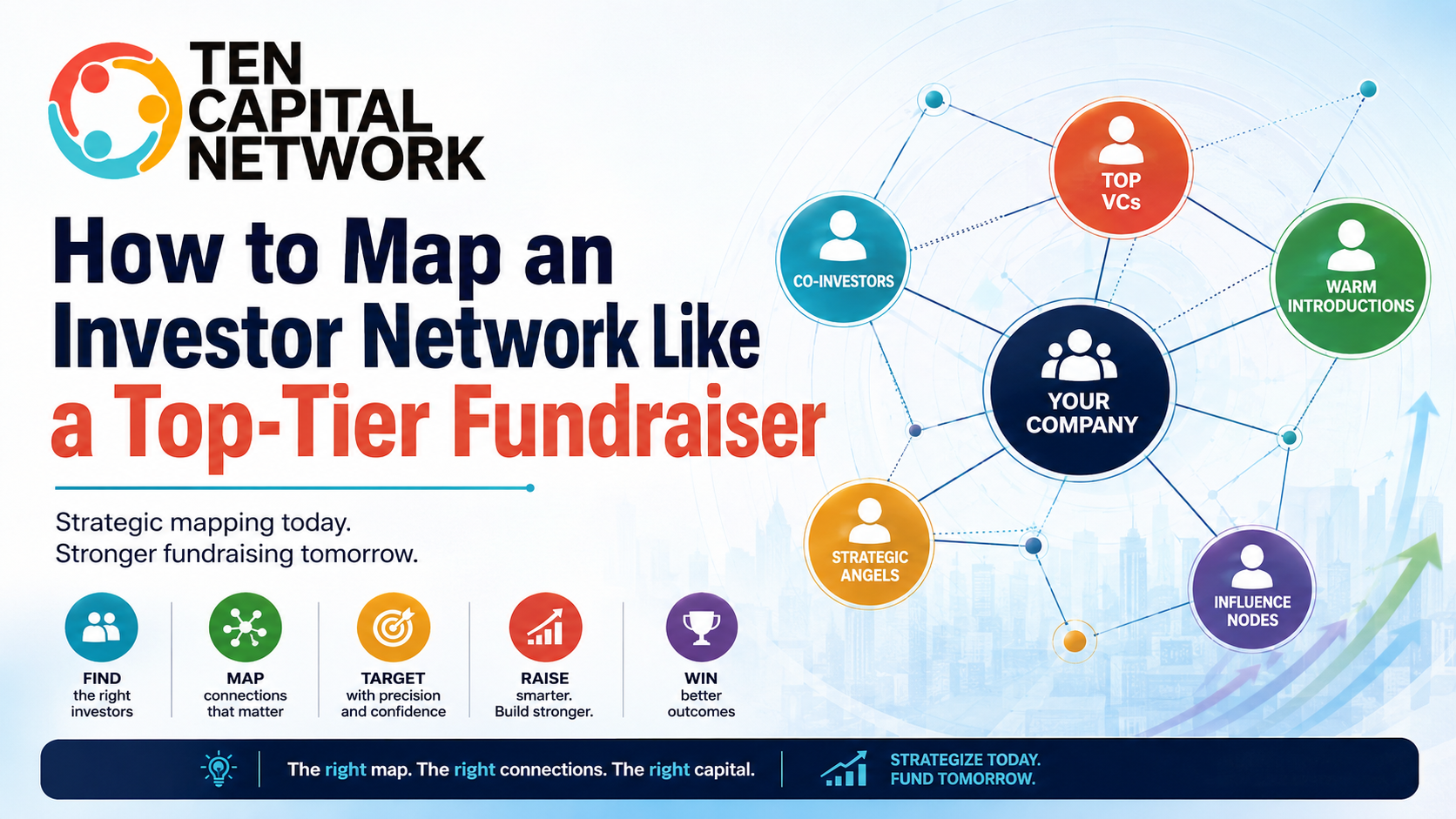
3 min read When starting out, it can be difficult to know how to identify quality companies for investment. In funding startups, investors need to find a source of deal flow that provides venture-fundable deals. Venture-Fundable Deals Venture-funded companies typically share these characteristics:   Recurring or repeat revenue business model   Doubling revenue year over year   Tech-enabled   Strong team with industry experience   Large target market allowing the firm to scale In searching for a startup in which to invest, you should look for all of these characteristics. Learn About Sectors Before Investing Many startup investors begin with a portfolio theory approach in which one makes a few investments across a broad range of sectors. I often hear, “My strategy is to invest in good deals.” This is easier said than done. A broad-based investing approach requires the investor to come up to speed on each and every sector. That’s a lot of homework for an investment in one or two deals. Some investors choose to focus on a few key domains and become an expert in those areas. By diving deep, one can understand the trends, challenges, and factors that drive company success. There’s a risk that if you have too many companies in a sector, you are at risk for major disruptions. If the sector is broad enough, you can move to new areas within the space as it matures. How to Find Deals in a Sector To find deals in a sector, you can search Crunchbase for industry-specific reports. Pitchbook produces funded reports by sector by subscribing to their daily newsletter. Conferences are a great place to find personal introductions and meet with new startups. Also, venture capital is evolving into service models in which they not only fund the companies but also help with operations such as sales, CFO, etc. It’s not hard to find a list of VC firms focused on a sector. Identifying the Risks Every sector comes with its risks, such as regulations. Also, disruption from new technologies is an ever-present risk in the industry. By spending time with startups and investors in the space, it becomes clear where the threats come from and what one can do to mitigate the risk. Read more on the TEN Capital eGuide: How to Invest in a Startup Hall T. Martin is the founder and CEO of the TEN Capital Network. TEN Capital has been connecting startups with investors for over ten years. You can connect with Hall about fundraising, business growth, and emerging technologies via LinkedIn or email: hallmartin@tencapital.group

How to Raise Funding at Every Stage of the Business

1 min read Crowdfunding can be used to raise funding throughout the life of a business.  When the idea of a new business strikes you, and there’s nothing built yet, then you should run a donations campaign–ask family and friends to donate $10K collectively.  Make sure they understand that no one is getting paid back.  The value of this step is that it establishes a network to support your business.  The money can be used for some initial costs such as filing patents, building websites, and starting work on a prototype. Rewards The next step is to use a Rewards/Prepay campaign to pre-sell 50 units of your product.  It can be anything.  The key here is that you start to build your customer network.  If you can’t presell 50 units, then you have a product problem that needs to be solved first before you go any further.  The funding you raise should be enough to build the first version of your product. Crowdfunding Campaign With a successful rewards campaign behind you,  you now move towards turning those customers into investors using the Texas Intrastate crowdfunding campaign.  The Texas Intrastate law gives anyone the ability to invest in your business.  Again, the funding helps, but building your network is the crucial point.  If all fifty of your Prepay customers invested in your business you now have fifty brand ambassadors supporting your business–not trivial support by any means. With support from your customers, and now investors in your business, you approach angel investors and start to raise funding to grow the business.  Angels invest $250 to $2M to grow a working operation.  When you arrive at the angel investors’ door, they are expecting you to have a product at some stage of usage and some revenue.  The previous steps give you the ability to do that. If you need more funding, then you can go back and raise revenue-based funding.  The investors at this stage take a piece of the revenue as payment rather than an equity stake.  If you find yourself having trouble raising funding, it may mean that you skipped some key steps. You should go back and fill in the gaps of building your support network and your customer base before proceeding. Read more in the TEN Capital eGuide: http://staging.startupfundingespresso.com/how-to-raise-funding-eguide/ Hall T. Martin is the founder and CEO of the TEN Capital Network. TEN Capital has been connecting startups with investors for over ten years. You can connect with Hall about fundraising, business growth, and emerging technologies via LinkedIn or email: hallmartin@tencapital.group

How to Raise Funding – A Little at a Time

1 min read Traditionally fundraising takes a tremendous amount of time on the part of the startup CEO. Some CEOs drop everything to run the fundraise.  I advise against spending too much time fundraising but instead set up a system to help with the fundraise. With the right use of online tools (analytics, CRM, Drip campaigns, etc) the CEO doesn’t have to let fundraising become a huge distraction. Building a list of investor prospects and keeping them informed of your progress, the CEO can reach out to ask for an investment at the right time. Instead of raising two years’ worth of funding, the CEO can raise a few months which is a great deal easier. This type of funding works best for early stage, and those with recurring revenue business models. These techniques were popularized by crowdfunding but can be applied to accredited investor raises as well. As investors see more and more deal flow, they need help in finding, qualifying, and following up the deals. At TEN Capital we let the investor select the deals they want to see and then send updates only on those deals. We work with the startups to build upgrades to share with interested investors, All of this happens online. At some point, interested investors set up a call to talk with the CEO and later they decide to invest or pass. Most of the process if not all takes place online. Read more the TEN Capital eGuide: http://staging.startupfundingespresso.com/how-to-raise-funding-eguide/ Hall T. Martin is the founder and CEO of the TEN Capital Network. TEN Capital has been connecting startups with investors for over ten years. You can connect with Hall about fundraising, business growth, and emerging technologies via LinkedIn or email: hallmartin@tencapital.group

Need-To-Know Metrics for Investors

2 min read As an investor, there are several metrics to keep in mind while evaluating and managing your startup investments. Today, we are going to talk about four key metrics: redemption facilitation, 3X in 3 terms, IRR, and ROI. Continue reading to learn what these metrics are used for and how to put them into action for your investment portfolio. Redemption Facilitation: In an early-exit term sheet, it’s important to have a redemption facilitation process. This includes the steps for setting up the bank accounts, capturing the investor’s interest, providing payouts, and investor updates. The process also tracks escrow of repayment funds and later revenue share payments to complete the redemption process. For the redemption exercise, here is the timeline and steps: 180 days from Note maturity: Capture the current version of the cap table and financials, including the current income statement and balance sheet. Send a notice to the investors to consider their decision to redeem. 90 days from Note maturity: Confirm the investors’ decision to redeem. Prepare payment options for the company to consider.  60 days from Note maturity date: Send notice to the investors of impending maturity and confirm their decision on redemption. 30 days from Note maturity date: Update investors with status on a regular basis. Send notice of redemption to the company and ask for payment due in one week. 23 days from Note maturity date: If payment is not received, then a payment plan will be due in one week by the company. 16 days from Note maturity date if no payment plan is provided: Set up a follow-up meeting with the company to discuss options. Upon maturity of the Note or in the event of a Corporate Transaction payment: Create a promissory note of the debt due. Elect a board of directors with investors having majority control. 3X in 3 Terms I analyzed the results of several angel networks and found that 65% of the investments after three years were still in business but were no longer on the venture track. In most cases, they were growing businesses but we’re not going to be bought out for a significant return to the investor as the market conditions had changed, the competition had taken over, or the founder was no longer interested in keeping pace to achieve a venture exit. The best-case scenario was the entrepreneur would sell the business for 2-3X after 10 years, in which case the investor would get a minimal return on investment. In my investing experience, three years into the investment, it becomes clear if the company will continue on the venture path or not.  I often saw the entrepreneur signal their departure from the venture path by taking above-market rate salaries.  I called this taking the ‘payroll exit’, in which case they no longer needed an ‘equity exit’.   This left the investor stranded on the equity plan with no way out. I set up a deal structure that would allow the investor to go on the payroll exit in the event the startup chose that path. In this structure, the investor receives three times their investment three years from the date of investment. Therefore, $100K in yields $300K out. If the company continues on the equity exit, then the investor may choose to stay in the investment.  ROI ROI is the return on investment without respect to time. If I invest $100K and 5 years later I receive a return of $300,000 then my ROI is 3X as I’ve tripled my initial investment. Since ROI doesn’t reflect time passed, if I receive my return 10 years later my ROI is still 3X. As you’ll see in the next section, this is where ROI and IRR differ from one another.  IRR IRR is the internal rate of return which is the return on investment with respect to time. It’s easiest to calculate IRR using an excel spreadsheet. Follow the steps below: Open up a column Set each row as one year Put the amount invested in year 1 (use a minus sign for this input) The amount returned in the appropriate year (use a positive sign for this input) Put a zero in each unfilled row Apply the IRR formula from Excel to make the calculation To understand your investment results better, you’ll find IRR is often a better metric than ROI as it considers the time factor. Read more TEN Capital eduction:  http://staging.startupfundingespresso.com/education/ Hall T. Martin is the founder and CEO of the TEN Capital Network. TEN Capital has been connecting startups with investors for over ten years. You can connect with Hall about fundraising, business growth, and emerging technologies via LinkedIn or email: hallmartin@tencapital.group

Thinking Out of the Box: Creative Sources of Funding for Startups

2 min read Finding funding is an indefinite ongoing process for startup organizations. Equity funding is a typical go-to for many startups, however, it is not always the most ideal form of funding. Below are a few creative sources you can look to for your next raise. Loans Loans are debt instruments that must be repaid. Startups can find it difficult to get a traditional loan from a bank. The Small Business Administration offers several loan types for early-stage companies. These loans come with personal guarantees and cannot be closed out with the dissolution of the business. There’s also debt through the use of credit cards and microloans. It’s difficult to use debt to pay for your core product development. Debt makes sense when you have some revenue coming in to pay for the loan.  There are other types of debt including accounts receivable factoring in which you raise money on what customers owe you. There’s also equipment financing in which the equipment collateralizes the debt. Factoring works when you have to pay customers and want to shrink the cash float from the time you build the product until the time you receive payment. Equipment financing works well if you need machinery to build your product or run your business. Credit Lines A line of credit is a short-term loan from the bank to help smooth out cash-flow cycles. Unlike a bank loan in which you receive an injection of funds, a line of credit lets you draw upon it when you need and pay it back when you can. The interest rate on a line of credit is substantially lower than credit cards and offers a higher borrowing limit than most credit cards. However, the interest rates are often variable and not fixed. A secured line of credit is backed by an asset, while an unsecured line of credit is not. An unsecured line of credit will come with a higher interest rate. There are both personal and business lines of credit. Personal lines of credit are often secured by personal property. For a business line of credit, the bank determines your credit limit based on the business assets and cash flow. The bank determines the interest rate by adding the interest to a margin that is affected by your credit history, profitability, and business risk. The line of credit is a useful tool for early-stage businesses to help with cash-flow issues. Licensing You may be able to reduce the amount of funding needed to grow your business by licensing your technology to others. Instead of building and selling a product, you can license to others who will build and sell the product. In licensing, you must have a patent to protect your technology and oftentimes a series of supporting tools to help those who license your technology for using it.  Licensing brings the following benefits: It reduces the amount of capital you need to raise. It can generate a substantial return given the costs are low. The risk of product failure is shifted to the licensee. The disadvantages are: You don’t control how it is used. Your licensee may later compete with you. You don’t receive the full revenue as if you had built and sold the product yourself. Licensees can also bring you new ideas for improvements on the technology. For applications requiring high-capital expenditures for building and selling the product, licensing is a good fit. Grants Grants are typically provided by government organizations to spur research and make a small contribution to the business. Commonly used grants include SBIR, Small Business Innovation Research, which provides phase 1, 2, and 3 grants that add up to $1M. You can search for grants at www.grants.gov. Grant funding is mostly one-time offerings and need not be paid back. They are non-dilutive which means they don’t take any space on the cap table. Use grants to cover costs that customers will not. For example, customers will not pay for basic research but only for finished products. Grants often come with rules on how they can be spent. Be careful in spending too much time with grants. I once worked with a company that had raised over $4M from grants over a five-year period. The team became experts at writing grant proposals but no one could sell, market, or do much of anything for a customer because for five years they focused on writing and winning government grants. Read more TEN Capital eduction:  http://staging.startupfundingespresso.com/education/ Hall T. Martin is the founder and CEO of the TEN Capital Network. TEN Capital has been connecting startups with investors for over ten years. You can connect with Hall about fundraising, business growth, and emerging technologies via LinkedIn or email: hallmartin@tencapital.group

Timing Your Exit

2 min read For every business, there comes a time to sell. Whether you are a startup or an investor, recognizing when this time is key to success. In this article, we cover when you should consider selling a business, how long it takes, and the benefit of taking an early exit. When to Sell Your Business Ask the following questions to find if now is the right time to sell your business: Do you still want to run the business? You may want to move on to new projects and opportunities and the current business may no longer be fulfilling. Do you still believe in the business and what it can do for you? Sometimes the market changes and the business opportunity is no longer there. What can you get from the business today versus two years from now? Waiting a few years to sell may give you a better exit. Do you need more funding, and can you raise it? If your business needs funding to continue and you can raise it, then do so. If you cannot, then consider exiting. What do the other team members want to do? Aside from your own interests, what do the other stakeholders want? It takes a team to run a business. If they want an exit, that should be part of the consideration. Early Exits In setting the exit, most investors look to maximize the exit value. It’s important to remember that the metric investors use, IRR or Internal Rate of Return, has a time component to it. The faster the exit, the higher the IRR. As an investor, consider pursuing the highest IRR over the biggest dollar exit as bigger exits take longer. While the news highlights the biggest exits, the vast majority of exits are under $20M. Selling a business for under $20M is not that hard. Growing a business and selling it over $100M is very hard. Most acquirers don’t need the business to be large, they only need to know the business model is defined and is profitable. Staying in the deal longer opens up the investor for dilution and other events that reduce the return on investment. A startup should be proving its business model and turning it into a repeatable, predictable process. With funding and time, it will scale. As an angel investor, you should look for early exits and structure your investments accordingly. Timeline for an Exit Most startups are launched with the idea of selling the business for a substantial gain in five to seven years. Many companies reach that stage and find they can’t sell the business, at least not for the price they want. It takes six months to a year to complete a buyout. Delays often come from the startup not being prepared or ready for the M&A process. Also, setting valuation and final terms can take substantial time for research and negotiations. To shorten the time, consider the following: Identify and contact the likely buyers and build a relationship before starting the process. Position the startup leadership as a thought leader with published articles and keynote speeches to provide credibility. Build a data room of key documents that will be used in a transaction process. This is basically a gathering process but does take some time. Beware of competitors in the diligence process as they will have access to your detailed financials and other information. Understand the interest level from the buyer and what other activities may delay their work on your deal. Set realistic expectations for how fast things will go. Read more in the TEN Capital eGuide: http://staging.startupfundingespresso.com/how-to-achieve-an-exit/ Hall T. Martin is the founder and CEO of the TEN Capital Network. TEN Capital has been connecting startups with investors for over ten years. You can connect with Hall about fundraising, business growth, and emerging technologies via LinkedIn or email: hallmartin@tencapital.group

Site Map

Scroll to Top