
Startup Funding

Related Guides

Trending

The most popular articles on Startup Funding in the past day.

Portfolio Construction for Angel Investors: Building Your First 10 Deals

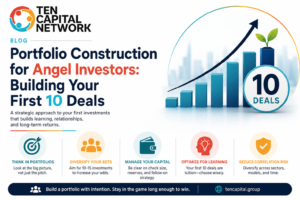
7 min read Portfolio Construction for Angel Investors: Building Your First 10 Deals Angel investing is often romanticized as a series of bold bets on visionary founders—but the reality is more disciplined and far more strategic. Your first 10 investments will shape not only your financial outcomes, but also your learning curve, reputation, and long-term access to quality deal flow. Portfolio construction at this stage isn’t about finding the one unicorn; it’s about building a foundation that gives you multiple shots on goal. In this piece, we’ll break down how to think about your first 10 deals with intention, realism, and a long-term edge. Why the First 10 Deals Matter Most new angels underestimate how much variance exists in early-stage investing. Outcomes are lumpy, timelines are long, and even great decisions can produce bad results. That’s exactly why portfolio construction matters more than individual deal selection early on. Your first 10 deals are less about maximizing returns and more about: Learning how deals actually play out Understanding your own risk tolerance Developing pattern recognition Building founder and co-investor relationships Think of this phase as laying track, not racing the train. 5 Key Takeaways for Building Your First Angel Portfolio 1. Think in Portfolios, Not Pitches It’s easy to get swept up in a compelling founder story or a slick deck. But angel investing only makes sense when viewed across a portfolio, not deal by deal. Any single investment has a high probability of underperforming—or going to zero entirely. When evaluating a deal, ask yourself how it fits with your other investments. Does it diversify your exposure by sector, business model, or stage? Portfolio thinking forces discipline and reduces emotional decision-making. 2. Aim for 10–15 Investments, Not 1–2 Big Bets A common early mistake is concentrating too much capital into a handful of deals. Early-stage outcomes follow a power-law distribution: one or two companies may drive most (or all) of the returns, while many will fail or return capital at best. If you’re just starting out, spreading capital across at least 10 deals increases your odds of participating in an outlier. Smaller check sizes buy you more data, more learning, and more optionality—without betting the farm too early. 3. Be Honest About Your Check Size and Reserves Before making your first investment, define your total angel allocation—not just what you’ll invest today. Can you afford follow-on investments? Do you want the option to double down on winners, or are you strictly a one-check angel? Clarity here matters. Writing a $25k check without the ability to support future rounds may be perfectly fine—but it should be a conscious choice, not an accident. Portfolio construction is as much about capital management as it is about deal quality. 4. Optimize Early for Learning, Not Returns Your first 10 deals are your tuition. Prioritize opportunities where you can learn the most: transparent founders, strong lead investors, and sectors where you want to build long-term expertise. Consider deals where you have some proximity—industry knowledge, customer insight, or the ability to add value. Even if the financial outcome is uncertain, the informational return can compound across your next 20 investments. 5. Don’t Ignore Correlation Risk Many first-time angels over-index on what’s familiar: the same industry, the same geography, the same founder archetype. Familiarity feels safe, but it can quietly increase correlation risk across your portfolio. If all 10 of your investments depend on the same market cycle, technology trend, or buyer behavior, you’re effectively making one macro bet. Intentional diversification—across sectors, go-to-market models, and time—helps smooth outcomes and protect against blind spots. A Simple Framework for Your First 10 Deals While there’s no one-size-fits-all model, many new angels benefit from a rough structure like this: 5 core bets in areas you understand well 3 exploratory bets in adjacent or emerging spaces 2 asymmetric bets that feel riskier but have outsized upside This isn’t about rigid rules—it’s about making your implicit strategy explicit. The Long Game of Angel Investing Angel investing rewards patience, humility, and process. Your first 10 deals won’t define your net worth, but they will define your habits. Investors who survive long enough to see real returns are rarely the ones who chased every hot deal—they’re the ones who built thoughtful portfolios, learned quickly, and stayed in the game. If you’re intentional now, you’ll give yourself something far more valuable than a lucky win: a repeatable approach. Final thought: If you’re building—or thinking about building—your angel portfolio, I’d love to hear how you’re approaching your first few deals. Subscribe for more practical insights on early-stage investing, drop a comment with your questions, or reach out if you want to go deeper on portfolio strategy.

How to Use the Startup Success Forecasting Framework

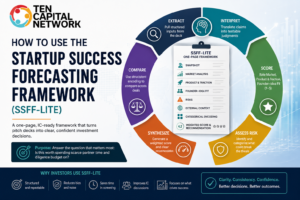
7 min read How to Use the Startup Success Forecasting Framework Most early-stage investment decisions fail for two opposite reasons: we over-index on storytelling (and miss structural weaknesses), or we drown in details (and fail to make a crisp decision). The Startup Success Forecasting Framework (SSFF-Lite) is designed to do neither. It forces you to translate a pitch deck into a one-page, IC-ready judgment: what the company is, why it wins, what can break, and whether the bet is worth making right now. This article shows you how to use SSFF-Lite in practice, fast, repeatable, and decision-oriented, and without copying deck language or slipping into founder-friendly marketing. What SSFF-Lite is (and what it isn’t) SSFF-Lite is a disciplined compression tool. It converts slide content into a structured memo with: Three core scores (Market, Product & Traction, Founder–Idea Fit) A risk categorization table A categorical feature encoding (so you can compare companies consistently) A short external context check A weighted composite score and a clear recommendation It is not a full diligence report. It’s a first-pass investment committee artifact that answers: “Is this worth spending scarce partner time and diligence budget on?” The operating principle: interpret, don’t transcribe Pitch decks are persuasion documents. SSFF-Lite is an evaluation document. That means: Don’t copy slide phrases (“world-class,” “disrupting,” “only platform”). Translate them into testable claims. When data is missing, state assumptions explicitly—don’t fill gaps with optimism. If numbers are unclear, inflated, or inconsistent across slides, flag credibility risk. Your job is not to be “fair.” Your job is to be accurate under uncertainty. Step 1: Extract structured inputs (10–20 minutes) Before you score anything, build a clean fact base. SSFF-Lite starts with a structured extraction because bad evaluation often comes from messy inputs. Create a scratchpad and pull these items from the deck: Company identity Company Name Sector / Subsector (be specific—“Fintech” is not specific) Stage (inferable via traction, product maturity, fundraising ask) What it sells and to whom Business model (SaaS, marketplace, usage-based, services wrapper, etc.) Target customer (title + segment + buyer/user distinction) Revenue model (pricing units, contract size, payment terms) Problem and product Core problem (1–2 sentences, precise and painful) Product description (what it does; how it fits in workflow; why now) Traction metrics (only if provided; otherwise say “Not provided”) Revenue, growth rate, retention, CAC/LTV, pipeline, margins, engagement If metrics are missing but logos exist: treat that as distribution evidence, not PMF Team Founders & background: prior wins/losses, domain depth, technical capability, credibility signals Note team gaps (e.g., sales-led motion but no GTM leader) Market and competition TAM/SAM/SOM (if provided; sanity check definitions) Market growth claims and timing narrative Competitors named and implied (including “do nothing”) Differentiation and moat claims (translate into mechanisms) External context signals Industry shifts (regulatory change, platform shift, AI enabling wave, supply constraints) Funding environment referenced (if any) If anything is not explicitly stated: infer cautiously, label it as Assumption, and keep it falsifiable. Pro tip: separate your extraction into two columns: Deck claims Your interpretation This keeps you honest and prevents accidental marketing copy. Step 2: Write the SSFF-Lite memo (the one-page discipline) Now you convert inputs into judgment, section by section. 1) Snapshot (VC-scout layer) This is your fastest summary of the company’s shape: Sector classification Stage assessment (inferred) Business model clarity (clear / semi-clear / unclear) Core problem (precise, no fluff) Outcome delivered (measurable if possible) Think of this as the “triage paragraph” an IC member reads first. If you can’t write it cleanly, you don’t understand the business yet. Scoring: how to assign 1–5 without fooling yourself SSFF-Lite asks you to score Market, Product & Traction, and Founder–Idea Fit from 1 to 5. The point isn’t false precision—it’s consistency. 2) Market Analysis (Score 1–5) Evaluate four things: Market size: niche / mid-size / large / massive Growth phase: early / inflecting / accelerating / mature Competitive intensity: low / moderate / high Structural moat: none / emerging / defensible Write one analytical paragraph that answers: Is this a big outcome space or a constrained pond? Is the wave growing or stagnant? Are there entrenched incumbents or commodity competition? Is there a structural advantage available (data, network effects, regulation, switching costs)? Scoring guidance 1: structurally limited, hard ceiling, or brutal incumbent dominance 3: credible market, but competitive and not structurally advantaged 5: large + fast-growing + a real path to structural advantage Avoid giving a 5 just because TAM is large. TAM slides are often aspirational. 3) Product & Traction (Score 1–5) Evaluate: Value proposition clarity (can you explain it in one sentence?) Product maturity (MVP / early revenue / scaling / mature) Evidence of PMF (none / early signals / retention proof / expansion proof) Execution velocity (shipping, sales cycle learning, iteration cadence) Use actual metrics if available. If not, be explicit: “Traction metrics not provided; evidence limited to logos and pilot claims.” Scoring guidance 1: vague product, no proof, long path to adoption 3: functioning product + early demand signals, but PMF unproven 5: retention/expansion proof and clear scaling motion 4) Founder–Idea Fit (FIFS) (Score 1–5) Assess: Domain alignment (lived pain or deep operator experience) Insight advantage (why this team sees the wedge others don’t) Technical/operational credibility (can they build and ship?) Commitment signals (time, focus, sacrifices) Team completeness (or clear plan to fill gaps) Scoring guidance 1: weak alignment, generic story 3: relevant experience, credible builders 5: deep, unfair advantage (domain network + technical edge + insight) 5) Risk categorization table (make risks legible) Create a table with: Market Risk Product Risk Execution Risk Capital Intensity Regulatory Risk Label each Low/Medium/High and add a one-line why. This forces you to distinguish between: “We don’t like it” (vibes) “It can break here” (mechanism) Example (in plain language): Execution risk: High — enterprise sales motion with no senior GTM leader; long cycles could stall learning. 6) Structured feature encoding (so you can compare companies) This is a categorical summary with no narrative: Market Size: Small / Mid / Large Market

Differentiation Isn’t Enough — In Deeptech Fundraising, the Real Goal Is Sounding Non-Replaceable

7 min read Differentiation Isn’t Enough — In Deeptech Fundraising, the Real Goal Is Sounding Non-Replaceable Every deeptech founder believes they are differentiated. They have patents. They have technical breakthroughs. They have scientific novelty. But here is the uncomfortable truth: Most differentiated deeptech companies still sound replaceable in a Series A–C pitch. The founder hears “unique technology.” The investor hears, “I’ve seen five versions of this already.” This disconnect isn’t about science. It’s about narrative physics. Deeptech founders compete on novelty, while investors evaluate replaceability risk, the risk that another team, corporate, academic lab, or stealth competitor could plausibly solve the same problem with a different approach. The difference between differentiation and non-replaceability is the difference between a pitch that earns polite interest and one that prompts a partner to fight for the deal internally. Let’s unpack how to shift your story from: “We’re differentiated,” to “No rational investor would pass on us — because no one else can credibly build what we’re building.” This is the art of sounding non-replaceable. The Wrong Goal: “Show Differentiation” Most deeptech founders think the goal is: Show unique IP Show better performance Show technical superiority Show a new architecture Show a novel materials approach This is differentiation, yes, but it’s not enough. Differentiation is merely a feature. Non-replaceability is a position. Investors increasingly expect technological differentiation, especially as AI, sensing, robotics, advanced materials, and climate hardtech reach commercialization maturity. Here is what Series A–C VCs fear far more than technical risk: Replaceability risk is the possibility that another team could solve the same problem with a similar probability of success. If you don’t neutralize replaceability risk, your entire story is fragile. Investors Are Pattern-Matching a Different Question Than You Think Founders think investors ask: “Is the technology good?” Investors actually ask: “Is this the team that will win the market?” And beneath that: “Can anyone else credibly do this?” Replaceability risk is a psychological evaluation, not a scientific one. Investors evaluate: Team rarity Domain advantage Execution asymmetry Insider access Market timing Customer lock-in potential Switching penalties: Architectural disadvantages in competitors A superior technology is meaningless if another group: Has deeper commercialization experience Has a better channel Has better supply chain agreements Has better OEM relationships Can raise more money faster Has a structurally advantaged team Replaceability is not a technical issue. It’s a narrative issue. Your story must shift from: Performance comparison to Positioning yourself as the only credible executor of this future. Framework #1 — The Non-Replaceability Index™ In deeptech, investors evaluate five dimensions of non-replaceability. A strong Series A–C narrative must hit all five: 1. Founder Rarity What combination of experience, insight, and exposure makes your team uniquely suited? Examples: DARPA/DoD-grade systems experience 15+ years in a niche domain Ex–Tesla or Ex–SpaceX manufacturing DNA Top 0.1% materials science or photonics expertise Narrative requirement: Show why no adjacent founder can replicate your intuition or insight velocity. 2. Architecture Lock-In Why is your solution architecture fundamentally harder to replicate? Examples: Proprietary data pipelines that improve faster with scale Control algorithms that get better with deployment Hardware–software co-design loops that create irreversible learning Narrative requirement: Show why alternatives will always be disadvantaged by physics, cost curves, or feedback dynamics. 3. Distribution Asymmetry What access or channel advantage do you have that competitors cannot match? Examples: OEM partnerships Industry incumbents backing your architecture Regulatory capture A primed early-adopter segment with an urgent need Narrative requirement: Show how you’ve secured “kingmaker” partnerships that create momentum no competitor can easily dislodge. 4. Switching Costs & Integration Depth Why does the first commercial user stick with you permanently? Examples: High integration depth Customized co-development loops Regulatory certification locked to your design Long-term supply agreements Narrative requirement: Show how your early integrations become long-term monopolies. 5. Ecosystem Gravity Why does the market start reorganizing around your solution? Examples: Standards adoption Tender specifications that match your design Industry-wide migration towards your architecture Supply chain consolidation favors your approach Narrative requirement: Show the gravitational pull of your solution, not just its novelty. Framework #2 — How to Construct a Non-Replaceable Deeptech Narrative Your story should follow a simple 4-step sequence: Step 1 — Define the Market Inevitability Start with the unstoppable trend. “The world is moving toward X whether anyone wants it or not.” Step 2 — Define the Constraint The core bottleneck is preventing inevitability. “This constraint has blocked progress for 20 years.” Step 3 — Reveal the Asymmetric Advantage Your unique unlock. “This team is the only team that can break the constraint because…” Step 4 — Demonstrate Irreversibility Why can’t the market go backward? “Once our architecture is deployed, the ecosystem standard shifts permanently.” This is how you sound like the only credible builder — not merely a differentiated one. Heuristic #1 — “If They Can Imagine Another Founder Doing It, You Lose.” Whenever you present: A milestone A technical advantage A partnership A customer win Ask: “Could an investor imagine another founder achieving this?” If yes, it doesn’t create non-replaceability. You must reframe around: Insight Access Irreversible commitments Asymmetric execution Architecture advantage Hard constraints that others can’t overcome Replaceability is a perception game. Heuristic #2 — “Show Not Just Why You Win, But Why Others Lose.” Deeptech founders are often too polite. They show their own strengths but avoid discussing competitive weaknesses. But investors need to hear why: Competing architectures hit scaling walls Incumbents face an incentive mismatch Alternatives fail economically Other approaches can’t meet integration requirements Competitors have timeline disadvantages You don’t need to attack competitors — you need to articulate the structural disadvantages of alternative paths. Heuristic #3 — “The Narrative Must Tie Technical Choices to Commercial Inevitability.” The best deeptech founders explain: Why is their architecture commercially privileged Why their design choices accelerate adoption Why alternatives become unscalable at commercial volumes Why customers gain more from switching earlier Investors love inevitability. Make your narrative about inevitability, not innovation. Pattern Recognition: What Non-Replaceable Deeptech Companies Have in Common Looking across robotics, autonomy, advanced sensors, energy

Site Map

Scroll to Top