Startup Funding

Related Guides

Trending

The most popular articles on Startup Funding in the past day.

The Missing Slide in Most Pitch Decks: Mapping the Customer Journey to Prove Market Demand

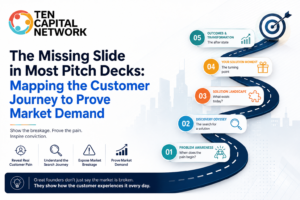
6 min read The Missing Slide in Most Pitch Decks: Mapping the Customer Journey to Prove Market Demand Most startup pitch decks spend too much time talking about the product and not enough time explaining the customer’s pain. Founders often assume investors will automatically understand the urgency of the problem. They won’t. Investors see hundreds of companies claiming to solve “massive inefficiencies” every year. What separates a compelling pitch from a forgettable one is the ability to show the lived reality of the customer. That’s where customer journey mapping becomes one of the most powerful storytelling tools in a startup pitch deck. A well-constructed customer journey slide does more than explain user behavior. It demonstrates friction, wasted time, emotional burden, operational inefficiency, and the hidden costs of unmet need. It transforms your startup from “interesting software” into a necessary market solution. The best founders don’t simply say the market is broken. They show the audience exactly how the customer experiences the breakage every day. Why Investors Care About the Customer Journey Investors are not just evaluating whether your product works. They are evaluating: Whether the pain is severe enough to drive purchasing behavior Whether existing solutions are inadequate Whether the market inefficiency is large enough to support venture-scale returns Whether customers are actively searching for alternatives Whether the timing is right for disruption A customer journey narrative answers all five questions simultaneously. When done properly, it creates emotional and analytical conviction. Instead of saying: “The procurement process is inefficient.” You show: A CFO spending 14 months evaluating vendors Operations teams manually stitching together spreadsheets Employees duplicating work across systems Compliance failures due to fragmented workflows Rising labor costs from inefficient tooling Burnout from operational chaos Now the investor feels the pain instead of merely hearing about it. That difference matters. Stage 1: Problem Awareness — When Does the Pain Begin? Every meaningful startup opportunity begins long before the customer buys software. The pain usually starts quietly. A missed report. A failed audit. A delayed customer response. An operational bottleneck. An unexpected financial loss. The most effective pitch decks identify the exact trigger moment when the customer first recognizes the problem. This stage matters because it demonstrates urgency. Questions to answer in your deck: What event causes the customer to notice the issue? How frequently does it occur? Who experiences the pain first? How long do they tolerate it before acting? What are the hidden costs of delay? For example: “Mid-market manufacturers typically experience inventory forecasting failures for 12–18 months before actively seeking a solution. During that period, excess inventory costs rise 8–12%, while production delays increase customer churn.” That statement communicates duration, financial impact, and behavioral timing. Investors immediately understand the market inefficiency. You are not just selling software anymore. You are quantifying unresolved pain. Stage 2: Discovery Odyssey — The Search for a Solution Most customers do not discover your company immediately. In fact, the complexity of their search is often evidence of market dysfunction. This is one of the most underused sections in startup storytelling. Map the customer’s “discovery odyssey” by showing: How many vendors they evaluate How many channels they search through How long the buying process takes Which departments become involved What causes confusion or abandonment This section demonstrates friction within the existing ecosystem. For example: Stage Customer Experience Initial Search Google, peer referrals, consultants Vendor Research 8–12 platforms evaluated Internal Alignment IT, finance, operations, compliance reviews Trial & Testing Multiple pilots fail integration requirements Decision Delay Procurement cycle extends 9–14 months Now the investor sees something important: The customer is actively trying to solve the problem — but the market is failing them. That distinction is critical. A weak market is one where customers do not care. A massive startup opportunity is one where customers desperately search for answers but cannot find a satisfactory solution. That’s the difference between inconvenience and unmet demand. Stage 3: Solution Landscape — What Exists Today? This is where most founders make a major mistake. They create a competitor matrix filled with checkmarks. Investors rarely care. Instead, explain why current solutions structurally fail. Focus less on features and more on systemic shortcomings. What investors want to know is: Why hasn’t this problem already been solved? Why do customers remain dissatisfied? Why are incumbents vulnerable? Why is now the right time for disruption? A better approach is to categorize the current landscape by compromise. For example: Existing Option Core Weakness Legacy Enterprise Software Expensive, slow implementation Point Solutions Fragmented workflows Consultants High recurring labor costs Internal Spreadsheets Human error and scalability limits Outsourcing Providers Lack of visibility and control This framing is powerful because it demonstrates that customers are already spending money — just inefficiently. That’s a key venture insight. Markets become enormous when spending already exists but value delivery remains poor. You are not creating demand from scratch. You are reallocating inefficient spend. Stage 4: A Day in the Life — Show the Human Burden This is the emotional center of the pitch. Great founders understand that operational pain creates emotional pain. A strong “day in the life” section illustrates the downstream consequences of the problem across the organization. Do not merely discuss workflow inefficiency. Show: Stress Delays Reputation risk Employee burnout Team conflict Customer dissatisfaction Financial uncertainty For example: “The VP of Operations starts every Monday reconciling inconsistent data from six disconnected systems. Finance disputes inventory counts. Customer success teams escalate delayed shipments. Executives spend weekly leadership meetings debating which dashboard is accurate.” That narrative communicates operational fragmentation far more effectively than a chart. You can also quantify the annual burden: Hours wasted annually Revenue leakage Compliance penalties Employee turnover Customer churn Delayed strategic initiatives This is where investors begin visualizing the magnitude of the market opportunity. Because large markets are often created by cumulative inefficiencies that appear small individually but become enormous at scale. Stage 5: The Gaps That Matter Now that the audience understands the customer’s struggle, explain what still remains unresolved — even after existing


How to Map an Investor Network Like a Top-Tier Fundraiser

7 min read How to Map an Investor Network Like a Top-Tier Fundraiser Most founders approach fundraising backwards. They build a pitch deck first, then start scrambling to find investors. The best founders do the opposite: they build an investor network map before they ever ask for capital. Investor mapping is no longer optional. In today’s market, capital is concentrated in highly connected networks. The founders who understand those networks gain faster introductions, higher response rates, and better fundraising outcomes. [1] An investor network map is more than a spreadsheet of venture firms. It’s a strategic intelligence system that identifies: Which investors actively fund your sector Who co-invests together Which partners lead rounds Where warm introductions exist Which firms are deploying capital now How influence flows across your market The goal is simple: stop pitching random investors and start targeting connected capital. Step 1: Define Your “Ideal Investor Profile” Before researching firms, define exactly who should invest in your company. Your investor profile should include: Stage Pre-Seed Seed Series A Growth Sector Focus AI Fintech Healthcare Climate SaaS Deep Tech Geography U.S. Europe LATAM Southeast Asia Check Size Angel: $25k–$100k Seed VC: $250k–$2M Institutional: $2M+ Portfolio Alignment Similar companies Competitive adjacency Market thesis overlap This narrows your universe dramatically and prevents wasted meetings. Strategic investor mapping starts with precision, not volume. [3] Step 2: Build Your Initial Investor Universe Most founders stop after listing “top VCs.” That’s a mistake. You want layered investor categories: Tier 1: Dream investors Tier 2: Active specialists Tier 3: Strategic angels Tier 4: Syndicates and microfunds Tier 5: Corporate venture arms Use research platforms to identify active investors: Crunchbase AngelList PitchBook LinkedIn OpenVC Demo Day lists Podcast appearances Conference speaker rosters AngelList and Crunchbase are especially useful for filtering by stage, geography, and sector focus. [2] Your first pass should identify 50–100 relevant investors. Not all will matter equally. That’s where network analysis begins. Step 3: Identify Co-Investment Patterns The most important fundraising insight is this: Investors rarely invest alone. VCs operate in clusters. Some firms consistently co-invest together. Some angels follow specific lead investors. Some funds specialize in certain ecosystems or accelerators. Your job is to map those relationships. For every investor, track: Recent deals Co-investors in each round Lead vs follow behavior Repeat founder relationships Shared board members Accelerator affiliations You’ll quickly notice patterns. For example: Investor A always co-invests with Fund B Angel C appears in nearly every AI infrastructure seed round Fund D follows YC companies aggressively This transforms your fundraising strategy from “cold outreach” into network navigation. Network analysis helps startups identify the most connected and relevant capital pathways. [6] Step 4: Build a Warm Introduction Graph The highest-converting fundraising channel is still the warm introduction. But founders misunderstand warm intros. A warm intro is not “someone knows someone.” A strong warm intro comes from: Portfolio founders Repeat co-investors Trusted operators Existing LP relationships Shared accelerators Prior successful founders Create a relationship graph with three levels: Hot Connections People who know the investor personally and can directly recommend you. Warm Connections Second-degree relationships through founders, operators, or syndicates. Cold Connections No direct path, requiring content, traction, or outbound strategy. This becomes your investor access map. One warm introduction from a trusted founder can outperform 100 cold emails. Step 5: Score Investors by Probability Not all investors deserve equal attention. You should rank investors using a scoring model. Suggested scoring categories: Category Weight Sector Alignment 30% Stage Match 25% Recent Activity 20% Warm Intro Access 15% Geographic Fit 10% An investor actively funding your exact category within the past 12 months should rank far higher than a famous but inactive firm. The best founders focus on investors currently deploying capital, not just recognizable names. [4] Step 6: Track Investor Momentum Signals Investor mapping is dynamic. Funds evolve constantly. Some firms: Slow deployment Change thesis Raise new funds Shift stages Replace partners Pause investments You need momentum signals. Watch for: New fund announcements Hiring activity Recent lead rounds Increased conference appearances Podcast interviews Public market commentary Regulatory themes If a fund recently raised a new vehicle, deployment pressure rises significantly. That’s opportunity. Step 7: Map Influence Nodes Every ecosystem has hidden power centers. Sometimes the most influential person isn’t a VC partner. It may be: A super angel Accelerator MD Startup attorney Banker Founder with strong syndicate pull Scout program operator These people act as network bridges. One introduction from a highly connected node can unlock dozens of investor conversations. Mapping influence is often more important than mapping capital itself. Step 8: Organize Your Investor CRM At this point, you’re not building a contact list. You’re building a fundraising operating system. Your CRM should track: Investor name Fund Partner focus Last investment Intro path Relationship strength Follow-up timing Meeting notes Objections Interest level Next action Most founders lose fundraising momentum because they fail to systematize follow-up. Professional fundraising requires process discipline. Step 9: Create an Investor Narrative Strategy Every investor cluster responds to different narratives. Examples: AI investors care about infrastructure defensibility Climate investors focus on regulatory leverage Fintech investors care about distribution and compliance Deep tech investors prioritize technical moat Your investor map should include messaging angles for each segment. The best founders customize: Deck emphasis KPI framing Market sizing Technical depth Competitive positioning Fundraising is not one pitch. It’s a network-specific communication strategy. Step 10: Build Relationships Before You Need Capital The worst time to meet investors is when your runway is collapsing. The best founders start relationship-building 6–18 months before raising. This creates: Familiarity Credibility Progress tracking Trust accumulation Experts recommend identifying 20–30 aligned investors early and nurturing relationships over time. [5] Investors fund momentum they’ve observed, not just stories they’ve heard. Final Thoughts The modern fundraising market is not driven by access to information. Everyone has access to databases. The advantage now comes from understanding networks. Investor mapping gives founders: Better introductions Faster diligence Higher conversion rates Stronger syndicates More strategic investors The founders who win fundraising

How to Generate Momentum and FOMO in a Fundraise Campaign

8 min read How to Generate Momentum and FOMO in a Fundraise Campaign Most founders misunderstand fundraising momentum. They assume momentum comes from announcing a round. In reality, momentum is created long before the round officially opens. The best raises feel “oversubscribed” before the deck is broadly circulated because investors have already been conditioned through repeated exposure, visible execution, and social proof. FOMO is not manufactured through hype. It is built through consistency, sequencing, and timing. The strongest fundraising campaigns operate like enterprise sales funnels: multiple touches, proof accumulation, strategic signaling, and carefully controlled access. Investors rarely commit because of a single meeting. They commit because they’ve watched the company execute over time. The pre-raise phase is where great rounds are won. The Real Goal of Pre-Raise Communications The objective is not to “pitch investors.” The objective is to create: Familiarity Trust Pattern recognition Competitive urgency Perceived inevitability Investors fund companies that appear to be accelerating regardless of whether they participate. Momentum creates psychological safety. If other sophisticated investors are leaning in, the opportunity feels validated. That means founders should spend 60–90 days before opening a round intentionally building narrative pressure. The strongest signals include: Product launches Marketplace distribution Customer traction Strategic partnerships Hiring growth Revenue milestones Pilot conversions Waitlist growth Usage expansion Investor re-engagement cadence A fundraising campaign should feel like a story unfolding in real time. The Four-Touch Investor Re-Engagement Sequence One of the biggest fundraising mistakes is reaching out only when capital is needed. Elite founders maintain investor relationships months before the round opens. Here’s a proven 4-touch sequence. Touch #1 — The Progress Update This is a lightweight reactivation message. The goal is not fundraising. The goal is awareness. Example themes: Product now live Early user traction New marketplace listing First enterprise pilot Expansion in recruiter network New partnership signed Keep it concise and metrics-driven. Example: “Since we last spoke, we launched the live platform, added 42 enterprise recruiters, and finalized marketplace distribution with two strategic channel partners.” The message should communicate execution without sounding promotional. Touch #2 — The Proof Layer Two to three weeks later, send proof. This is where momentum begins to compound. Possible proof points: Revenue growth Retention metrics Usage data Customer testimonials Pipeline growth Partnership engagement Conversion improvements The key is specificity. Weak: “Things are going great.” Strong: “Monthly active usage increased 38% over the last 60 days, and three pilot customers expanded into annual contracts.” Investors trust measurable progress more than vision statements. Touch #3 — The Timing Signal This is where founders begin introducing fundraising timing. The message should subtly communicate: The company is preparing for expansion Conversations are beginning Existing investors are engaged There is already inbound interest This is not a hard raise announcement. Example: “We’re beginning conversations around our next growth round as we scale distribution and enterprise onboarding heading into Q3.” This creates anticipation without pressure. The psychology matters: Investors dislike missing access more than they dislike saying no. Touch #4 — The Soft Open This is the controlled-access phase. The round is not yet public, but select investors are invited early. A strong soft-open message sounds calm and confident. Example: “We’re opening a limited set of early conversations ahead of formally launching the round next month. Given recent traction and strategic interest, we expect allocation to move quickly.” Notice what this does: Signals exclusivity Implies demand Avoids desperation Maintains professionalism The best fundraising messages never sound needy. Talking Points That Build Momentum Without Hype Sophisticated investors are highly sensitive to exaggeration. The strongest fundraising narratives rely on observable traction. Good momentum talking points include: Product Progress Live product deployments User onboarding velocity Feature releases API integrations Infrastructure scaling Distribution Expansion Marketplace approvals Strategic channel partnerships Enterprise integrations Geographic expansion Customer Proof Paying customers Renewals Retention Referrals Pilot conversions Hiring and Team Signals Senior hires Advisory additions Technical team expansion Industry expertise Market Validation Partnership activity Ecosystem participation Industry adoption Inbound demand Avoid exaggerated claims like: “Category-defining” “Guaranteed market leader” “Unstoppable growth” “First ever” “Revolutionary” Credibility compounds faster than excitement. Milestone Announcements That Create Investor Excitement Great milestone announcements are short, specific, and measurable. Here are examples founders can adapt. Product Milestone We officially launched the platform this month and onboarded our first cohort of enterprise users. Early engagement metrics are exceeding internal expectations, and customer onboarding time has decreased by 42% since beta. Partnership Milestone We finalized a strategic distribution partnership that significantly expands our access to enterprise buyers and accelerates our go-to-market timeline across multiple verticals. Customer Proof Milestone Three pilot customers converted into annual contracts this quarter, with two expanding usage beyond initial deployment assumptions. These updates work because they demonstrate traction through facts rather than storytelling alone. How FOMO Actually Works in Venture Capital FOMO is rarely about emotion alone. It is usually driven by three factors: 1. Perceived Scarcity Investors move faster when access appears limited. 2. Social Validation If respected investors or strategic partners are involved, perceived risk declines. 3. Evidence of Acceleration Investors chase momentum, not stagnation. This is why fundraising campaigns should create visible sequencing: Update Proof Expansion Timing Soft-open Allocation pressure When executed properly, investors begin competing for access before the official raise begins. The Importance of Controlled Information Flow One common mistake is sending the full deck to everyone simultaneously. Strong fundraising campaigns release information gradually. Why? Because staged information creates ongoing engagement. A better process: Initial update Follow-up traction Intro call Additional proof points Investor references Soft-open conversation Allocation discussion This creates relationship momentum rather than transactional pitching. The strongest rounds often feel like an unfolding narrative rather than a fundraising event. Risks and Claims Founders Should Avoid Nothing destroys investor trust faster than inconsistencies. Before launching a campaign, founders should audit the deck carefully. Common red flags include: Contradictory revenue figures Inflated TAM estimates Misleading partnership language Confusing user metrics Overstated pipeline projections “Verbal commitments” presented as signed deals Misrepresented AI capabilities Unrealistic growth assumptions Partnership claims are especially dangerous. Saying: “Partnered

What Is the Raskin Framework — And Why Great Pitch Decks Start With Change

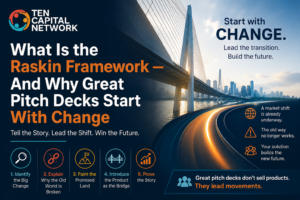
7 min read What Is the Raskin Framework — And Why Great Pitch Decks Start With Change Most startup pitch decks fail in the first three slides. Not because the founders lack vision. Not because the market opportunity is too small. Not because the technology is weak. They fail because they start in the wrong place. Most founders begin with the product. Great founders begin with change. That insight sits at the center of the Raskin Framework, a strategic storytelling methodology popularized by messaging strategist Andy Raskin. His work has influenced some of Silicon Valley’s most effective sales narratives and venture pitches, helping companies frame themselves not merely as software vendors, but as leaders of an inevitable market transition. [1][4] The framework has become particularly influential in SaaS, AI, fintech, and enterprise technology because it transforms a pitch deck from a product presentation into a movement investors and customers want to join. And in today’s market, narrative matters more than ever. The Core Idea: Every Great Pitch Starts With a Shift Traditional pitch decks usually follow this structure: Here’s our company Here’s our product Here are our features Here’s our traction Please invest The problem is that investors see hundreds of these decks every month. What they rarely see is a founder who convincingly explains why the world has fundamentally changed. Raskin argues that the best pitches begin by identifying a major market shift already underway. [1] That shift becomes the foundation for the entire story. Examples include: AI replacing manual workflows Distributed teams replacing centralized offices APIs replacing monolithic software Private markets becoming accessible to retail investors Real-time analytics replacing static reporting The founder’s job is not merely to sell a product. The founder’s job is to explain why the old way no longer works. That framing instantly creates urgency. Why the Raskin Framework Works Humans understand stories better than spreadsheets. Investors do not just evaluate numbers. They evaluate conviction, timing, inevitability, and market psychology. The Raskin Framework works because it aligns the startup with a larger historical trend. Instead of saying: “We built software that automates compliance workflows.” The narrative becomes: “As financial regulation becomes exponentially more complex, manual compliance systems are collapsing under the weight of modern reporting requirements.” That shift changes everything. Now the company is no longer selling software. It is helping customers survive the future. This approach is visible in many iconic enterprise companies. Salesforce framed itself around the shift away from on-premise software. Gong framed itself around the collapse of intuition-based sales management. Cloudflare framed itself around the transformation of internet infrastructure. [4] The strongest startups position themselves as inevitable consequences of market evolution. The Five Parts of the Raskin Framework While versions vary, the framework generally follows five core components. 1. Identify the Big Change Start with a market transition that is already happening. The key is credibility. The shift cannot feel hypothetical. It must feel observable and unavoidable. Good examples: AI copilots are becoming the default software interface Venture capital is moving from intuition toward data-driven underwriting Consumers increasingly expect embedded financial products inside non-financial platforms Weak examples: “People want better software.” “Technology is evolving.” “Digital transformation matters.” The change must feel urgent and specific. 2. Explain Why the Old World Is Broken Once the shift is established, show why legacy approaches fail inside the new environment. This is where pain enters the narrative. A strong deck demonstrates: inefficiency risk lost revenue operational bottlenecks market irrelevance The goal is not fearmongering. The goal is to demonstrate inevitability. If the audience believes the old world is collapsing, they naturally begin searching for the new model. That creates receptivity. 3. Paint the “Promised Land” This is one of the most powerful ideas in Raskin’s methodology. The “promised land” is the future state customers want to achieve. [2] Importantly, it is not a product description. It is an aspirational transformation. For example: “Every investment decision powered by real-time intelligence.” “Compliance completed autonomously.” “Sales teams coached instantly by AI.” The best promised lands are emotional. They make the audience imagine a better operating reality. 4. Introduce the Product as the Bridge Only after the shift, pain, and future vision are established should the company introduce the product. This ordering matters enormously. Because now the product feels like a solution to an urgent market problem — not merely another software platform. This is where founders explain: product architecture competitive differentiation workflows automation layers proprietary data advantages integrations But the product is always subordinate to the narrative. The product exists because the market changed. 5. Prove the Story Finally, validate the narrative with evidence. This includes: customer success stories revenue growth retention metrics case studies testimonials adoption curves Narrative without proof feels like hype. Proof without narrative feels like noise. The strongest decks combine both. Why Most Founders Get This Wrong Founders are naturally product-centric. They spend years building features, workflows, infrastructure, and technical differentiation. So when they pitch, they instinctively explain the mechanics. But investors are not buying software demos. They are buying market timing. Great venture outcomes happen when a company aligns with a large structural transition. The best pitch decks therefore answer one question above all others: “Why now?” That question sits at the heart of the Raskin Framework. Applying the Raskin Framework to a Pitch Deck Here’s how founders can structure a modern narrative-driven deck. Slide 1: The Market Shift Open with the macro change. This should immediately create tension and relevance. Avoid company history. Avoid feature lists. Lead with transformation. Slide 2: Why Legacy Systems Fail Demonstrate why incumbent approaches break under the new market conditions. Use data, trends, customer pain, or workflow friction. The audience should feel the problem becoming unavoidable. Slide 3: The Cost of Inaction Show what happens if companies fail to adapt. Lost revenue. Operational risk. Competitive decline. This creates urgency. Slide 4: The Promised Land Now introduce the future state. Describe the world customers actually want. Keep this visual and aspirational. Slide 5: Your Product Only

How to Make Your Pitch Deck AI-Ready

7 min read How to Make Your Pitch Deck AI-Ready Investors don’t read pitch decks the way they used to. A growing share of associates and partners now run incoming decks through an LLM before a human ever opens the PDF: summarize the thesis, flag the risks, benchmark the metrics against the portfolio, draft the partner memo. Your deck isn’t just being read anymore. It’s being parsed. That changes what “good” looks like. A deck that’s gorgeous in Figma but structured as a wall of abstract slides can confuse a model the same way it confuses a tired analyst at 11pm, except the model won’t give you the benefit of the doubt, and it won’t ask a follow-up question in the hallway. It will just summarize what’s there, badly, and that summary might be the only thing a partner reads before deciding whether to take the meeting. Making your deck “AI-ready” isn’t a gimmick or a new font choice. It’s a discipline that happens to make your deck better for humans too, because the things that confuse a model are usually the same things that make a busy investor lose the thread. Why this matters now Founders have always optimized for the five-minute skim. Partners forward decks to associates, associates summarize them in Slack, and somewhere in that chain, fidelity gets lost. AI tools have just formalized and accelerated a process that was already happening informally. Many funds now use internal tools — built on top of Claude, GPT-4, or similar models, to triage inbound deal flow, extract key metrics into a tracking spreadsheet, and generate first-pass summaries for partners. If your deck depends on a clever visual metaphor on slide 3 to make sense, or if your TAM number lives only inside a chart with no surrounding text, a model summarizing your deck may miss it entirely. The fix isn’t to dumb the deck down. It’s to make sure the substance survives extraction, whether the thing extracting it is a human skimming on their phone or a model parsing the PDF text layer. Start with text, not just visuals Most modern decks lean hard on visual storytelling: big numbers, icons, minimal text, a single word per slide. That works great in a live pitch where you’re narrating. It works poorly when the deck has to stand on its own, because an LLM (and most humans skimming a forwarded PDF) only has the text and layout to work with, not your voice. The practical fix is to make every slide intelligible from its text content alone. If a slide’s main point is “we’re 10x cheaper than the incumbent,” that sentence — or something close to it — should appear as actual text on the slide, not just implied by two bars in a chart. You don’t need to abandon visual design. You need a one-line takeaway on each slide that a reader could extract without the visual. This also means avoiding image-only slides where critical information lives entirely inside a screenshot or embedded graphic with no alt text or surrounding caption. PDF text extraction tools (and the models built on top of them) often can’t read text baked into an image. A market-size chart with no caption stating the actual numbers is information that’s invisible to anything parsing the file as text. Make your structure predictable Pitch decks have converged on a fairly standard shape for a reason: problem, solution, market, product, traction, business model, team, ask. That convention isn’t just tradition — it’s load-bearing. Investors and the tools they use have learned to expect information in roughly that order, and deviating wildly from it forces extra interpretive work. This doesn’t mean every deck must follow the template slavishly, especially if your business has an unconventional shape. But if you’re going to reorder things, it helps to use explicit section headers that name what’s coming: “The Problem,” “Our Traction,” “The Ask.” A model summarizing your deck is essentially doing pattern matching against thousands of other decks it’s effectively learned the shape of. Clear headers let it map your content onto that pattern instead of guessing. Put your numbers in text, not just charts This is the single highest-leverage fix for most decks. Revenue, growth rate, retention, margins, burn, runway — these numbers are often the first things a partner asks an AI summarization tool to extract. If your $2M ARR lives only as the height of a bar in a chart, with the actual figure never written anywhere as text, that number effectively doesn’t exist to a text-based extraction pipeline. The fix is simple and doesn’t require sacrificing visual polish: state your key metrics in words somewhere on the slide, even if the chart is doing the visual storytelling. “ARR grew from $400K to $2.1M in the last 12 months (5.25x)” as a text callout next to your chart gives both a human skimmer and a parsing tool the number directly, with the chart serving to reinforce rather than encode it. Write a real executive summary If your deck doesn’t have a one-slide or one-page summary near the front, add one. This single slide is disproportionately important for AI-assisted triage, because it’s often the first thing an automated summarization tool latches onto, and it’s the natural place to compress your whole pitch into a form that survives compression. A good executive summary slide states, in plain sentences: what you do, the size of the problem, your traction in concrete numbers, and what you’re raising. Think of it as the abstract of a paper — written so that someone (or something) reading only that slide could accurately describe your company to someone else. Avoid jargon that only makes sense with context Founders often invent internal shorthand — clever names for features, internal codenames for products, abbreviations that make sense in the building but nowhere else. That’s fine for an internal slide deck. It’s a liability in a fundraising deck that needs to be legible to an outside reader (human or

How to Use the Startup Success Forecasting Framework

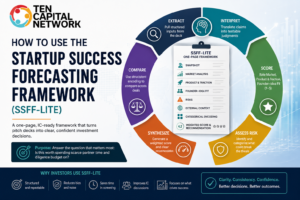
7 min read How to Use the Startup Success Forecasting Framework Most early-stage investment decisions fail for two opposite reasons: we over-index on storytelling (and miss structural weaknesses), or we drown in details (and fail to make a crisp decision). The Startup Success Forecasting Framework (SSFF-Lite) is designed to do neither. It forces you to translate a pitch deck into a one-page, IC-ready judgment: what the company is, why it wins, what can break, and whether the bet is worth making right now. This article shows you how to use SSFF-Lite in practice, fast, repeatable, and decision-oriented, and without copying deck language or slipping into founder-friendly marketing. What SSFF-Lite is (and what it isn’t) SSFF-Lite is a disciplined compression tool. It converts slide content into a structured memo with: Three core scores (Market, Product & Traction, Founder–Idea Fit) A risk categorization table A categorical feature encoding (so you can compare companies consistently) A short external context check A weighted composite score and a clear recommendation It is not a full diligence report. It’s a first-pass investment committee artifact that answers: “Is this worth spending scarce partner time and diligence budget on?” The operating principle: interpret, don’t transcribe Pitch decks are persuasion documents. SSFF-Lite is an evaluation document. That means: Don’t copy slide phrases (“world-class,” “disrupting,” “only platform”). Translate them into testable claims. When data is missing, state assumptions explicitly—don’t fill gaps with optimism. If numbers are unclear, inflated, or inconsistent across slides, flag credibility risk. Your job is not to be “fair.” Your job is to be accurate under uncertainty. Step 1: Extract structured inputs (10–20 minutes) Before you score anything, build a clean fact base. SSFF-Lite starts with a structured extraction because bad evaluation often comes from messy inputs. Create a scratchpad and pull these items from the deck: Company identity Company Name Sector / Subsector (be specific—“Fintech” is not specific) Stage (inferable via traction, product maturity, fundraising ask) What it sells and to whom Business model (SaaS, marketplace, usage-based, services wrapper, etc.) Target customer (title + segment + buyer/user distinction) Revenue model (pricing units, contract size, payment terms) Problem and product Core problem (1–2 sentences, precise and painful) Product description (what it does; how it fits in workflow; why now) Traction metrics (only if provided; otherwise say “Not provided”) Revenue, growth rate, retention, CAC/LTV, pipeline, margins, engagement If metrics are missing but logos exist: treat that as distribution evidence, not PMF Team Founders & background: prior wins/losses, domain depth, technical capability, credibility signals Note team gaps (e.g., sales-led motion but no GTM leader) Market and competition TAM/SAM/SOM (if provided; sanity check definitions) Market growth claims and timing narrative Competitors named and implied (including “do nothing”) Differentiation and moat claims (translate into mechanisms) External context signals Industry shifts (regulatory change, platform shift, AI enabling wave, supply constraints) Funding environment referenced (if any) If anything is not explicitly stated: infer cautiously, label it as Assumption, and keep it falsifiable. Pro tip: separate your extraction into two columns: Deck claims Your interpretation This keeps you honest and prevents accidental marketing copy. Step 2: Write the SSFF-Lite memo (the one-page discipline) Now you convert inputs into judgment, section by section. 1) Snapshot (VC-scout layer) This is your fastest summary of the company’s shape: Sector classification Stage assessment (inferred) Business model clarity (clear / semi-clear / unclear) Core problem (precise, no fluff) Outcome delivered (measurable if possible) Think of this as the “triage paragraph” an IC member reads first. If you can’t write it cleanly, you don’t understand the business yet. Scoring: how to assign 1–5 without fooling yourself SSFF-Lite asks you to score Market, Product & Traction, and Founder–Idea Fit from 1 to 5. The point isn’t false precision—it’s consistency. 2) Market Analysis (Score 1–5) Evaluate four things: Market size: niche / mid-size / large / massive Growth phase: early / inflecting / accelerating / mature Competitive intensity: low / moderate / high Structural moat: none / emerging / defensible Write one analytical paragraph that answers: Is this a big outcome space or a constrained pond? Is the wave growing or stagnant? Are there entrenched incumbents or commodity competition? Is there a structural advantage available (data, network effects, regulation, switching costs)? Scoring guidance 1: structurally limited, hard ceiling, or brutal incumbent dominance 3: credible market, but competitive and not structurally advantaged 5: large + fast-growing + a real path to structural advantage Avoid giving a 5 just because TAM is large. TAM slides are often aspirational. 3) Product & Traction (Score 1–5) Evaluate: Value proposition clarity (can you explain it in one sentence?) Product maturity (MVP / early revenue / scaling / mature) Evidence of PMF (none / early signals / retention proof / expansion proof) Execution velocity (shipping, sales cycle learning, iteration cadence) Use actual metrics if available. If not, be explicit: “Traction metrics not provided; evidence limited to logos and pilot claims.” Scoring guidance 1: vague product, no proof, long path to adoption 3: functioning product + early demand signals, but PMF unproven 5: retention/expansion proof and clear scaling motion 4) Founder–Idea Fit (FIFS) (Score 1–5) Assess: Domain alignment (lived pain or deep operator experience) Insight advantage (why this team sees the wedge others don’t) Technical/operational credibility (can they build and ship?) Commitment signals (time, focus, sacrifices) Team completeness (or clear plan to fill gaps) Scoring guidance 1: weak alignment, generic story 3: relevant experience, credible builders 5: deep, unfair advantage (domain network + technical edge + insight) 5) Risk categorization table (make risks legible) Create a table with: Market Risk Product Risk Execution Risk Capital Intensity Regulatory Risk Label each Low/Medium/High and add a one-line why. This forces you to distinguish between: “We don’t like it” (vibes) “It can break here” (mechanism) Example (in plain language): Execution risk: High — enterprise sales motion with no senior GTM leader; long cycles could stall learning. 6) Structured feature encoding (so you can compare companies) This is a categorical summary with no narrative: Market Size: Small / Mid / Large Market

The Importance of Signaling in a Pitchdeck

7 min read The Importance of Signaling in a Pitchdeck   Why investors often fund what your deck implies—not just what it says. Most founders believe a pitch deck exists to communicate information. Investors know a pitch deck exists to communicate signals. This distinction is one of the most important lessons an entrepreneur can learn during a fundraising process. While founders spend countless hours perfecting market slides, refining financial projections, and debating TAM calculations, sophisticated investors are often evaluating something entirely different: what the deck signals about the company, the founder, and the probability of future success. Fundraising is fundamentally an exercise in reducing uncertainty. Investors are asked to place capital into businesses that have little operating history, incomplete data, and uncertain outcomes. Because direct evidence is limited, investors rely heavily on signals to infer quality. The best pitch decks understand this reality and are intentionally designed to send strong signals at every stage of the presentation. What Is Signaling? In venture capital, signaling refers to information that communicates quality, credibility, momentum, or future potential beyond the literal facts being presented. A signal helps investors answer questions such as: Is this founder exceptional? Is this market real? Are customers validating the product? Are other sophisticated people involved? Is momentum accelerating? Will this company attract future investors? Every slide in a pitch deck either strengthens or weakens these perceptions. The most successful fundraising decks don’t simply explain a business. They create confidence. Investors Invest in Confidence Consider two companies generating identical revenue. Company A reports $500,000 in annual recurring revenue. Company B reports $500,000 in annual recurring revenue but also shows: 20% month-over-month growth Enterprise customers A former Google executive as advisor A respected lead investor Multiple inbound partnership discussions The financial result is identical. The signaling value is dramatically different. The second company appears less risky because multiple external parties are already validating the opportunity. Investors are constantly looking for evidence that others have independently reached the same positive conclusion. Strong signaling reduces perceived risk. Reduced risk increases valuation. Founder Signaling Matters More Than Most Founders Realize Early-stage investors frequently state they invest in teams more than products. This is another way of saying they invest in founder signals. Before meaningful revenue exists, investors evaluate indicators such as: Prior Success Previous exits, startup experience, industry expertise, patents, publications, and leadership roles all function as credibility signals. A founder who previously built and sold a company sends a different signal than a first-time entrepreneur. That doesn’t mean first-time founders cannot raise capital. It means they must compensate with other signals. Domain Expertise Founders who have spent years inside the problem demonstrate insight that outsiders often lack. For example: A healthcare startup founded by a physician signals deeper understanding than one founded by someone who simply identified a healthcare market opportunity. Investors view lived experience as evidence that the team understands customer pain points, industry dynamics, and regulatory challenges. Founder-Market Fit One of the strongest signals in venture investing is founder-market fit. Investors want to see a compelling reason why this specific team is uniquely positioned to win. The strongest founder slides answer: “Why are you the people to solve this problem?” Not: “Why is this problem important?” Customer Validation Is a Signal, Not Just a Metric Founders often view traction slides as numerical reporting. Investors view them as validation signals. For example: Ten pilot customers may be more impressive than one hundred free users. Why? Because pilots require commitment. Commitment signals belief. Belief signals value. Similarly, enterprise customers often carry stronger signaling power than consumer users because enterprise buying decisions involve more scrutiny. A Fortune 500 customer effectively says: “We evaluated alternatives and selected this solution.” That endorsement carries substantial weight. When building traction slides, founders should ask: “What does this metric signal about customer conviction?” Not simply: “What number is largest?” The Power of Social Proof Social proof is one of the strongest signaling mechanisms in fundraising. Investors routinely ask themselves: “What do other smart people think about this opportunity?” Every credible third-party validation strengthens the answer. Examples include: Existing Investors Well-known angel investors, venture funds, or industry leaders create powerful signals. Investors understand that sophisticated capital providers conduct diligence. When respected investors participate, they effectively lend credibility to the company. Strategic Advisors Advisors can provide meaningful signaling value when they are genuinely involved and relevant. An advisor with direct industry expertise often signals: Market access Industry understanding Operational support Future partnership opportunities However, investors quickly recognize decorative advisors with minimal engagement. Authenticity matters. Partnerships Meaningful commercial partnerships demonstrate market validation. They signal that established organizations believe the startup provides value. Partnership announcements often generate more investor interest because they imply future distribution opportunities and reduced go-to-market risk. Design Quality Is a Signal Many founders underestimate the signaling value of deck design. Investors notice. A poorly designed deck may unintentionally communicate: Lack of attention to detail Weak communication skills Resource constraints Inexperience Conversely, a clean, professional deck signals discipline, preparation, and competence. Importantly, investors are not looking for artistic excellence. They are looking for clarity. A simple, well-structured deck often outperforms a visually impressive but confusing presentation. The signal investors want is operational excellence. Not graphic design talent. Momentum Is One of the Most Powerful Signals in Venture Capital Nothing attracts investors like acceleration. Momentum suggests that future performance may exceed historical performance. Examples include: Revenue growth User growth Customer acquisition efficiency Product adoption Hiring progress Pipeline expansion A company growing from $10,000 to $50,000 monthly revenue in six months often appears more attractive than a company generating $500,000 annually with flat growth. Investors are buying the future. Momentum helps them visualize that future. The best fundraising decks showcase acceleration wherever possible. Not just absolute scale. Scarcity Creates Signaling Effects Fundraising itself generates signals. This is why experienced founders carefully manage their fundraising process. When investors believe: Multiple firms are engaged Demand exceeds allocation The round is progressing quickly They often perceive the opportunity as more attractive. Scarcity functions

Red Flags in Startup Pitches: What Makes Experienced Investors Pass

5 min read    Red Flags in Startup Pitches: What Makes Experienced Investors Pass Every investor loves the thrill of discovering a breakout company. But after a decade of reviewing thousands of startup pitches, I can tell you this: avoiding bad investments is just as important, often more important, than finding the next unicorn. Pattern recognition isn’t built by the wins alone; it’s forged by seeing the same mistakes repeat themselves over and over. In this piece, I’ll walk through the most common red flags that cause experienced investors to quietly, or not so quietly, pass on a deal. These aren’t theoretical concerns or academic nitpicks. They’re real-world signals that something beneath the surface isn’t ready, resilient, or investable. Why Red Flags Matter More Than Hype Great storytelling can open doors, but fundamentals determine whether they stay open. Investors who have been burned before learn to listen less to the sizzle and more to the structure underneath. Red flags are rarely fatal on their own—but clusters of them almost always are. The goal isn’t perfection. It’s coherence, honesty, and evidence of thoughtful leadership under pressure. Five Red Flags That Make Investors Walk Away 1. The Founder Can’t Clearly Explain the Problem If a founder struggles to articulate the problem they’re solving in plain language, investors immediately question whether the problem is real—or merely convenient. Complexity isn’t a sign of sophistication; clarity is. When the pain point sounds abstract, generic, or borrowed from a trend report, conviction erodes fast. Strong founders can explain the problem simply because they’ve lived it, studied it deeply, or watched it break real systems. If the “why now” is missing or fuzzy, it’s usually a pass. 2. The Market Size Is Inflated or Vague “TAM is $100 billion” has become background noise. What investors want to see is how this company realistically captures a meaningful slice of a market, not how large the theoretical ceiling might be. Overly inflated market sizing signals either naivety or intentional misdirection. Experienced investors look for bottoms-up thinking: specific customers, real pricing, and believable adoption paths. When market math feels like a PowerPoint exercise instead of a business reality, confidence drops quickly. 3. Financials That Don’t Match the Story One of the fastest ways to lose investor trust is internal inconsistency. If the pitch narrative says one thing and the financial model says another, investors assume the model—or the story—can’t be trusted. Optimism is expected; disconnects are not. Revenue projections without operational detail, cost structures that defy logic, or growth curves that ignore constraints all raise alarms. Investors aren’t looking for perfect forecasts—they’re looking for disciplined thinking. 4. Defensive or Evasive Responses to Tough Questions Every serious pitch includes hard questions. The red flag isn’t not knowing the answer—it’s how the founder reacts when challenged. Defensiveness, deflection, or overconfidence suggests fragility under pressure. Great founders treat questions as collaboration, not confrontation. They acknowledge risks, explain tradeoffs, and show how they’re learning in real time. When ego blocks insight, investors take notice—and step back. 5. No Evidence of Learning or Adaptation Startups are defined by uncertainty. Founders who present their strategy as fixed, flawless, or immune to change signal inexperience. Investors want to see evidence of iteration: pivots informed by data, customer feedback shaping product decisions, and lessons learned from things that didn’t work. A pitch that sounds too polished, too static, or too certain often hides a lack of real-world testing. Growth-stage thinking starts with humility, not certainty. What Experienced Investors Are Really Screening For Behind every red flag is a deeper question investors are asking themselves: Can I trust this team with my capital when things go wrong? Because they will go wrong, markets shift, customers surprise you, and capital tightens. Pattern recognition doesn’t make investors cynical; it makes them selective. The best pitches don’t eliminate risk, they demonstrate awareness, judgment, and resilience in the face of it. A Final Thought Learning what not to invest in is one of the most valuable skills an investor can develop. The same is true for founders: understanding how your pitch may be perceived can dramatically improve both your fundraising outcomes and your strategic thinking. If this resonated, I’d love to hear your thoughts. Drop a comment with the toughest investor question you’ve faced—or the biggest red flag you’ve learned to avoid. And if you want more insights drawn from real-world deal review and investor pattern recognition, consider subscribing to stay in the loop.  

Early-Stage Valuation Formula: The Method Top Angels Use

5 min read Early-Stage Valuation Formula: The Method Top Angels Use Valuation is one of the hardest, and most misunderstood, parts of angel investing. Founders often think valuation is about storytelling. Early angels know better. Valuation is about risk. It’s about pricing uncertainty in a way that protects your downside while keeping you competitive in great deals. After reviewing thousands of early-stage financings and working alongside some of the most consistent angel investors in the market, I’ve noticed something important: top angels don’t “wing” valuation. They use a repeatable framework. Not because it’s perfect, but because it dramatically improves decision quality, negotiation confidence, and portfolio outcomes. This article breaks down the early-stage valuation formula experienced angels actually use, why it works, and how you can apply it deal by deal. Why Valuation Is the #1 Pain Point for Angels If you ask angels where they feel least confident, valuation usually tops the list. Here’s why: There’s no revenue—or very little Comparable data is noisy or misleading Founders anchor aggressively Every deal “feels” unique Fear of missing out clouds judgment The result? Many angels either: Overpay and hope for growth to bail them out, or Walk away from good deals because they can’t justify the price Neither is a great strategy. The best angels solve this by reframing the question. They don’t ask: “What is this company worth?” They ask: “What valuation compensates me for the risks I’m taking?” That shift changes everything. The Core Insight: Early-Stage Valuation Is Risk Pricing At the angel stage, valuation is not a math problem. It’s a risk-weighted judgment. You are underwriting: Execution risk Market risk\ Team risk Financing risk Timing risk Since you can’t eliminate those risks, you price them. Top angels do this by starting with a baseline valuation range, then adjusting up or down based on observable risk factors. This is where the formula comes in. The Baseline: Start With the Market, Not the Founder The biggest mistake angels make is negotiating from the founder’s number. Experienced angels start elsewhere. They anchor to: Stage (pre-seed, seed) Geography Capital raised Current market conditions For example, in today’s environment, a reasonable baseline for a U.S. pre-seed company might look like: $4M–$6M pre-money for a strong but unproven team $6M–$8M pre-money for a repeat or highly credible founder This baseline isn’t a rule—it’s a reference point. It answers one question: “What do deals like this actually clear at, absent special factors?” Once you have that anchor, the real work begins. The Formula: Adjust Valuation by Risk Buckets Top angels mentally score deals across five risk buckets, then adjust valuation accordingly. Here’s the simplified framework. 1. Team Risk (± 30%) This is the biggest lever. Questions angels ask: Has this team built and exited before? Have they shipped real products? Do they understand this market deeply? Adjustments: Exceptional, repeat founder → increase valuation tolerance First-time founder, incomplete team → discount valuation Great teams earn higher prices. Weak teams don’t get priced on vision alone. 2. Market Risk (± 25%) Market size and structure matter early—more than most founders admit. Key considerations: Is this a large, expanding market? Is it fragmented or dominated by incumbents? Is the buyer clear and reachable? Adjustments: Clear, large, growing market → upward adjustment Niche, slow, or poorly defined market → downward adjustment Angels don’t need certainty—but they need plausible upside. 3. Traction Risk (± 20%) Traction doesn’t have to mean revenue. Angels look for: Evidence of demand User engagement Pipeline quality Customer behavior, not vanity metrics Adjustments: Strong early signals → supports higher valuation Pure concept, no validation → valuation compression Traction reduces risk. Reduced risk increases price. 4. Product & Technology Risk (± 15%) This is often misunderstood. The question isn’t “Is the tech cool?” It’s “Is this hard and defensible?” Consider: Technical complexity Speed to MVP Replicability IP leverage  Adjustments: Difficult, defensible build → modest valuation premium Commodity or easily copied product → valuation discount Angels price defensibility, not buzzwords. 5. Capital & Financing Risk (± 10%) Finally, angels look ahead. Questions: How much capital is really required?              Is the next round plausible? Does the valuation leave room for future investors? Adjustments: Capital-efficient path → valuation flexibility Heavy burn, unclear next round → valuation pressure Angels don’t want paper wins that collapse in the next raise. Putting It Together: How Angels Actually Decide Here’s what this looks like in practice. An angel starts with a $6M pre-money baseline. Then: Strong first-time founder team (+10%) Large but competitive market (0%) Early customer pilots (+10%) Average technical moat (0%) Capital-efficient plan (+5%) Net adjustment: +25% Final comfort valuation: ~$7.5M pre-money Now the angel can negotiate confidently—not emotionally. Why This Framework Improves Outcomes Angels who use this approach benefit in three major ways: 1. Better Deal Discipline You stop chasing founder narratives and start pricing risk rationally. 2. Stronger Negotiation Position You can explain why a valuation works—or doesn’t—without antagonism. 3. More Consistent Portfolios You avoid extreme overpayment while still staying competitive. This is how professional angels think—even if they don’t always say it explicitly. The Real Edge: Consistency Beats Brilliance The goal isn’t to “win” every valuation discussion. The goal is to: Pay fair prices Protect downside Leave room for upside Build a survivable portfolio Most angel returns don’t come from perfect picks. They come from not overpaying for risk. That’s the quiet discipline that separates hobby investing from professional angel investing. Final Thought Valuation will never be precise at the early stage. But it doesn’t have to be guesswork. A clear framework won’t eliminate risk—but it will: Sharpen judgment Reduce regret Improve long-term returns This is why experienced angels lean on formulas—not because they’re rigid, but because they create clarity. And in early-stage investing, clarity is one of the most valuable assets you can have.

Site Map

Scroll to Top