Startup Funding

Related Guides

Trending

The most popular articles on Startup Funding in the past day.

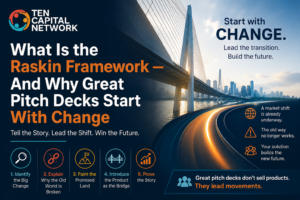
What Is the Raskin Framework — And Why Great Pitch Decks Start With Change

7 min read What Is the Raskin Framework — And Why Great Pitch Decks Start With Change Most startup pitch decks fail in the first three slides. Not because the founders lack vision. Not because the market opportunity is too small. Not because the technology is weak. They fail because they start in the wrong place. Most founders begin with the product. Great founders begin with change. That insight sits at the center of the Raskin Framework, a strategic storytelling methodology popularized by messaging strategist Andy Raskin. His work has influenced some of Silicon Valley’s most effective sales narratives and venture pitches, helping companies frame themselves not merely as software vendors, but as leaders of an inevitable market transition. [1][4] The framework has become particularly influential in SaaS, AI, fintech, and enterprise technology because it transforms a pitch deck from a product presentation into a movement investors and customers want to join. And in today’s market, narrative matters more than ever. The Core Idea: Every Great Pitch Starts With a Shift Traditional pitch decks usually follow this structure: Here’s our company Here’s our product Here are our features Here’s our traction Please invest The problem is that investors see hundreds of these decks every month. What they rarely see is a founder who convincingly explains why the world has fundamentally changed. Raskin argues that the best pitches begin by identifying a major market shift already underway. [1] That shift becomes the foundation for the entire story. Examples include: AI replacing manual workflows Distributed teams replacing centralized offices APIs replacing monolithic software Private markets becoming accessible to retail investors Real-time analytics replacing static reporting The founder’s job is not merely to sell a product. The founder’s job is to explain why the old way no longer works. That framing instantly creates urgency. Why the Raskin Framework Works Humans understand stories better than spreadsheets. Investors do not just evaluate numbers. They evaluate conviction, timing, inevitability, and market psychology. The Raskin Framework works because it aligns the startup with a larger historical trend. Instead of saying: “We built software that automates compliance workflows.” The narrative becomes: “As financial regulation becomes exponentially more complex, manual compliance systems are collapsing under the weight of modern reporting requirements.” That shift changes everything. Now the company is no longer selling software. It is helping customers survive the future. This approach is visible in many iconic enterprise companies. Salesforce framed itself around the shift away from on-premise software. Gong framed itself around the collapse of intuition-based sales management. Cloudflare framed itself around the transformation of internet infrastructure. [4] The strongest startups position themselves as inevitable consequences of market evolution. The Five Parts of the Raskin Framework While versions vary, the framework generally follows five core components. 1. Identify the Big Change Start with a market transition that is already happening. The key is credibility. The shift cannot feel hypothetical. It must feel observable and unavoidable. Good examples: AI copilots are becoming the default software interface Venture capital is moving from intuition toward data-driven underwriting Consumers increasingly expect embedded financial products inside non-financial platforms Weak examples: “People want better software.” “Technology is evolving.” “Digital transformation matters.” The change must feel urgent and specific. 2. Explain Why the Old World Is Broken Once the shift is established, show why legacy approaches fail inside the new environment. This is where pain enters the narrative. A strong deck demonstrates: inefficiency risk lost revenue operational bottlenecks market irrelevance The goal is not fearmongering. The goal is to demonstrate inevitability. If the audience believes the old world is collapsing, they naturally begin searching for the new model. That creates receptivity. 3. Paint the “Promised Land” This is one of the most powerful ideas in Raskin’s methodology. The “promised land” is the future state customers want to achieve. [2] Importantly, it is not a product description. It is an aspirational transformation. For example: “Every investment decision powered by real-time intelligence.” “Compliance completed autonomously.” “Sales teams coached instantly by AI.” The best promised lands are emotional. They make the audience imagine a better operating reality. 4. Introduce the Product as the Bridge Only after the shift, pain, and future vision are established should the company introduce the product. This ordering matters enormously. Because now the product feels like a solution to an urgent market problem — not merely another software platform. This is where founders explain: product architecture competitive differentiation workflows automation layers proprietary data advantages integrations But the product is always subordinate to the narrative. The product exists because the market changed. 5. Prove the Story Finally, validate the narrative with evidence. This includes: customer success stories revenue growth retention metrics case studies testimonials adoption curves Narrative without proof feels like hype. Proof without narrative feels like noise. The strongest decks combine both. Why Most Founders Get This Wrong Founders are naturally product-centric. They spend years building features, workflows, infrastructure, and technical differentiation. So when they pitch, they instinctively explain the mechanics. But investors are not buying software demos. They are buying market timing. Great venture outcomes happen when a company aligns with a large structural transition. The best pitch decks therefore answer one question above all others: “Why now?” That question sits at the heart of the Raskin Framework. Applying the Raskin Framework to a Pitch Deck Here’s how founders can structure a modern narrative-driven deck. Slide 1: The Market Shift Open with the macro change. This should immediately create tension and relevance. Avoid company history. Avoid feature lists. Lead with transformation. Slide 2: Why Legacy Systems Fail Demonstrate why incumbent approaches break under the new market conditions. Use data, trends, customer pain, or workflow friction. The audience should feel the problem becoming unavoidable. Slide 3: The Cost of Inaction Show what happens if companies fail to adapt. Lost revenue. Operational risk. Competitive decline. This creates urgency. Slide 4: The Promised Land Now introduce the future state. Describe the world customers actually want. Keep this visual and aspirational. Slide 5: Your Product Only


How to Make Your Pitch Deck AI-Ready

7 min read How to Make Your Pitch Deck AI-Ready Investors don’t read pitch decks the way they used to. A growing share of associates and partners now run incoming decks through an LLM before a human ever opens the PDF: summarize the thesis, flag the risks, benchmark the metrics against the portfolio, draft the partner memo. Your deck isn’t just being read anymore. It’s being parsed. That changes what “good” looks like. A deck that’s gorgeous in Figma but structured as a wall of abstract slides can confuse a model the same way it confuses a tired analyst at 11pm, except the model won’t give you the benefit of the doubt, and it won’t ask a follow-up question in the hallway. It will just summarize what’s there, badly, and that summary might be the only thing a partner reads before deciding whether to take the meeting. Making your deck “AI-ready” isn’t a gimmick or a new font choice. It’s a discipline that happens to make your deck better for humans too, because the things that confuse a model are usually the same things that make a busy investor lose the thread. Why this matters now Founders have always optimized for the five-minute skim. Partners forward decks to associates, associates summarize them in Slack, and somewhere in that chain, fidelity gets lost. AI tools have just formalized and accelerated a process that was already happening informally. Many funds now use internal tools — built on top of Claude, GPT-4, or similar models, to triage inbound deal flow, extract key metrics into a tracking spreadsheet, and generate first-pass summaries for partners. If your deck depends on a clever visual metaphor on slide 3 to make sense, or if your TAM number lives only inside a chart with no surrounding text, a model summarizing your deck may miss it entirely. The fix isn’t to dumb the deck down. It’s to make sure the substance survives extraction, whether the thing extracting it is a human skimming on their phone or a model parsing the PDF text layer. Start with text, not just visuals Most modern decks lean hard on visual storytelling: big numbers, icons, minimal text, a single word per slide. That works great in a live pitch where you’re narrating. It works poorly when the deck has to stand on its own, because an LLM (and most humans skimming a forwarded PDF) only has the text and layout to work with, not your voice. The practical fix is to make every slide intelligible from its text content alone. If a slide’s main point is “we’re 10x cheaper than the incumbent,” that sentence — or something close to it — should appear as actual text on the slide, not just implied by two bars in a chart. You don’t need to abandon visual design. You need a one-line takeaway on each slide that a reader could extract without the visual. This also means avoiding image-only slides where critical information lives entirely inside a screenshot or embedded graphic with no alt text or surrounding caption. PDF text extraction tools (and the models built on top of them) often can’t read text baked into an image. A market-size chart with no caption stating the actual numbers is information that’s invisible to anything parsing the file as text. Make your structure predictable Pitch decks have converged on a fairly standard shape for a reason: problem, solution, market, product, traction, business model, team, ask. That convention isn’t just tradition — it’s load-bearing. Investors and the tools they use have learned to expect information in roughly that order, and deviating wildly from it forces extra interpretive work. This doesn’t mean every deck must follow the template slavishly, especially if your business has an unconventional shape. But if you’re going to reorder things, it helps to use explicit section headers that name what’s coming: “The Problem,” “Our Traction,” “The Ask.” A model summarizing your deck is essentially doing pattern matching against thousands of other decks it’s effectively learned the shape of. Clear headers let it map your content onto that pattern instead of guessing. Put your numbers in text, not just charts This is the single highest-leverage fix for most decks. Revenue, growth rate, retention, margins, burn, runway — these numbers are often the first things a partner asks an AI summarization tool to extract. If your $2M ARR lives only as the height of a bar in a chart, with the actual figure never written anywhere as text, that number effectively doesn’t exist to a text-based extraction pipeline. The fix is simple and doesn’t require sacrificing visual polish: state your key metrics in words somewhere on the slide, even if the chart is doing the visual storytelling. “ARR grew from $400K to $2.1M in the last 12 months (5.25x)” as a text callout next to your chart gives both a human skimmer and a parsing tool the number directly, with the chart serving to reinforce rather than encode it. Write a real executive summary If your deck doesn’t have a one-slide or one-page summary near the front, add one. This single slide is disproportionately important for AI-assisted triage, because it’s often the first thing an automated summarization tool latches onto, and it’s the natural place to compress your whole pitch into a form that survives compression. A good executive summary slide states, in plain sentences: what you do, the size of the problem, your traction in concrete numbers, and what you’re raising. Think of it as the abstract of a paper — written so that someone (or something) reading only that slide could accurately describe your company to someone else. Avoid jargon that only makes sense with context Founders often invent internal shorthand — clever names for features, internal codenames for products, abbreviations that make sense in the building but nowhere else. That’s fine for an internal slide deck. It’s a liability in a fundraising deck that needs to be legible to an outside reader (human or

From Pitch to Proof: Turning Diligence into Decision

5 min read From Pitch to Proof: Turning Diligence into Decision How to structure diligence milestones that convert investor curiosity into conviction—and founders’ claims into evidence. Early-stage investing rarely fails because of a lack of interesting pitches. It fails because diligence drags, questions sprawl, and momentum dies in the face of ambiguity. Investors get curious, founders get hopeful—and then nothing happens. Great diligence isn’t about exhaustive analysis. It’s about structured progression. The best investors use clear diligence milestones to turn a compelling story into verifiable proof, and to move efficiently from “this is interesting” to “this is investable.” Diligence, done right, is both an art and a science. The science is in sequencing evidence, defining decision gates, and aligning on what “enough proof” actually means. The art is knowing which questions matter now, and which can wait. Below is a practical framework for designing diligence milestones that accelerate decisions, reduce friction, and increase conviction on both sides of the table. 1. Diligence as a Funnel, Not a Checklist The biggest mistake in diligence is treating it like a flat list of questions. Effective diligence is progressive; each stage earns the right to go deeper. Ask one guiding question at every phase: What must be true to move forward? Structure diligence into clear stages: Narrative validation Evidence confirmation Risk underwriting Decision readiness Each stage should narrow uncertainty—not expand it. 2. Milestone 1: Narrative Coherence → “Does the Story Hold?” This stage tests whether the pitch withstands scrutiny before data deep dives begin. Objective: Validate internal consistency, clarity, and logic. What to pressure-test: Problem definition vs. customer urgency Why this solution wins now Founder’s understanding of tradeoffs and constraints Alignment between vision, strategy, and near-term execution Proof looks like: Clear, repeatable articulation (not rehearsed buzzwords) Ability to explain the why, not just the what Consistent answers across conversations Red flag: The story evolves defensively instead of sharpening. Only narratives that hold together deserve deeper diligence. 3. Milestone 2: Evidence of Traction → “Is There Behavioral Proof?” This is where claims meet reality. Objective: Replace founder assertions with observable behavior. Validate through: Customer calls (listen for unprompted enthusiasm or frustration) Usage, retention, or engagement patterns Sales process reality vs. Slideware Why customers buy, don’t buy, or churn Proof looks like: Customers describing value in their own word Patterns across similar buyers Clear articulation of ICP and non-ICP Green flag: Founders openly discuss lost deals and weak signals. Traction diligence isn’t about scale—it’s about signal quality. 4. Milestone 3: Execution & Team Risk → “Can This Team Deliver?” Ideas don’t fail—execution does. Objective: Assess whether the team can translate momentum into outcomes. Focus on: Decision-making cadence Role clarity and ownership Ability to prioritize under constraints Learning velocity from mistakes Proof looks like: Evidence of shipping, iterating, and cutting scope Clear accountability (not consensus paralysis) Founders’ awareness of their own blind spots Red flag: Blaming externalities for execution gaps. Strong teams turn ambiguity into progress. 5. Milestone 4: Capital & Downside Underwriting → “Does the Risk Make Sense?” Only now does deep financial and structural diligence matter. Objective: Ensure capital is being used to reduce risk—not defer it. Underwrite: Burn relative to milestones achieved Use of funds tied to specific de-risking events Cap table cleanliness and incentive alignment Runway realism vs. fundraising optimism Proof looks like: Thoughtful capital planning Milestone-driven fundraising logic Governance readiness earlier than “necessary”. Early financial discipline predicts late-stage survivability. 6. Decision Gates: Define “Enough” in Advance The fastest investors don’t rush; they predefine conviction thresholds. Before diligence begins, clarify: What would cause a hard stop? What evidence is sufficient for a yes? What risks are acceptable at this stage? This prevents: Endless follow-up questions Moving goalposts Founder fatigue Diligence should feel directional, not infinite. 7. Founder Experience Matters (More Than You Think) How you run diligence is a signal. Founders infer: How you’ll behave in boardrooms How you’ll handle future tension Whether you decide—or drift Clear milestones create trust, even in the past. Best practice: Tell founders where they are in the process and what comes next. Final Thoughts Diligence is not about proving a company is perfect. It’s about proving that the risks are known, intentional, and worth taking. When structured well: Investor curiosity becomes conviction Founder narratives become evidence Decisions happen faster—with more confidence The best investors don’t just ask better questions. They design better paths to answers. Want to turn diligence into a competitive advantage? Join our investor community to access proven diligence milestone frameworks, evidence maps, and decision-gate templates—designed to help you move from pitch to proof faster, and say “yes” with clarity when it counts.

Tips For Using Your Financial Model

2 min read Financial models contain numerical data about the past, present, and future of your business. This information can be used to make business decisions, analyze the financial health of the company, and can also be presented to potential investors. In this article, we provide tips for using your financial model. Using Your Financial Model in Your Pitch The financial model is a key component of your pitch. You should be using key financial numbers from the model to tell the story of how your business can scale up. To do this, start with your unit economics to show the business works. Show how the systems you have built drive the business using the financial model. Highlight the market size and how fast the market is growing as well as how you will go to market if you are in the early stage. Call out key cost figures to demonstrate you know the numbers that drive your customer acquisition process and retention rates. Show how you will use the funds by pointing to the costs for building products, generating leads, or closing sales. Show your cash burn and how the fundraise will give you runway. The financial projections alone don’t tell the story of your business. You have to pull out key numbers to tell the story. Using Your Financial Model in Your Pitch Deck Many founders cut and paste cells from the financial model spreadsheet into a slide. This renders the information unreadable as the spreadsheet doesn’t fit with the presentation format. To show your financial projections, consider the following: Don’t cut and paste from the spreadsheet. Investors cannot take in a detailed spreadsheet on a slide, only the high-level information. Instead, choose specific numbers from your financial model and place them into the slide using the same font and format as the rest of the deck. Choose three sets of numbers: Revenue, costs, and profits. For these categories, show last year, this year, and projections for the next three years. This provides a five-year window into the company. For each of the three categories, create a line graph. Avoid hockey sticks as investors will discount those numbers as unrealistic. Investors will look for the growth rate you are projecting. They will look to see when you go cash flow positive. Investors will look at the burn rate on the profit line and then check the fundraise to see how much cash runway you are proposing. The key takeaway regarding how to present your financial projections is the importance of calling out three key numbers such as the growth rate, months to cash flow positive, and the number of months of cash runway. How Investors Use Your Financial Model Investors use the financial model to understand not only the business but also to learn about the founder and their skills.  Here are some key points investors look for: Salaries: How well is the team compensated, and does this fit the stage of the business? Customer acquisition and retention: Have you built a system for acquiring customers and retaining them? Traction: What traction do you have going so far? Knowledge of the business: How well do you know the costs of running the business as well as what factors drive revenue? Scale factors: Based on the costs and customer acquisition model, how well can the business scale? Use of funds: How are you are going to spend the funds raised? Does it make sense for the stage of the business? Potential outcome: Is this a venture business or a lifestyle business? Consider how the investor will view your deal in building out your financial projections.  Feel free to try out our calculators and contact us if you would like to discuss your fundraise: http://staging.startupfundingespresso.com/calculators/ Hall T. Martin is the founder and CEO of the TEN Capital Network. TEN Capital has been connecting startups with investors for over ten years. You can connect with Hall about fundraising, business growth, and emerging technologies via LinkedIn or email: hallmartin@tencapital.group.

How to Answer the Investor’s Questions

1 min read In raising funding, the startup will meet with many investors, so how should they answer the investor’s questions? First, listen to the investor’s questions carefully. Answer each one directly and to the point. If a question requires a number, give that number. For example, if the investor asks how much revenue do you have, answer with: “We have $200K of revenue so far this year” or, “We have $10K of monthly recurring revenue”. Be careful not to answer every question with a story. Long-winded answers waste the investor’s valuable time and often miss vital information. If the investor wants to hear the back story for a particular question, they will ask. For example, “That sounds interesting. Tell me how you arrived at that model”. The investor often has a list of questions to go through and a limited amount of time. Not responding with direct and to-the-point answers only serves to lengthen the pitch process. Also, some investors may interpret the long and winding response as avoiding the answer, which raises a red flag. It’s best to be straight up. Read more in the TEN Capital eGuide: http://staging.startupfundingespresso.com/the-art-of-pitching/ Hall T. Martin is the founder and CEO of the TEN Capital Network. TEN Capital has been connecting startups with investors for over ten years. You can connect with Hall about fundraising, business growth, and emerging technologies via LinkedIn or email: hallmartin@tencapital.group

Five Things Investors Love to Hear in a Pitch

1 min read What are some things Investors love to hear in a pitch? Investors hear pitches continually throughout the year. There are so many that it can be hard to truly hear them all. But, from time to time, an entrepreneur will make a pitch that stands out from the crowd. Investors are listening for a few key things that show you have a real business with real growth. The rest is filler. Every entrepreneur has a story. Many are interesting; some are not. For investing purposes, there has to be five key elements to capture their interest: Real Traction Entrepreneurs who have sales and show it are head and shoulders above the rest. Most talk about the traction they will have in the FUTURE but not what they have today. In an investor’s mind, this equates to “No Traction.” Real Pain Point The entrepreneur has found a real pain point in the market and is filling it. Someone once said, customers pay for pain to go away. They don’t pay for nuisances or inconveniences. Real Team The company has someone building it and someone selling it, and those team members know what they are doing. Real Product The product works and is non-trivial to build. It’s more than just spin marketing. Real Growth Prospects The market opportunity has strong growth potential and will not run out of steam in a year or two. A startup pitching with each of these elements in place will always capture the investor’s attention. Read more in the TEN Capital eGuide: http://staging.startupfundingespresso.com/the-art-of-pitching/ Hall T. Martin is the founder and CEO of the TEN Capital Network. TEN Capital has been connecting startups with investors for over ten years. You can connect with Hall about fundraising, business growth, and emerging technologies via LinkedIn or email: hallmartin@tencapital.group

How to Pitch Investors Through Email

1 min read To pitch investors online is a skill one can learn. Here are some crucial steps in reaching out to potential investors through email to pitch your deal. Choose investor prospects carefully. Don’t spam an entire list but rather research each lead and identify qualified candidates. Search for connections to those candidates and topics of interest. Then devise strategies for how to reach out to them. Indicate why you are reaching out to them. Show why that person and company could be interested in your deal. They may be interested based on a past investment, a network connection, or a group affiliation. Answering the “why” will keep them reading. Show your connection to the reader. Finding a common link will significantly improve your chance of a response, so it’s worth looking for someone who is in their network that can provide social proof that you are legitimate. Show the problem you solve. And not just the problem, but the solution that you offer and the market that you target. Do this in one or two sentences and not one or two pages of text. Show indications of traction. Use 3 to 5 examples of traction such as leads generated, sales closed, number of users in a beta program, etc. Introduce yourself and show social proof. There’s a tendency to start the email with this information but showing your position in the community and credibility comes after establishing a topic relevant to the investor. Close with a one-sentence ask. Make clear the next step such as a conference call, a meeting, advice, etc. Also, remember the following points: Write in a conversational but business-style tone; not marketing-speak. Keep it short and to the point avoiding long blocks of text. Use numbers to make your pitch stronger as it shows specificity. Remember to attach the executive summary or pitch deck. Read more in the TEN Capital eGuide: http://staging.startupfundingespresso.com/the-art-of-pitching/ Hall T. Martin is the founder and CEO of the TEN Capital Network. TEN Capital has been connecting startups with investors for over ten years. You can connect with Hall about fundraising, business growth, and emerging technologies via LinkedIn or email: hallmartin@tencapital.group

Startup Pitch Exercises

2 min read What are some startup pitch exercises to practice before approaching investors? Entrepreneurs know the importance of the pitch to investors. There are many blog posts explaining tips and techniques on how to communicate your vision, passion, and story to the investor. Keep in mind the best practices. As an exercise in building your pitch, try the following: Give your pitch in numbers. Use only 10 words or less. Present your deal from your customer’s point of view. How would your customer describe your business? What value do you offer the customer? Also, try a pitch from the investor’s point of view. How would the investor describe your pitch? How your business makes money? And don’t forget your employees’ point of view. How would your employee describe your business? What your company does on a day-to-day basis? Lastly, give your pitch from your competitor’s perspective. How would your competitor describe your business? What is unique about your business? Most pitches tell a story Some entrepreneurs use their entrepreneurial journey as the format which goes something like this: I had a problem I couldn’t find a solution So I created my own solution Others started asking me for it So I started a business Walk Through the Executive Summary Another approach is the “Walk through the Executive Summary” which takes the audience through the sections of your one-pager. Here’s the problem and how much it’s costing the world This is my solution to the problem This is the product I came up with for the first version Here’s the advantage of it Here’s how the business model works Etc. As the saying goes, practice makes perfect. Read more in the TEN Capital eGuide: http://staging.startupfundingespresso.com/the-art-of-pitching/ Hall T. Martin is the founder and CEO of the TEN Capital Network. TEN Capital has been connecting startups with investors for over ten years. You can connect with Hall about fundraising, business growth, and emerging technologies via LinkedIn or email: hallmartin@tencapital.group

Site Map

Scroll to Top