
Startup Funding

Related Guides

Trending

The most popular articles on Startup Funding in the past day.

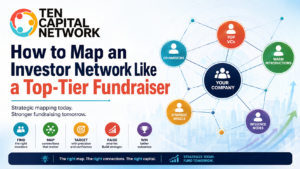
How to Map an Investor Network Like a Top-Tier Fundraiser

7 min read How to Map an Investor Network Like a Top-Tier Fundraiser Most founders approach fundraising backwards. They build a pitch deck first, then start scrambling to find investors. The best founders do the opposite: they build an investor network map before they ever ask for capital. Investor mapping is no longer optional. In today’s market, capital is concentrated in highly connected networks. The founders who understand those networks gain faster introductions, higher response rates, and better fundraising outcomes. [1] An investor network map is more than a spreadsheet of venture firms. It’s a strategic intelligence system that identifies: Which investors actively fund your sector Who co-invests together Which partners lead rounds Where warm introductions exist Which firms are deploying capital now How influence flows across your market The goal is simple: stop pitching random investors and start targeting connected capital. Step 1: Define Your “Ideal Investor Profile” Before researching firms, define exactly who should invest in your company. Your investor profile should include: Stage Pre-Seed Seed Series A Growth Sector Focus AI Fintech Healthcare Climate SaaS Deep Tech Geography U.S. Europe LATAM Southeast Asia Check Size Angel: $25k–$100k Seed VC: $250k–$2M Institutional: $2M+ Portfolio Alignment Similar companies Competitive adjacency Market thesis overlap This narrows your universe dramatically and prevents wasted meetings. Strategic investor mapping starts with precision, not volume. [3] Step 2: Build Your Initial Investor Universe Most founders stop after listing “top VCs.” That’s a mistake. You want layered investor categories: Tier 1: Dream investors Tier 2: Active specialists Tier 3: Strategic angels Tier 4: Syndicates and microfunds Tier 5: Corporate venture arms Use research platforms to identify active investors: Crunchbase AngelList PitchBook LinkedIn OpenVC Demo Day lists Podcast appearances Conference speaker rosters AngelList and Crunchbase are especially useful for filtering by stage, geography, and sector focus. [2] Your first pass should identify 50–100 relevant investors. Not all will matter equally. That’s where network analysis begins. Step 3: Identify Co-Investment Patterns The most important fundraising insight is this: Investors rarely invest alone. VCs operate in clusters. Some firms consistently co-invest together. Some angels follow specific lead investors. Some funds specialize in certain ecosystems or accelerators. Your job is to map those relationships. For every investor, track: Recent deals Co-investors in each round Lead vs follow behavior Repeat founder relationships Shared board members Accelerator affiliations You’ll quickly notice patterns. For example: Investor A always co-invests with Fund B Angel C appears in nearly every AI infrastructure seed round Fund D follows YC companies aggressively This transforms your fundraising strategy from “cold outreach” into network navigation. Network analysis helps startups identify the most connected and relevant capital pathways. [6] Step 4: Build a Warm Introduction Graph The highest-converting fundraising channel is still the warm introduction. But founders misunderstand warm intros. A warm intro is not “someone knows someone.” A strong warm intro comes from: Portfolio founders Repeat co-investors Trusted operators Existing LP relationships Shared accelerators Prior successful founders Create a relationship graph with three levels: Hot Connections People who know the investor personally and can directly recommend you. Warm Connections Second-degree relationships through founders, operators, or syndicates. Cold Connections No direct path, requiring content, traction, or outbound strategy. This becomes your investor access map. One warm introduction from a trusted founder can outperform 100 cold emails. Step 5: Score Investors by Probability Not all investors deserve equal attention. You should rank investors using a scoring model. Suggested scoring categories: Category Weight Sector Alignment 30% Stage Match 25% Recent Activity 20% Warm Intro Access 15% Geographic Fit 10% An investor actively funding your exact category within the past 12 months should rank far higher than a famous but inactive firm. The best founders focus on investors currently deploying capital, not just recognizable names. [4] Step 6: Track Investor Momentum Signals Investor mapping is dynamic. Funds evolve constantly. Some firms: Slow deployment Change thesis Raise new funds Shift stages Replace partners Pause investments You need momentum signals. Watch for: New fund announcements Hiring activity Recent lead rounds Increased conference appearances Podcast interviews Public market commentary Regulatory themes If a fund recently raised a new vehicle, deployment pressure rises significantly. That’s opportunity. Step 7: Map Influence Nodes Every ecosystem has hidden power centers. Sometimes the most influential person isn’t a VC partner. It may be: A super angel Accelerator MD Startup attorney Banker Founder with strong syndicate pull Scout program operator These people act as network bridges. One introduction from a highly connected node can unlock dozens of investor conversations. Mapping influence is often more important than mapping capital itself. Step 8: Organize Your Investor CRM At this point, you’re not building a contact list. You’re building a fundraising operating system. Your CRM should track: Investor name Fund Partner focus Last investment Intro path Relationship strength Follow-up timing Meeting notes Objections Interest level Next action Most founders lose fundraising momentum because they fail to systematize follow-up. Professional fundraising requires process discipline. Step 9: Create an Investor Narrative Strategy Every investor cluster responds to different narratives. Examples: AI investors care about infrastructure defensibility Climate investors focus on regulatory leverage Fintech investors care about distribution and compliance Deep tech investors prioritize technical moat Your investor map should include messaging angles for each segment. The best founders customize: Deck emphasis KPI framing Market sizing Technical depth Competitive positioning Fundraising is not one pitch. It’s a network-specific communication strategy. Step 10: Build Relationships Before You Need Capital The worst time to meet investors is when your runway is collapsing. The best founders start relationship-building 6–18 months before raising. This creates: Familiarity Credibility Progress tracking Trust accumulation Experts recommend identifying 20–30 aligned investors early and nurturing relationships over time. [5] Investors fund momentum they’ve observed, not just stories they’ve heard. Final Thoughts The modern fundraising market is not driven by access to information. Everyone has access to databases. The advantage now comes from understanding networks. Investor mapping gives founders: Better introductions Faster diligence Higher conversion rates Stronger syndicates More strategic investors The founders who win fundraising
The Growth Story Framework: What Top VCs Look for in Follow-On Rounds

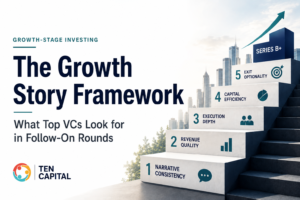
7 min read The Growth Story Framework: What Top VCs Look for in Follow-On Rounds Early-stage investors often focus on vision, team, and market potential. But when it comes to follow-on rounds—Series A, B, and beyond—the evaluation criteria shifts dramatically. Later-stage investors are not buying possibility; they’re underwriting performance, scalability, and durability. Understanding how growth-stage VCs evaluate companies doesn’t just help founders prepare for their next round—it helps angels and seed investors make smarter initial bets and support portfolio companies more effectively. It also sharpens exit strategy thinking from day one. Here’s the framework top VCs use when deciding whether to lean in—or walk away. 1. Narrative Consistency: Is the Growth Story Coherent? Growth-stage investors look for a clear, consistent narrative from inception to scale. The story must connect early traction to a larger strategic opportunity: Why this market? Why this model? Why now? If the company’s direction has pivoted multiple times without a compelling throughline, it raises questions about strategic clarity. The best companies demonstrate evolution—not randomness. Every stage builds logically on the last. Takeaway: Early investors should help founders craft a scalable narrative from day one. A company’s “Series A story” is often seeded in its pre-seed pitch. 2. Revenue Quality: Not Just Growth, but Durable Growth At the seed stage, 3x–5x growth can compensate for messy fundamentals. In follow-on rounds, that’s no longer enough. Later-stage VCs dissect revenue composition with precision: Customer concentration Retention cohorts Net revenue retention (NRR) Expansion revenue Gross margins Sales efficiency They want to know: Is this growth repeatable? Predictable? Profitable at scale? A company growing 100% year-over-year with strong retention and improving unit economics is fundamentally different from one buying growth through heavy discounting and churn. Takeaway: Angels should pay attention to revenue quality early. Supporting founders in building strong reporting habits and disciplined GTM processes pays off later. 3. Execution Depth: Can This Team Operate at Scale? Early-stage investing is often a bet on raw talent and founder grit. Later-stage investing evaluates operational maturity. Growth investors assess: Leadership bench strength Functional expertise (sales, finance, operations) Hiring velocity and retention Board governance KPI visibility and forecasting discipline A strong founder is essential—but insufficient. VCs want to see a management team that can run a multi-million (or multi-hundred-million) revenue engine. Takeaway: Smart early investors encourage founders to upgrade talent proactively—not reactively. Scaling companies require scaling leadership. 4. Capital Efficiency: How Much Fuel to Create the Next Milestone? Follow-on investors aren’t just asking, How big can this get? They’re asking, How efficiently can it get there? Burn multiple, CAC payback, and runway discipline matter. Even in bullish markets, growth-stage VCs prefer companies that demonstrate thoughtful capital allocation. In tighter markets, this becomes non-negotiable. Companies that can articulate exactly how $20M translates into defined ARR, margin expansion, or market share gains signal strategic maturity. Takeaway: Early investors should help founders treat capital as strategic leverage, not validation. Efficient companies have more financing options—and stronger negotiating power. 5. Exit Optionality: Is There a Clear Strategic Path? By the time a company reaches later-stage funding, investors are modeling outcomes. Who are the logical acquirers? What valuation benchmarks are realistic? Is there a credible IPO path? How defensible is the competitive moat? Follow-on investors want to see multiple exit pathways, not a single aspirational scenario. They’re underwriting return profiles based on risk-adjusted probability. For angels, this perspective is critical. A company that looks exciting at seed may struggle to attract growth capital if it lacks a clear path to liquidity. Takeaway: Exit strategy thinking shouldn’t start at Series C. It should inform market selection and business model design from the beginning. Why This Framework Matters for Early Investors Too often, early investors think in isolation: Is this a good seed deal? The better question is: Will this be a good Series A or B company? When angels understand how growth-stage VCs evaluate opportunities, they can: Select startups more likely to secure follow-on capital Coach founders toward scalable metrics Reduce dilution risk Increase probability of meaningful exits In other words, they invest with the end in mind. Building With the Future Round in Mind The most successful companies don’t “prepare for a Series A” at the last minute. They build in alignment with what growth capital demands from the start. As an investor or founder, ask yourself: Are we building durable growth—or temporary momentum? Are our metrics institutional-grade? Is our narrative scaling with our traction? Are we designing for exit optionality? These are not late-stage questions. They are foundational ones. Final Thought The Growth Story Framework is more than a fundraising checklist—it’s a strategic lens. Whether you’re writing your first check or preparing your next round, understanding how top VCs think will elevate your decisions. If you found this helpful, subscribe for deeper insights on startup finance, growth strategy, and investor intelligence. And if you’re supporting portfolio companies today, share this framework with them—it may shape their next round more than you think.

Managing Your Capital Effectively

2 min read Startups often struggle to obtain, preserve, and manage the amount of capital needed to get the proverbial ball rolling. Today, we share two tricks on how to get around this problem: equipment leasing and accounts receivable factoring. Learn how these methods can earn you capital upfront and help you maintain throughout your production and sales processes. Equipment Leasing Equipment leasing lets you borrow funds to obtain assets such as computers, machinery, and other items you may need to build your product and run your business. This method works best for cash-flow management when you have a long-term need for the equipment.  Instead of raising equity funding to buy the equipment, you can lease the equipment- an less expensive method that spreads the payments over a period of time rather than requiring the funding for the equipment upfront. This works well for businesses that are capital-intensive. There are two types of leasing. The Finance Lease (also called the Capital Lease) and the Operating Lease. The Finance Lease is a long-term arrangement in which the startup is required to pay the lease rent until the end of the contract, which is usually the life of the asset. The Operating Lease is for a shorter period of time and is often cancelable.  Providers of equipment leasing must have a license and cannot hold or offer real estate. The lease period cannot be fixed for less than three years, except for IT and computer equipment. Leased equipment appears as an expense on the income statement rather than on the balance sheet, which would reduce the startups’ liquidity. Over the long term, the cost of the asset will be higher than that of an outright purchase. It’s best to look for a closed-end lease without a balloon payment at the end. An open-end lease requires you to pay the difference between the value of the equipment and what you’ve paid for it so far. Factoring Factoring is selling your accounts receivables to a finance company at a discounted rate. It’s not a loan, you are not taking on debt. Rather you are selling your invoices for cash, albeit at a discount. Businesses with a cash-flow shortage often use factoring as it’s a fast way to access capital without taking on debt.  When you sell a physical product and invoice the customer, it can take up to sixty days or more before they pay.  Factoring provides funding by reducing your accounts receivable by selling the invoice. The factoring company gives you cash immediately when you sell and takes a transaction fee on the use of their funds. The factoring company is now at risk for non-payment. Factoring works well for consumer product companies that have cash-flow challenges as the business requires capital to build the product, sell and ship the product only to collect payment later. This method reduces the amount of working capital needed and may reduce the amount of funding you need from equity capital raises.  A typical factoring arrangement gives the business 85% of the value of the invoices and keeps 15%. The factoring company often charges a processing fee and a fee for however many days it takes the customer to pay the invoice. These two costs add up to be the discount the business is paying for the receipt of cash.  Keep in mind that your customers will know you are factoring as the invoice will be retitled into the name of the factoring company. Read more in our TEN Capital eGuides: http://staging.startupfundingespresso.com/eguide/ Hall T. Martin is the founder and CEO of the TEN Capital Network. TEN Capital has been connecting startups with investors for over ten years. You can connect with Hall about fundraising, business growth, and emerging technologies via LinkedIn or email: hallmartin@tencapital.group

Site Map

Scroll to Top