

Startup Funding

Related Guides

Trending

The most popular articles on Startup Funding in the past day.

Building a Financial Model

2min read Building a Financial Model Building a financial model is an important aspect of running a startup and achieving investor funding. Below, we learn how to create a quick version of the financial model, how to capture assumptions and drivers, and what mistakes to avoid in financial modeling. Quick Version of the Financial Model When setting up your fundraising plan at a high level, set a revenue target five years out. Then, draw a line from today to that five-year mark. Your fundraise and hiring plan will come from that. To calculate this quick and dirty version of the financial model, follow these steps: Start with current revenue. Apply your organic growth rate and map out your top-line revenue for five years. Calculate your revenue per person metric. Apply your expenses for five years using the revenue per person metric. Identify the negative profit line.  Set your fundraise to cover the negative working capital. If the amount is greater than one million dollars, break the fundraise into two rounds. This will give you a rough idea of how much you need to raise and how many people you will need to hire.  Assumptions and Drivers In building out your financial model, make explicit the assumptions you are using and identify the drivers in your business. Create a tab on your financial modeling spreadsheet for assumptions and drivers for the investor to review. As you build out the revenue forecast, capture the assumptions behind the growth rate. For the costs, make clear which are fixed and which are variable costs. Identify the drivers within the business. Typically, this is the number of products sold or the number of customers signed up. This drives the revenue line as well as the variable costs. For example, the more customers targeted for revenue, the higher the cost of sales and sales commission. Investors look to see if the costs align with the revenue forecast. Understanding what drives your revenue and costs will help you build out your financial model and create more accurate projections. Mistakes to Avoid in Financial Modeling Your financial model can be used not only for fundraising but also for running your startup. Avoid these mistakes in setting up your financial model: Tying your revenue to a factor that doesn’t actually drive revenue. Instead, figure out what actually drives sales and build your model around that. Trying to identify exact numbers for factors such as conversion rate. Instead, use a range of numbers to account for variations. Skipping the research into companies in your sector. Instead, spend time looking at similar companies to find out what drives their business. Trying to include too many drivers in your business model. Instead, focus on the top drivers that account for the majority of your sales. Setting up the financial model for generating financial statements only. Instead, set up the model so it also calculates key performance indicators. Design the spreadsheet for running the business in addition to raising funding.  Read More TEN Capital Education Here Hall T. Martin is the founder and CEO of the TEN Capital Network. TEN Capital has been connecting startups with investors for over ten years. You can connect with Hall about fundraising, business growth, and emerging technologies via LinkedIn or email: hallmartin@tencapital.group
Guide to Startup Ecosystems

2min read Guide to Startup Ecosystems If you are a serial entrepreneur or are otherwise serious about startups, building a startup ecosystem may be an attractive option for you. Startup ecosystems provide built-in connections and ongoing support, making the growth of a startup from the grassroots stage to a mature business far easier to manage. In this article, we discuss the best way to begin building your startup ecosystem. What is a Startup Ecosystem? A startup ecosystem is a network of startups, investors, and others who come together to foster startup formation and growth. At the core of the network are startups led by founders who launch high-growth businesses. This network encourages innovation through shared resources such as capital, talent, and mentorship. Each member of the network has something to offer: Accelerators and incubators: provide education around the initial launch Investors: provide potential capital Universities: provide talent for launching and supporting startups Freelancers: provide additional talent in the form of labor Providers: offer support for legal, financial, marketing, and other services Mentors: provide coaching and guidance on how to grow the business How to Build a Startup Ecosystem In building out your startup ecosystem, consider these points: First, investigate every kind of funding and consider where it may fit into your overall funding plan. It’s most likely that you will use two or three types of funding over the life of your business. To understand the type of funding you should look for, ask: “How will you pay the investor back?” For example, equity funding should be considered if you plan to pay back when you sell the business. On the other hand, if you plan to pay back out of the company’s cash flow, then debt funding is a better choice. If you have a consumer-facing product, consider crowdfunding which offers both debt and equity options. Break your funding down into parts, and consider using more than one type of funding for your business. How to Prepare for a Raise Before launching your fundraise campaign, prepare your business, complete your investor documents, and build your investor network. Start with a group of entrepreneurs interested in startups and meet regularly. Encourage startups to share their projects and invite others to support them through coaching and making introductions. Set up a blog and publish a newsletter each week on startup activities in the area. Interview startups and investors. Build a resource list for all startups to use. Recruit lawyers, accountants, and other professionals to join the meetings and support early-stage companies. Set up events such as pitch sessions and happy hours to expand the network and recruit more people into the community. Put the group on website lists for startup communities to generate awareness. Set up a coworking space to give startups a place to work. Recruit startup programs to your area, such as the 3-Day Startup, to provide additional programming. Start small and grow your startup community through regular meetings and consistent newsletter mailings. Remember that your role in building a startup community is to create connections and networks for players in the space. Therefore, facilitating communication and connection is key. Read More TEN Capital Education Here Hall T. Martin is the founder and CEO of the TEN Capital Network. TEN Capital has been connecting startups with investors for over ten years. You can connect with Hall about fundraising, business growth, and emerging technologies via LinkedIn or email: hallmartin@tencapital.group
How to Invest in Startups: Learn From Other Investors

2min read How to Invest in Startups: Learn From Other Investors As an investor, I helped launch three angel networks in Texas. In the process, I set up training programs, attended conferences, and talked with many other investors. Hearing and speaking to other investors was a wonderful learning tool. One of the best resources I found was a podcast by Frank Peters. Frank was an angel investor from the Tech Coast Angels in southern California. The Frank Peters Show Frank interviewed every angel, VC, and startup in the southern California community. After that, he later ran interviews across the US and worldwide. He ultimately recorded over 450 episodes which he posted on the web. As I drove my car, I listened to many podcasts and heard from angel investors about how they invested, their investment thesis, and the lessons they learned from the process. I recommend listening to podcasts that focus on startup funding. Podcasts are an excellent tool for learning from experts in the field. Some of my favorites are Jason Calacanis: Angel Podcast, Patrick O’Shaughnessy: Invest like the Best, and my podcast, Investor Connect.   Read more on the TEN Capital eGuide: http://staging.startupfundingespresso.com/how-to-invest-in-a-startup Hall T. Martin is the founder and CEO of the TEN Capital Network. TEN Capital has been connecting startups with investors for over ten years. You can connect with Hall about fundraising, business growth, and emerging technologies via LinkedIn or email: hallmartin@tencapital.group

How to Raise Funding- The New Normal for Fundraising- It’s Now Online

2min read A New Model for Startup Funding.  Fundraising Fundraising, like everything else, is moving online, almost all of it. Traditionally, those who wanted to raise funding would meet everyone in their local area. You would pitch to the local angel network or investment group, meet with the local venture capitalist, and canvas all your family and friends. The CEO had to do it because investors wanted to meet with the company’s CEO. It was time-consuming. You had to get introductions to investors you didn’t know, and you had to keep the investors up to date with your progress. It was not uncommon to hear about 50+ pitch sessions before receiving the first investment. The investor side was equally difficult. I ran an angel network in the 2000s and had many startups pitch to my investors in a dinner club setting. Ninety percent of the startups would disappear, and we would never hear from them again. We had no idea what happened to them. Only about ten percent would come back, give us updates and reminders, and show some semblance of progress. Those are the startups we funded. Those CEOs built a relationship with the investor and gave enough information to the investor that one could see momentum and traction in play. Today, there is a better way. Different Tools You can use online tools to help raise funding for your business. The key to fundraising is to build an investor prospect list and update them on your progress.  It takes seven touches to close a sale – so it takes seven touches to close an investor. To raise the funding you need to: Access a large number of investors.  You need to think worldwide-not, just citywide. Use analytics to find the right investor. Understand the different investor types – angels, VCs, family offices, etc. Engage and maintain contact with investors.  You have to demonstrate progress, not just state forecasts and make promises. Prepare investor documents—you must come prepared with your pitch deck, due diligence box, and other key documents for investors. Prepare the campaign – know what you will tell the investor about your deal. The rule of pitching is- if you don’t articulate it – it doesn’t exist.  If you have revenue but don’t mention it, you get no credit for it with the investors. This is an investor relations process using online tools.  In this blog series, we’ll outline the steps you need to go through and the process you need to deploy to achieve your fundraise.  Read more on the TEN Capital eGuide: How to Raise Funding Hall T. Martin is the founder and CEO of the TEN Capital Network. TEN Capital has been connecting startups with investors for over ten years. You can connect with Hall about fundraising, business growth, and emerging technologies via LinkedIn or email: hallmartin@tencapital.group

Negotiating the Terms Sheet

2min read Negotiating the Terms Sheet  During the ACA Summit, Robert Robinson of the Hawaii Angels offered the following advice. There are three elements to understand in any negotiation: Commitment – what have the parties agreed to? Verification – how will we know that everyone fulfills their commitment? Enforcement – what happens if a party does not fulfill its commitment? Areas to negotiate include: –Expectations–Process–Terms Sheet–Communications–Portfolio governance–Follow-on financing–Exit During the presentation, he brought up a key point of negotiation when he stated,“Principles unite, numbers divide.” As soon as someone starts using numbers, conflicts start to arise. At some point in the negotiation, numbers must be used, but building a common base first goes a long way in helping navigate through the possible numbers later. The negotiation process itself is important. In this blog post, a first-time CEO gives his experience in negotiating with a VC and applies it to angels. Knowing the terms and what they mean is critical to the negotiation process. I’ve sat across the negotiation table with entrepreneurs who, from time to time, lean over to their attorney and ask, “What does that term mean?” To that end, we’ve taken steps to provide more training to entrepreneurs in the form of special events like the Central Texas Entrepreneur Funding Symposium and Mock Terms Sheet practices sponsored by Andrews Kurth. For a tutorial review of Terms Sheet terms, check out this site.   Read more on TEN Capital Network Hall T. Martin is the founder and CEO of the TEN Capital Network. TEN Capital has been connecting startups with investors for over ten years. You can connect with Hall about fundraising, business growth, and emerging technologies via LinkedIn or email: hallmartin@tencapital.group

Startup Fundraising Basics

2min read Most startups need additional capital to help launch or grow their business. One way to obtain this additional capital is to raise funds via investors. In this article, we cover the basics of startup fundraising including if you should raise funding, when you should raise funding, how much funding you should raise, and how to milestone your raise.  Should Your Startup Raise Funding? Before raising funding, consider if you should raise funding for your startup. Ask why you need funding and consider if you have a specific need for funding that is tied to growing the business.  If you have a business that is on a high growth trajectory, then consider venture funding. If the business is not high growth or you have no vision of selling it, then consider other forms of funding such as SBA loans or revenue-based funding.  Investors expect a return in the ballpark of five times their investment in five years. Angel and venture capital funding goes to those startups. Other factors to consider for venture funding include the following: You have a large addressable market. You are building a business that is scalable. You are using a recurring revenue monetization model. You are building a platform-based business rather than a single product. You plan to sell the business rather than keep it for a lifestyle business.  Finally, you have built enough of the business to prove product and market validation; the product works and people will pay for it.  When to Raise Funding Most founders go out for a fundraise prematurely because they need money and not because they are ready for fundraising. Consider the following to understand when to raise funding: Have a compelling idea that you can clearly articulate. Have a validated customer, market, and product lined up. Have the investor documents been prepared? While you will always be changing the deck, it needs to show the core product, team, and fundraise. Be able to demonstrate the product even at an early stage. Show customer interest through engagement as well as revenue. Talk to some investors to identify what risks they see in the deal then show how you mitigate those risks. When you have these things done, then consider launching your fundraise. Engage investors with your deal and remember to never show up to an investor meeting empty-handed. Always have some customer engagement to discuss. How Much Funding to Raise When raising funding consider how much you should raise. Start with the overall amount of funding required to take the business to cash flow positive. This is often a fairly large number for platform-based businesses in a high-growth sector. Take the overall amount of funding and break it down into milestone raises. At the early stage of the business, the valuation is low. As you build the team, the product, and the revenue, your valuation will go up. For the first round of funding raised as little as you need to reach the next milestone. If you raise too much funding in the first round you will be giving away too much equity. Save the larger rounds of funding for later when you have a much higher valuation. Pre-seed rounds are often at $250K, Seed rounds at $500K to $750K, and Series A rounds at $1M to $5M. Each round will cost you 20% of the equity. Milestone the Raise Founders often want to compress their fundraise into one round for the sake of efficiency. While this may sound like a good idea, it’s actually an expensive one for the founder. Raising too much money in the early stages will cost the founder equity dilution. The valuation of the startup is low at the beginning and will rise with more products built and revenue generated. Raise a small amount upfront to get the business going such as $250K. If you try to raise less than $250K, most angels and venture capitalists will not consider this enough to build something meaningful. Take your overall fundraise and break it into smaller milestones such as $500K for a seed round. It’s often the case that you will need to raise another $500K a year later which some call a seed plus round.  It’s still seed funding and comes at the same terms as before. But it’s easier to raise because you broke a $1M raise into two milestones. This strategy lets you raise funding and then work on the business. For the next round, you’ll need some time to build the product and close customers. A rule of thumb is it takes one year to raise $1M. A $500K raise will come in closer to half a year. When you raise funding it should be a full-time job. The key here is it doesn’t have to be a full-time job for the entire year.   Read more on the TEN Capital eGuide:  How to Prepare for a Fundraise Hall T. Martin is the founder and CEO of the TEN Capital Network. TEN Capital has been connecting startups with investors for over ten years. You can connect with Hall about fundraising, business growth, and emerging technologies via LinkedIn or email: hallmartin@tencapital.group
Beyond Due Diligence

2min read Completing your due diligence with care before investing in a startup is an indisputable rule in the world of investing. However, to ensure that your deal is going to work out as close to your expectations as possible, you need to go beyond due diligence. In today’s article, we will discuss how to do exactly that using three core strategies: finding the full answer, spotting red flags, and scanning for what isn’t being said in the startup’s pitch. Reaching the Full Answer The first strategy is to find the full answer. In talking with startups, I find the investor must always probe for the final answer. A single question rarely reveals the full answer. I spoke with a startup recently who said, “We’re raising a million dollars and we have raised half of it already.” On the surface, it sounded like they had $500K invested in the business. So, I asked, “You have $500K in the bank already from your raise?” They responded, “Well, not exactly. We have several investors telling us they are interested in investing.” After four more questions, it came out that they had $100K in the bank and around $300K in soft-circled commitments. It’s good progress, but not exactly the half a million we heard at the beginning. Never take the first statement as the final answer. It takes at least 5 questions to get down to the real answer, and as an investor, you want to know the real answer. Spotting Red Flags The second strategy is actively scanning for red flags. These indicate something is wrong. Some red flags to beware of include: The founders are not investing any of their own money into the business.  The cap table is crowded with many small investors, meaning the earlier funding was a challenge. The team is incomplete. Either the solo founder wears too many hats, or everyone is a tech developer, meaning no one is outselling the product. The team lacks awareness of the industry, especially the regulatory side. There are no KPIs or operational metrics to review. Plans are generic and lack specific customer names or revenue amounts. They have loads of debt, and previous investors have no further interest in funding or supporting the business. The business appears to be set up to be the CEO’s lifestyle business. They offer hockey-stick projections with no apparent supporting evidence. There’s no board of advisors or directors. The team you see is what you will get. The financials use year 1, and year-2 naming, rather than actual years. What Isn’t Being Said In due diligence, what isn’t being said or shared is as important as what is. When a startup pitches its idea, you should be skeptical of founders that don’t mention potential risks or discuss their experience in the industry or their traction. Here are other key items the investor should look for in a startup’s pitch: what needs to be done and what risks exist in the deal market size and growth rates reflect the market the team is pursuing financial projections show the startup’s understanding of their business information about the founding team including industry experience, commitment to the startup, and no criminal records If a startup leaves any of this information out, it may be an indicator that something is wrong. Use the five-question rule from above to find the true answer. Read more on the TEN Capital eGuide: Due Diligence and Leading the Deal Hall T. Martin is the founder and CEO of the TEN Capital Network. TEN Capital has been connecting startups with investors for over ten years. You can connect with Hall about fundraising, business growth, and emerging technologies via LinkedIn or email: hallmartin@tencapital.group
How to Raise Funding at Every Stage of the Business

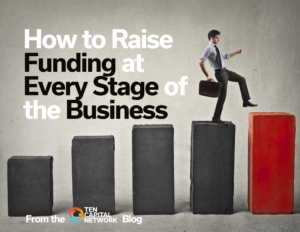
1 min read Crowdfunding can be used to raise funding throughout the life of a business.  When the idea of a new business strikes you, and there’s nothing built yet, then you should run a donations campaign–ask family and friends to donate $10K collectively.  Make sure they understand that no one is getting paid back.  The value of this step is that it establishes a network to support your business.  The money can be used for some initial costs such as filing patents, building websites, and starting work on a prototype. Rewards The next step is to use a Rewards/Prepay campaign to pre-sell 50 units of your product.  It can be anything.  The key here is that you start to build your customer network.  If you can’t presell 50 units, then you have a product problem that needs to be solved first before you go any further.  The funding you raise should be enough to build the first version of your product. Crowdfunding Campaign With a successful rewards campaign behind you,  you now move towards turning those customers into investors using the Texas Intrastate crowdfunding campaign.  The Texas Intrastate law gives anyone the ability to invest in your business.  Again, the funding helps, but building your network is the crucial point.  If all fifty of your Prepay customers invested in your business you now have fifty brand ambassadors supporting your business–not trivial support by any means. With support from your customers, and now investors in your business, you approach angel investors and start to raise funding to grow the business.  Angels invest $250 to $2M to grow a working operation.  When you arrive at the angel investors’ door, they are expecting you to have a product at some stage of usage and some revenue.  The previous steps give you the ability to do that. If you need more funding, then you can go back and raise revenue-based funding.  The investors at this stage take a piece of the revenue as payment rather than an equity stake.  If you find yourself having trouble raising funding, it may mean that you skipped some key steps. You should go back and fill in the gaps of building your support network and your customer base before proceeding. Read more in the TEN Capital eGuide: http://staging.startupfundingespresso.com/how-to-raise-funding-eguide/ Hall T. Martin is the founder and CEO of the TEN Capital Network. TEN Capital has been connecting startups with investors for over ten years. You can connect with Hall about fundraising, business growth, and emerging technologies via LinkedIn or email: hallmartin@tencapital.group

How to Raise Funding – A Little at a Time

1 min read Traditionally fundraising takes a tremendous amount of time on the part of the startup CEO. Some CEOs drop everything to run the fundraise.  I advise against spending too much time fundraising but instead set up a system to help with the fundraise. With the right use of online tools (analytics, CRM, Drip campaigns, etc) the CEO doesn’t have to let fundraising become a huge distraction. Building a list of investor prospects and keeping them informed of your progress, the CEO can reach out to ask for an investment at the right time. Instead of raising two years’ worth of funding, the CEO can raise a few months which is a great deal easier. This type of funding works best for early stage, and those with recurring revenue business models. These techniques were popularized by crowdfunding but can be applied to accredited investor raises as well. As investors see more and more deal flow, they need help in finding, qualifying, and following up the deals. At TEN Capital we let the investor select the deals they want to see and then send updates only on those deals. We work with the startups to build upgrades to share with interested investors, All of this happens online. At some point, interested investors set up a call to talk with the CEO and later they decide to invest or pass. Most of the process if not all takes place online. Read more the TEN Capital eGuide: http://staging.startupfundingespresso.com/how-to-raise-funding-eguide/ Hall T. Martin is the founder and CEO of the TEN Capital Network. TEN Capital has been connecting startups with investors for over ten years. You can connect with Hall about fundraising, business growth, and emerging technologies via LinkedIn or email: hallmartin@tencapital.group

Site Map

Scroll to Top