Startup Funding

Related Guides

Trending

The most popular articles on Startup Funding in the past day.

Joining an Angel Group

2 min read You may find yourself contemplating joining an angel investment group. As with all investment decisions, there are both benefits and drawbacks to joining an investment group. Familiarize yourself with both before making the final decision. Benefits The angel network can build resources to share with the angel such as due diligence. This is time-intensive work, so it helps to share the load. Angel networks provide more and better deal flow than individual investors can find. The bigger the angel network, the more likely there will be investors that are knowledgeable about the market segments and startup business models. This lets the angel investor pursue deals outside their core expertise. Angel groups can write bigger checks than individual angels and thus command better terms with the startup. Experienced angel investors can share their knowledge with new angels. This is particularly helpful in setting valuations, defining term sheets, and supporting the company. Angel investors can find diversification through the angel network and its deal flow. An angel network will have more influence over its startup scene than an individual investor.  Challenges Here are some challenges related to angel investment groups to consider: Angel investing requires hands-on work with the startups, not only in funding but also in supporting them after the investment. They are often left filling in the gaps left by the local incubators and accelerator programs in coaching them into a place where they can raise funding. First-time angels can find it time-consuming and expensive to learn the process. Newmarket segments require the angel investor to continually learn new industries and business models.  There’s no collateral for the investment and it can all go to zero as it’s a risky investment class. One out of ten investments will be a home run. Two or three will provide a small return on investment. And the rest will fail.  Angel investing can be a rewarding endeavor but it’s not without its challenges. Read more on the TEN Capital eGuide: Leading an Angel Group Hall T. Martin is the founder and CEO of the TEN Capital Network. TEN Capital has been connecting startups with investors for over ten years. You can connect with Hall about fundraising, business growth, and emerging technologies via LinkedIn or email: hallmartin@tencapital.group

Starting an Angel Investor Group

2 min read Starting an angel investment group can be a tempting option for some investors. It can definitely be a rewarding and lucrative process. Keep in mind however that this does not come without its difficulties. If you are considering starting an angel investor group, consider the information below before getting started. Should You Start an Angel Network? Next, before launching an angel network, assess your community as follows: Do you have accredited investors interested in startup investing? You have any investors who will take the lead on diligence and investing for each deal? Do you have a champion who will organize and lead the angel group for the first two to three years? Do you have a flow of startups seeking funding that you can access? Is there a resource for incubating and educating those startups in the area? Are there local service providers such as attorneys, accountants, financial advisors, and others who can support the startups? Are there other investor groups that currently fund those deals in your community to support syndication? Is there access to follow-on funding for startups? Research your community to see what currently exists and what must be built. Check with the local entrepreneur groups to make this assessment and get their potential support for starting an angel group. Considering Service Providers In setting up an angel network, it’s important to have support from services providers such as lawyers, accountants, and financial advisors. Startups will need legal, accounting, and financial support. Review your community for current service providers who are already helping the startups. Assess the skills of the providers to see if they are a fit for early-stage companies. Some providers only work with more mature companies, but the angel network will be dealing with very early ones. Discuss with local entrepreneur groups and professional organizations about their experience with the providers. Identify the ones who provide the best experience for their clients. Reach out and develop a relationship with them as potential speakers, sponsors, or even members. For those services missing from the community, reach out online to other organizations that can provide the support virtually. If the demand is big enough, providers will move to the area to support the community. This often occurs in entrepreneur hubs that are growing fast. Liabilities and Disclosures There’s risk in startup investing as most investments don’t pay a return to the investor. In running an angel network, one must take steps to mitigate liability. It’s a best practice to have all members sign liability waivers stating they understand the risk of startup investing and take responsibility for it. The waiver should indicate that each member makes their own investment decisions and the angel group is not recommending any startup for investment. Members in the group should provide full disclosure. If the member has any relationship with a proposed startup such as advising, consulting, or otherwise, the member should disclose this to the other members. Each member can decide for themselves how that impacts their investment decision. In syndicating deals to other groups, an angel network should have those groups sign liability waivers indicating that each investor is responsible for their due diligence. Most startups are raising capital from angel investors who are doing so under an SEC exemption. The angel group should have written confirmation from the members indicating that they are accredited investors. Take care to cover these areas of liability for your angel network.   Read more on the TEN Capital Network eGuide: Leading an Angel Group Hall T. Martin is the founder and CEO of the TEN Capital Network. TEN Capital has been connecting startups with investors for over ten years. You can connect with Hall about fundraising, business growth, and emerging technologies via LinkedIn or email: hallmartin@tencapital.group
Investor Connect Interview: Ander Iruretagoyena of Impact Engine

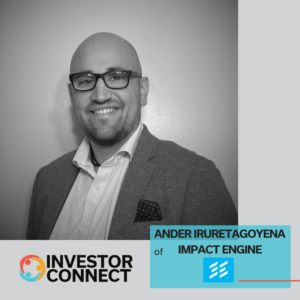
2 min read On this episode of Investor Connect, Hall welcomes Ander Iruretagoyena, the Senior Associate at Impact Engine. Headquartered in Chicago, Illinois, Impact Engine is a women-owned and led venture capital and private equity firm investing in companies driving positive impact in education, economic empowerment, health, and environmental sustainability. Impact Engine was launched in 2012 as an accelerator fund with the goal of identifying promising entrepreneurs starting businesses with the potential to drive both attractive financial returns and positive social impact. Impact Engine raised two subsequent accelerator funds in 2013 and 2014, all focused on investing in pre-seed stage companies. Across the three accelerator funds, Impact Engine invested in a portfolio of 23 companies. Between 2015 and 2016, Impact Engine shifted its investment strategy and raised a $10 million venture fund which invested in 22 companies. Between 2018 and 2019, they began operating as a public benefit corporation, raised a $25M second venture fund, and raised a $31.5M first PE fund, allowing them to invest in impact funds for the first time. Impact Engine’s investors include institutions, family offices, foundations, and individuals who believe in investing for both financial return as well as social impact. They are also committed to cultivating community among their investors. Their goal is to help their investors learn from each other and leading-edge impact investors who deploy capital across asset classes and geographies. Prior to joining Impact Engine, Ander was an investment banking associate at Bank of America Merrill Lynch, working with Latin American corporations. During these years, Ander worked on a total of 17 transactions for $10.7B across 4 products, 9 industries, and 6 geographies. Ander also previously worked on financial inclusion strategies at the Bill and Melinda Gates Foundation. Ander holds a BA in Economics as well as Latin American Studies from the University of Chicago and earned his MBA degree from the Chicago Booth School of Business. Ander is originally from Mexico and loves FC Barcelona. Ander shares what excites him now and discusses the state of impact investing, how he sees the industry evolving, the challenges investors and startups face, and more.  You can visit Impact Engine at www.theimpactengine.com/, via LinkedIn at www.linkedin.com/company/theimpactengine/, and via Twitter at www.twitter.com/TheImpactEngine.  Ander can be contacted via email at ander@theimpactengine.com, and via LinkedIn at www.linkedin.com/in/ander-iruretagoyena/.  If you would like to read the full transcript click here or listen to the interview click here.  Hall T. Martin is the founder and CEO of the TEN Capital Network. TEN Capital has been connecting startups with investors for over ten years. You can connect with Hall about fundraising, business growth, and emerging technologies via LinkedIn or email: hallmartin@tencapital.group

Startup Valuations

2 min read Startup valuations differ from standard valuations in that they don’t solely rely on expected cash flows, book value, or other tangible aspects of the business. Intangibles such as quality of the team, intellectual property, product status, and customers are the driving factors. In this article, we look at why startups may want to perform a valuation and how they can maximize their results. Why Perform Startup Valuations Most angel investors want 25% of the equity for an initial round of investment. In addition, they want to have a say in the business through a board of directors or advisory role. To justify your startup value, focus on articulating the values that are already in the business as follows: Highlight the team you have built so far and their experience. Show what the team is doing to make the company successful. Show the current product development and highlight what has been done so far. Outline the intellectual property you have including provision patents. Make sure you file your provisional patents in advance of launching a fundraise so you can point to having patent-pending technology. Always note customers even if they are not yet paying for your product. Customer involvement results in a higher valuation. If you have revenue, use it to prove market validation showing customers will pay for it.  If you cannot sell the proposed valuation for the raise consider cutting the fundraise target in half to make the risk appear lower. Maximizing Your Valuation Valuation is a negotiation and not a formula. While there are formulas and rules of thumb to help determine valuation, it ultimately comes down to positioning and negotiating. Here are some key points to maximize your valuation: Emphasize the team and show what they are doing to help your business. Highlight the repeatable, predictable nature of your revenue rather than the absolute value of it. Emphasize your most recent milestones showing customer demand and past market success. Calculate your valuation with various models to find the one that puts your deal in the best light with the highest valuation. Consider the market in timing your fundraise.  The hotter the stock market, the higher the valuation you can demand. Investors pay more for new, trendy technology. Connect your startup to a technology trend if possible. Positioning your deal properly will earn you a higher valuation. And remember, valuation is a negotiation. This means everything counts.    Feel free to try out our calculators and contact us if you would like to discuss your fundraise: http://staging.startupfundingespresso.com/calculators/ Hall T. Martin is the founder and CEO of the TEN Capital Network. TEN Capital has been connecting startups with investors for over ten years. You can connect with Hall about fundraising, business growth, and emerging technologies via LinkedIn or email: hallmartin@tencapital.group.

Tips For Starting an Angel Investment Group

2 min read There are many things to consider when starting an angel investment group. What kind of deals you will pursue, how much you will invest, and who will be on your team are all things you will need to consider during the planning process. Below are some tips and best practices for recruiting members, branding, and allocating funds for your angel investment group. Recruiting Members It’s important to recruit members to join your angel investment group. The first step of recruitment is showcasing the deals you have to prospective investors to gauge interest. Send them recently funded deals as an example of the type of deals your group offers. You can also give them access to all of your deals for a period of time and then see if they want to join. Network through your current investors to find potential new members. Have the current members bring friends and colleagues to the presentation meetings and invite them to invest in deals the members are funding. Provide the returns for the group to show the track record. It helps to have a fund that investors can join for those who don’t have the time to review specific deals. For every four investors who want to participate, three will join the fund and one will join the group. Setup a syndicate that takes care of the diligence and makes it easy for investors to join the deals. Make the goal and mission of the group clear to prospective investors as the why is stronger than the return in gaining new members. Branding Your Group In running an angel network it’s important to establish a brand for the group and to then promote it. Branding can make your group appear larger and shows it is an established and well-thought organization. A brand consists of a unique name, logo, mission statement, and mantra. Your brand helps your group stand out from the crowd. It helps build trust and is a promise to the investors and startups you serve. It helps people remember your group by giving them a name to associate it with. A brand also helps attract investors as investors want to belong to a group that stands for something. Finally, a brand helps attract startups. Startups need to recognize your group as a viable source of funding for their company.  Allocating Funds In preparing for Startup investing, determine upfront how much you are willing to invest. In general, it’s best to keep your startup investing to 3-5% of your discretionary investment funds- funds you can lose and not impact your lifestyle or other investments. When determining how much you plan to invest, use a five-year window. Separate these funds from the rest of your investments to make it easier to manage the process. The amount you invest per deal will determine what platforms you will use. You invest $5K you will most likely be on an online funding platform. If you invest $25K you can join a group and invest with angel investors. If you invest $50K you can join a syndicate. And if you invest $100K or more you can invest through investment banks.  Feel free to try out our calculators and contact us if you would like to discuss your fundraise: http://staging.startupfundingespresso.com/calculators/ Hall T. Martin is the founder and CEO of the TEN Capital Network. TEN Capital has been connecting startups with investors for over ten years. You can connect with Hall about fundraising, business growth, and emerging technologies via LinkedIn or email: hallmartin@tencapital.group.

How To Start Investing Busting The “One-Size-Fits-All” Myth

2 min read There’s a lot of information out there about how to start investing. As a new investor entering into an unfamiliar field, it can be confusing and overwhelming when figuring out where to begin. Unfortunately, this is why many first-timers fall prey to the “one-size-fits-all-myth”. But the truth is that there’s no right way and there’s no wrong way to do it. There is no “one-size-fits-all” for investing. Different approaches work for different people, and what it really comes down to is finding the best approach that works for you. Ultimately, your approach to investing in Startup A should in fact be different than Startup B. With this new perspective, we hope you can confidently go out into the field and make informed investment decisions based on the specific company you are planning to work invest in.  Why Can’t One Size Fit All Startups? For starters, not all startups are even the same size. I’ve learned over the years that where you are in the world molds your definition of what counts as a startup.  In Austin, if you have a great idea, and two people working on it, then you’re a startup.  In Dallas, if you have $1M of revenue, then you’re a startup. If you have less than $1M then you don’t exist.  In Shanghai, if you have $10M of revenue then you are a startup.  I once heard a fund manager refer to a $20M company as a startup. What makes entrepreneur communities vibrant is their inclusion of all players in the ecosystem, not just those with substantial traction. Startups with differing levels of experience and revenue streams require different investment approaches. Growing Number of Potential Deals In the past, angel investors followed the one-size-fits-all approach, writing $50K to $100K checks for the deals that looked promising.  If the deal went well, they would write another $50K or $100K check to add on to their investment.  However, in today’s world, there are so many deals that it’s hard to invest this much into each deal unless you know it’s going somewhere. This is another reason to approach each startup as a unique investment opportunity. An Easy Rule of Thumb The one-size-fits-all investment approach is a likable theory due to the fact that it makes investing easy. But if there isn’t one solid approach to startup investing, and there isn’t even a standard definition of what a startup company is, then how do you know what to invest where? We’ve generated a rule of thumb for you to follow in future investments. But keep in mind, each scenario is unique, and you may need to just go with your gut. In most cases, we advise to invest: $2500/deal for a seed company $5000/deal for a growth company $10000/deal for an expansion company Feel free to try out our calculators and contact us if you would like to discuss your fundraise: http://staging.startupfundingespresso.com/calculators/ Hall T. Martin is the founder and CEO of the TEN Capital Network. TEN Capital has been connecting startups with investors for over ten years. You can connect with Hall about fundraising, business growth, and emerging technologies via LinkedIn or email: hallmartin@tencapital.group
Five Investor Biases You Should Watch For

2 min read Whether you are a new investor or you have been in the industry for decades, you may be falling prey to one of these common investor biases. Read them, study them, maybe even write them down and keep them on your desk. The more familiar you become with these biases, the easier it will be for you to avoid them and make fair and profitable decisions going forward.  Confirmation Bias Confirmation bias is a cognitive bias defined by Wikipedia as the tendency to search for, interpret, focus on and remember information in a way that confirms one’s preconceptions. Investors bring their recent investment experiences to funding new startups. If the investor recently lost their investment on a deal in a specific sector, they will most likely look unfavorably on other deals in that sector. On the other hand, if the investor found success in investing in a particular type of company, then most likely, the investor will look for similar companies. It’s important to understand these forces when setting up an investment thesis and a criterion for funding startups.   To overcome confirmation bias, consider the following: Try to view the deal from other angles than you traditionally use. Ask other investors for their view on it and note the ones with strong objections. Discuss your thought process with other investors to see where you might be off the mark. Expand your connections to include people with different experiences and viewpoints. Give prominence in your thinking to views divergent from your own.  Courtesy Bias Wikipedia defines Courtesy bias as the tendency to give an opinion more socially correct than one’s genuine opinion to avoid offending anyone. Courtesy bias arises when an investor tells the startup what they think it wants to hear rather than what the investor thinks. The investor spares the feelings of the startup but, in the process, withholds feedback the startup needs to hear.  Feedback should be candid, even if it’s not all positive. If the feedback is all positive and negative, it may signify that the investor is under courtesy bias. Consider giving a more balanced view of the startup with both positive and negative feedback to learn from the experience and have something to work on. Another form of courtesy bias is investors who hide their social, political, or other leanings. For example, some investors believe that only those from their social or political circle are reliable investments, but they call out some other facet of the startup for passing. To overcome the courtesy bias, investors should take note of the deals they fund and identify factors swaying their decision. Present Bias Present bias is a cognitive bias defined by Wikipedia as the tendency of people to give more substantial weight to payoffs that are closer to the current time when considering trade-offs between two future moments. Early exits weigh stronger on investors than further out exits, even if substantially larger. Under present bias, investors forgo longer-term gains for immediate gratification. To overcome present bias, consider yourself in the future compared to today. Ask what your future self wants rather than your present-day self. If holding the investment longer will make your future self happier, that can outweigh what your present self wants. Another way to overcome present bias is to set goals and criteria for buying and selling and use those for determining when to buy and sell.  Finally, the time value of money measures how much future returns are worth based on the time to return. By using these calculations, you can see the quantitative difference between the two investment choices.  Shared Information Bias The shared information bias is a cognitive bias defined by Wikipedia as the tendency for group members to spend more time and energy discussing information that all members are already familiar with and less time and energy discussing information that only some members are aware of. Investors focus on information their investor group already knows and talks about but spend less time on information not well understood. In diligence, investors focus on the areas they already know and give less attention to the unknown areas. To overcome shared information bias, consider creating a checklist of critical topics to discuss and move the group forward through the list. Give weight to the voices discussing diverse opinions. Look for those who have experience with the topics and highlight their views. Expand your group to include others who have more varied experiences. Capture the dialog into written form for a follow-up review. It’s easy to talk about the things you know and more challenging to discuss new things. Hindsight Bias Wikipedia defines hindsight bias as the tendency to see past events as predictable when those events happened. Early indicators come back to the investors ‘ minds when an investor witnesses a startup fail or succeed. In some cases, investors selectively remember specific events or facts that later confirm the outcome, leading to overconfidence.  If one believes he can predict the outcome, he’ll make mistakes erroneously, thinking he can envision the result of any startup. Often, success or failure is a combination of market selection, timing, team dynamics, and not just one facet of the business. To overcome the hindsight bias, remember you cannot predict the future. Review the facts of the startup and not just how you feel about it. Write out your thought process, including the facts at hand and the justification for investing. When the investment outcome becomes known, you can refer back to the notes to check your decision-making. Consider other outcomes aside from the one you expect and keep an open mind throughout the process. Build a decision-making process and focus on it rather than guessing the outcome.  Read more in the TEN Capital eGuide: http://staging.startupfundingespresso.com/startup-and-investor-biases/ Hall T. Martin is the founder and CEO of the TEN Capital Network. TEN Capital has been connecting startups with investors for over ten years. You can connect with Hall about fundraising, business growth, and emerging technologies via LinkedIn or email:

To Invest or Not to Invest

2 min read In the startup world, everyone has a grand idea, but how do you know when to invest? The startup needs more than just goals in the slide deck; they need systems in place to accomplish the goal and show the growth story in progress. As an investor, how do you know which startups can talk the talk and walk the walk? There are characteristics to look out for in a startup that raise either green or red flags. When to Invest After you have applied the traditional investment thesis to the startup’s plans, check for the following positive traits: There should be a strong team with integrity, industry knowledge, and business experience. They should have product validation and market validation, meaning that the product works and people will pay for it. The startup should already have the prospects for high growth and be demonstrating this at some level now. The business needs to be scalable and something that other companies will want to buy into eventually. The potential return needs to be significant to allow you as the investor to reach a 44% IRR or better. Finally, you need to help the startup in some way, such as finding other investors, providing domain knowledge, or making other meaningful connections for the startup. When Not to Invest There are traits you can look for that will tell you not to invest in the startup. Here is a checklist of showstoppers: There’s no business plan, as well as no plan for an exit. There’s no vision for the company. There’s no growth in the target market. The business doesn’t provide enough of a return on investment. The team has too many holes to stand up. The projected growth rate is too high and is unrealistic. There’s no differentiation over the competition. You should also beware of the “Pretend-preneur,” the entrepreneur who likes the idea of running a startup but is not committed to the work required to make it a success. Here are some tell-tale signs to watch out for: They are overly worried about job titles and credit for the work. They don’t seem too focused on the customer and what it will take to make them happy with the product. They view this as a “detail to figure out later.” They focus on the superficialities of the business and not the core functions of building the product and selling it. They look for ways around the hard work rather than working their way through it. Problems are the fault of everyone else, and there’s nothing that they can do about it. They don’t know who their customers are, and this doesn’t bother them. They think funding will solve all problems and life will be easier after the raise. They don’t know their numbers, but someone else in their organization does, and that’s good enough. Making The Final Decision The decision to invest or pass is entirely up to you. No one knows what the future may hold. But we can make the most informed, rational, and logical choice possible in this scenario. Taking the positive and negative characteristics lists above into consideration, you can use the process of elimination to remove deals from your potential investment list, allowing you to focus on the ones that can bring success to you and your team. Read more about how TEN Capital can help you find the right deal-flow: http://staging.startupfundingespresso.com/investor-landing/ Hall T. Martin is the founder and CEO of the TEN Capital Network. TEN Capital has been connecting startups with investors for over ten years. You can connect with Hall about fundraising, business growth, and emerging technologies via LinkedIn or email: hallmartin@tencapital.group
Investing in Consumer Packaged Goods

2 min read Investing in CPG The CPG space is a solid one to invest in, especially in a post-COVID era. There are specific cues that make startups stand out to investors. You should make sure that any company you are considering investing in has a competitive edge and strong customer engagement. And you, as an investor, are going to need the patience to succeed in this sector. Competitive Edge Investors want a considerable market size in the future, and they want to see a competitive edge. If you have a massive market it probably means there are people in it already. Ideally, you want to find a company entering a market that will be meaningful enough with high growth rates that aren’t over-saturated. An example of this is nonalcoholic beer. It isn’t as saturated as the IPA sector, but it’s meaningful and on the rise. Customer Engagement You can measure customer engagement in a variety of ways. Engagement can happen on the company’s social channels, through different marketing activations, and through other methods being used to reach customers outside of digital channels. Omni Distribution Investors should look for companies with omnichannel forms of distribution. Single-channel and single customer models lead to too much concentration. Also, more channels require more brand awareness opportunities. Getting distribution is hard for the CPG producer. The big firms block out the small firms. Look for companies that have found creative ways to bring the product to market. CPG Takes Time Everything in CPG takes longer than you expect. When you’re investing in a CPG company, you have to be patient. Unlike software, the startup cannot go from one to one billion users overnight. It takes a long time to bring the product to market. The company has to prepare its packaging, get production up and running, be ready to ship, acquire distribution, be able to refill orders, and more. As an investor, you have to come in knowing that it’s a longer cycle and it’s a different risk profile. Once the consumers are in that buying cycle, however, it’s a beautiful thing to see it. Read more in the TEN Capital eGuide: http://staging.startupfundingespresso.com/trends-in-cpg/ Hall T. Martin is the founder and CEO of the TEN Capital Network. TEN Capital has been connecting startups with investors for over ten years. You can connect with Hall about fundraising, business growth, and emerging technologies via LinkedIn or email: hallmartin@tencapital.group

Site Map

Scroll to Top