

Startup Funding

Related Guides

Trending

The most popular articles on Startup Funding in the past day.

What is the Real Due Diligence Process?

2 min read, I’m always surprised by how many investors say the team is the most important element of a startup, but how little the due diligence process focuses on the team. I can look back on successes and failures in my startup investing career, and almost all failures can be traced back to the “team wasn’t up to the task.” I recognize that I often underestimated the challenge at hand, but in all cases, failure was due to the team lacking skills or focused commitment. In running the due diligence process, it’s not about the product; it’s about the team. There are standard checklists, and the investor should verify the basics such as legal entities, tax filings, patent filings, etc., but the real due diligence comes when you go to the startup’s office and meet the team. I had a new angel investor ask me the other day how he should diligence a startup. I encouraged him to set up a meeting in the startups’ office and meet the team and interview each one. The first person you want to meet if you haven’t already is the CEO. You are assessing leadership, communication, strategy, and other key skills. If this interaction isn’t stellar, there’s no need to continue further with the potential investment. In reviewing the rest of the team, you want to check to see those on the team’s skill levels. If there are advisors or mentors, you want to meet with them to see how much time commitment they have for the project. In the end, time, skills, and focus will need to be applied, and you are looking to see if the team can do that. You can learn a great deal about a company when you go to their workplace. I had a friend who worked for IBM and considered investing in a startup by some of his former coworkers and set up a meeting at their office. When he followed the address, it led him to a skyscraper in the downtown area. There he found the team had rented out the entire 12th floor of the building. Needless to say, the startup ran out of cash in just 6 months. Walking through their office, you’ll get a much deeper sense of who they are and what they are doing. Products come and go, markets shift, and change, but the team is a constant. Read more: http://staging.startupfundingespresso.com/education/ Hall T. Martin is the founder and CEO of the TEN Capital Network.TEN Capital has been connecting startups with investors for over ten years. You can connect with Hall about fundraising, business growth, and emerging technologies via LinkedIn or email: hallmartin@tencapital.group

The Due Diligence Process

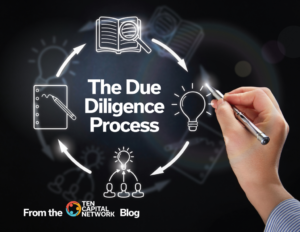
2 min read When embarking on a new investment, it’s essential to have a Due Diligence process in place to check the basics. This process will vary from deal to deal based on the risks associated with each one. Start by making a list of your concerns. In most cases, you’ll sign a terms sheet with funding contingent on due diligence. It helps to tell the company about your diligence process, such as what documents are required, what steps you take, and how long it will be, thereby eliminating the “how is it going” calls. There are three phases to diligence: Documentation Diligence, Team Diligence, and Domain Diligence. Documentation Diligence Ask the startup for a list of critical documents. If they are not all in one spot, ask the team to put them into a Google Drive folder, or create a more secure Box.com account. It’s common for startups to continually add to their diligence boxes and have many people view them simultaneously, so keeping everything in one place is very helpful. The primary documents should be: Entity filings and articles of incorporation Patent filings Income statement Balance sheet statement 3-5 year financial projections Cap table Other documents related to the business, such as lawsuits, product breakdowns, customer breakdowns, etc. should be requested. Read each document and check to see if it matches what you understood about the deal. Note any differences and ask for clarification. You must review the diligence documents so you understand the business. You may need to sign a Non Disclosure Agreement (NDA) for sensitive information. It’s standard practice to do so as the documentation should be kept confidential, even without an NDA in place. Team Diligence Thoroughly researching the startup’s team is the most critical part of the Due Diligence process. Meet with the team and assess their skills. In almost every startup failure, the investor can trace it back to the team not being up to the task. It may be the task was under-estimated by all upfront, but with the right team, the company can succeed. Gather references for the CEO and call them up to hear what they have to say about the founder, including management style, how they pivot, and their team dynamics. In most cases, you’ve heard the CEO pitch, but it’s essential to understand the CEO skills set, including what is there and what is not. The rest of the team needs to bring the necessary skills to succeed. Domain Diligence Let’s break this process down into steps: Research the competition to determine the company’s position in the marketplace Check the positioning of the company in the marketplace Identify the value proposition and how well it resonates with customers Look at their pricing compared to the competition Check the industry to see the conditions in which it will grow or decline Once you finish diligence and have your questions answered, ask for their wiring instructions Remember, break it down into baby steps Finally, use the model of “fast no’s and slow yes’s” in reviewing a deal, so the entrepreneur is not chasing you for a response. Read more: http://staging.startupfundingespresso.com/education/ Hall T. Martin is the founder and CEO of the TEN Capital Network.TEN Capital has been connecting startups with investors for over ten years. You can connect with Hall about fundraising, business growth, and emerging technologies via LinkedIn or email: hallmartin@tencapital.group

Your Data Room: What it is, and How to Build One

A data room, sometimes referred to as a “due diligence box,” is a cloud solution made for the sharing and securing of sensitive business information. A data room should not be confused with a simple cloud storing service. When handling confidential information, you’ll need features such as rights management and Q&A. The goal here is to maximize your fundraising potential by being organized and demonstrating that you respect the investor’s time by being prepared. Having a well-organized folder is also an opportunity to show investors that you have a real business and are ready to raise capital. This data room contains vital documents about your business and is incredibly useful to your potential investors, so it’s essential to keep it both functional and secure. The materials in your data room should include:  Entity filings Patent filings Articles of incorporation Income statements Balance sheet Other documents detailing your business  Investors who want to invest will look for these documents so they can run their due diligence on you and your business. The more simplified you can make this process for them, the better. Spend some time putting your data room together and make sure you have all the necessary documents for your investors. Most importantly, be prepared and have these documents ready before you begin your raise. Continue reading in our most recent eGuide: How to Prepare for Your Fundraise   Hall T. Martin is the founder and CEO of the TEN Capital Network.TEN Capital has been connecting startups with investors for over ten years. You can connect with Hall about fundraising, business growth, and emerging technologies via LinkedIn or email: hallmartin@tencapital.group  

Technical Due Diligence

1 min read Technical Due Diligence (TDD) is a detailed evaluation of a company’s technical side, including both existing software and hardware products and those in development. Potential investors need to gather detailed information about a prospective company to highlight any potential risks associated with their investment. While the Technical Due Diligence process may seem intimidating to some small business owners initially, it is, in fact, a routine step. If efficiently planned and executed, a TDD should be able to answer investor questions in easy-to-understand terms. Whether you are a potential investor, or a startup new to the process, the following article provides an insightful take on making the process work. When embarking on the TDD process, investors typically want to know about 4 major areas: Strategy: Does the company and its product(s) fit within the investor’s overall growth objectives? Does the company’s own strategy match up with the investors’ strategy? Quality: Are there quality issues with the company’s product that will require fixing? If product development or fixes are needed, what are the expected costs? Growth:  Is the company or its product poised for growth? What roadblocks would hinder growth in terms of labor, manufacturing, infrastructure, and/or development? Can the product be scaled? Stability:  Are the company founders and their employees in it for the long haul? Are their processes organized and well-documented? Are there contingency plans and redundancies in case of an unforeseen event? Read more: http://staging.startupfundingespresso.com/education/ Hall T. Martin is the founder and CEO of the TEN Capital Network.TEN Capital has been connecting startups with investors for over ten years. You can connect with Hall about fundraising, business growth, and emerging technologies via LinkedIn or email: hallmartin@tencapital.group

Site Map

Scroll to Top