
5 min read AI as a Domain Knowledge Expert: Market Opportunity Assessment
For decades, venture capital has rewarded investors who possessed something few others had: deep domain expertise. Whether evaluating a new cancer therapy, a novel semiconductor architecture, an energy storage breakthrough, or a revolutionary medical device, the most successful investors differentiated themselves through specialized knowledge. Their advantage came from understanding technologies that most generalist investors could not evaluate.
That model is beginning to change.
Artificial intelligence is transforming domain expertise from an individual capability into a scalable institutional resource. Rather than replacing experts, AI is becoming a domain knowledge expert that enables investors, founders, corporate development teams, and strategic acquirers to analyze complex technologies faster, more comprehensively, and with greater consistency than ever before.
The market opportunity is enormous.
The Information Explosion
Every scientific and technical field is experiencing exponential growth in knowledge.
Thousands of scientific papers are published every day. Patent databases continue to expand rapidly. Clinical trial registries, regulatory guidance documents, engineering standards, conference proceedings, technical blogs, and competitive announcements create a constant stream of new information.
No individual expert can absorb it all.
This creates a growing gap between the amount of information available and the amount any human can realistically process. Historically, organizations filled this gap by hiring more specialists. That approach is becoming increasingly expensive and increasingly ineffective.
AI changes the equation.
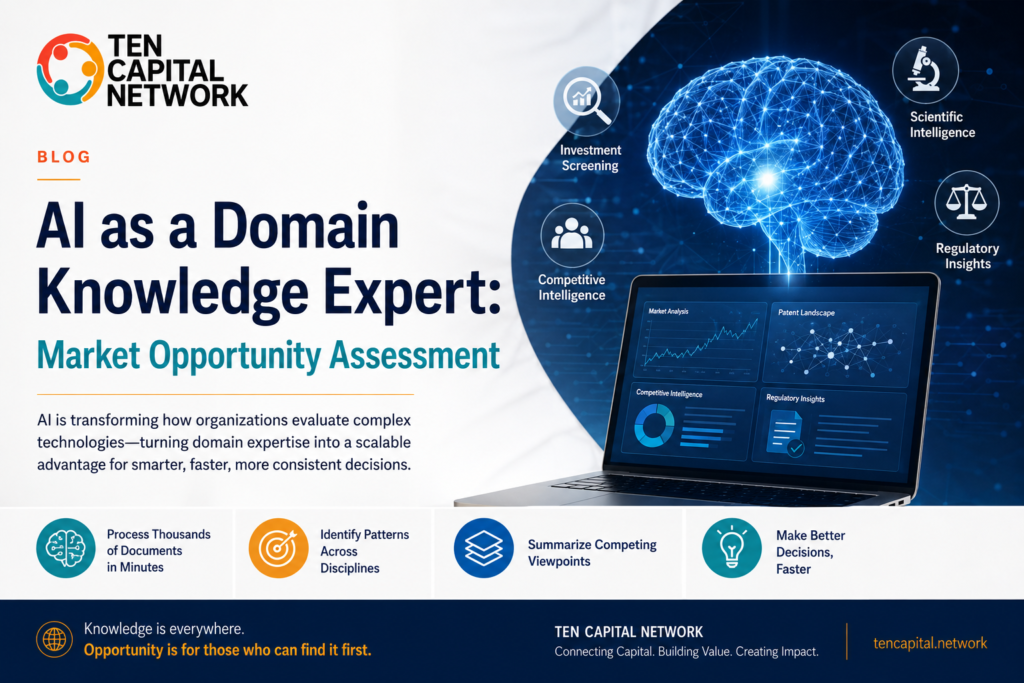
Large language models combined with retrieval systems can process thousands of technical documents in minutes, identify patterns across disciplines, summarize competing viewpoints, and organize information into coherent knowledge structures.
The result is not simply faster research—it is a new way of making decisions.
The Market Is Much Larger Than Venture Capital
While venture investing provides an obvious application, the addressable market extends far beyond investors.
Nearly every knowledge-intensive organization faces the same challenge: making high-quality decisions under conditions of overwhelming information complexity.
Potential customers include:
- Venture capital firms
- Private equity funds
- Family offices
- Corporate venture groups
- Pharmaceutical companies
- Medical device manufacturers
- Research universities
- Technology transfer offices
- Investment banks
- Consulting firms
- Government agencies
- Intellectual property firms
- Regulatory consulting organizations
Each organization spends significant resources evaluating technical opportunities. AI dramatically reduces the cost and time required for that analysis while improving consistency.
Domain Expertise Is Becoming Infrastructure
Traditionally, expertise has been viewed as a characteristic of individuals.
The future is likely to be different.
Organizations will increasingly treat domain knowledge as infrastructure.
Instead of asking whether a company employs enough experts, leaders will ask whether their organization has built the best knowledge system.
This shift resembles previous technological transitions.
Spreadsheets did not replace accountants.
Computer-aided design did not replace engineers.
Electronic medical records did not replace physicians.
Instead, each technology increased the productivity of skilled professionals.
AI is poised to do the same for domain experts.
Multiple High-Value Use Cases
The commercial applications extend across the entire innovation lifecycle.
Investment Screening
AI can rapidly analyze pitch decks, technical white papers, scientific publications, patents, competitive landscapes, and regulatory strategies to help investors prioritize opportunities.
Scientific Due Diligence
Biotechnology, life sciences, and advanced materials companies often require months of diligence. AI can synthesize evidence, compare mechanisms of action, identify competing technologies, and highlight unresolved scientific questions.
Regulatory Intelligence
Organizations can continuously monitor regulatory guidance, approval trends, predicate devices, safety communications, and evolving agency expectations.
Competitive Intelligence
AI can map patent landscapes, monitor competitor filings, identify adjacent technologies, and detect emerging market entrants.
Commercialization Assessment
Technical success alone does not create successful companies.
AI can analyze reimbursement, physician adoption, manufacturing complexity, customer demand, pricing dynamics, and market timing.
Each application represents an independent commercial opportunity.
Together they create a comprehensive decision-support platform.
Healthcare Represents the Largest Near-Term Opportunity
Biotechnology and medical technology are particularly attractive markets.
These industries combine several characteristics that favor AI-assisted analysis:
- Extremely large scientific literature
- High regulatory complexity
- Long commercialization timelines
- Expensive diligence processes
- Specialized expertise shortages
- High financial stakes
Investment decisions routinely involve tens or hundreds of millions of dollars.
Reducing uncertainty by even a small percentage creates substantial economic value.
Deep Tech Will Follow
The same pattern extends beyond healthcare.
Climate technology.
Energy storage.
Semiconductors.
Quantum computing.
Advanced manufacturing.
Defense technologies.
Robotics.
Space systems.
Synthetic biology.
In each of these markets, technical complexity exceeds the capacity of purely human analysis.
AI becomes a force multiplier for domain expertise.
The Business Model Opportunity
Several business models are emerging.
Software-as-a-Service platforms can provide continuous access to domain intelligence.
Enterprise subscriptions can support investment teams, research organizations, and corporate strategy groups.
Professional service firms can combine AI with human expertise to deliver higher-value advisory engagements.
Vertical AI platforms can specialize in specific industries such as oncology, medical devices, climate technology, or semiconductor manufacturing.
Over time, domain-specific knowledge platforms may become standard infrastructure across innovation-driven industries.
Competitive Advantages
The strongest AI knowledge platforms will differentiate themselves through proprietary data rather than model performance alone.
Examples include:
- Curated scientific databases
- Regulatory decision histories
- Clinical outcome repositories
- Proprietary diligence frameworks
- Historical investment outcomes
- Patent intelligence
- Commercialization benchmarks
These proprietary datasets become increasingly valuable as organizations accumulate years of institutional knowledge.
The more the system learns, the more difficult it becomes to replicate.
Challenges Remain
Despite the opportunity, several important limitations remain.
AI does not replace expert judgment.
Scientific literature contains errors, publication bias, and conflicting evidence.
Regulatory agencies exercise discretion.
Commercial adoption remains influenced by human behavior.
Novel technologies frequently lack historical precedent.
Organizations that rely exclusively on AI risk developing false confidence.
The winning model is likely to be hybrid.
AI performs large-scale synthesis and pattern recognition.
Human experts provide skepticism, context, creativity, and strategic judgment.
Together they create a stronger decision-making process than either could achieve independently.
Why the Timing Is Right
Several trends are converging simultaneously.
Foundation models have reached a level of technical capability sufficient for complex reasoning.
Scientific publishing continues to accelerate.
Organizations face increasing pressure to evaluate more opportunities with fewer resources.
Investment competition is intensifying.
Deep technology markets continue expanding.
Cloud infrastructure has dramatically lowered deployment costs.
These forces create favorable conditions for widespread adoption.
The Long-Term Vision
Over the next decade, AI-based domain expertise may become as fundamental to innovation as search engines became to information retrieval.
Organizations will maintain continuously updated knowledge graphs that integrate scientific research, patents, regulatory guidance, market intelligence, customer feedback, and competitive developments.
Rather than searching for information, professionals will interrogate living knowledge systems capable of explaining relationships, highlighting contradictions, and identifying emerging opportunities.
Decision-making becomes faster.
Diligence becomes deeper.
Knowledge becomes institutional rather than individual.
Conclusion
The greatest opportunity is not replacing experts.
It is multiplying their effectiveness.
Every industry built on specialized knowledge faces the same challenge: information is growing faster than human cognition can absorb it. AI provides a scalable solution by transforming fragmented information into actionable knowledge.
For investors, this means more informed capital allocation. For founders, it means stronger strategic planning. For corporations, it means faster innovation. For researchers, it means more productive discovery.
The firms that build AI-powered domain knowledge platforms today are not simply creating another productivity tool. They are building the analytical infrastructure that will support the next generation of scientific, technical, and commercial decision-making.
In the coming years, competitive advantage will depend less on who knows the most and more on who can integrate human expertise with machine intelligence most effectively.
That transition represents one of the largest market opportunities emerging from the AI revolution.