
5 min read Regulatory Pathway Analysis
AI is Becoming the Regulatory Expert Every Venture Firm Needs
For decades, regulatory expertise has been one of biotechnology’s most valuable—and most limited—resources.
A startup can possess breakthrough science, compelling preclinical data, and world-class researchers, yet still fail because it misunderstood the regulatory pathway. Investors have learned this lesson repeatedly. Scientific innovation alone rarely determines success. The ability to navigate FDA requirements, clinical evidence expectations, manufacturing standards, reimbursement strategy, and post-market obligations often determines whether a company reaches commercialization.
Historically, evaluating regulatory strategy required years of specialized experience. Venture firms relied on former FDA reviewers, regulatory consultants, clinical experts, and experienced operators to determine whether management’s proposed pathway was realistic.
Artificial intelligence is beginning to transform this process.
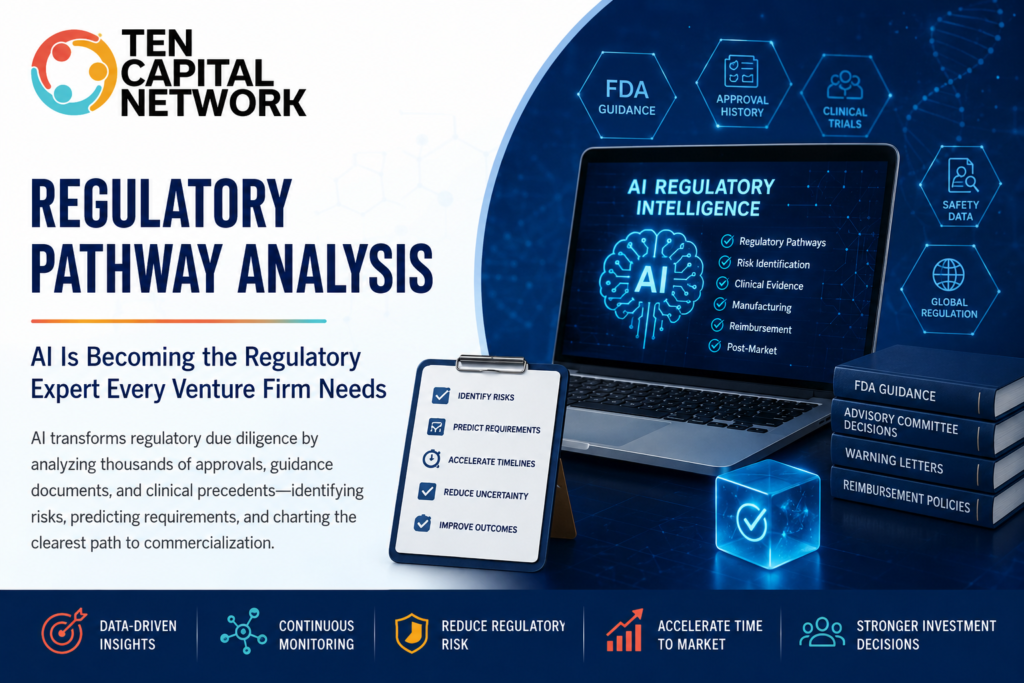
Rather than replacing regulatory professionals, AI is becoming a scalable regulatory knowledge platform capable of synthesizing decades of agency guidance, historical approvals, clinical trial precedents, warning letters, advisory committee decisions, reimbursement policies, and scientific publications into a continuously updated analytical framework.
The result is a fundamental shift in venture capital due diligence.
Regulatory Intelligence Is Becoming Data Science
Regulation has always been information intensive.
Every approval creates precedent.
Every clinical trial contributes evidence.
Every FDA guidance document establishes expectations.
Every adverse event shapes future review standards.
The problem is not the lack of information.
The problem is that no individual can absorb it all.
A traditional regulatory consultant might reference dozens of similar products when evaluating a new medical device.
AI can analyze thousands.
It can compare historical approvals across therapeutic classes, identify similarities in predicate devices, evaluate endpoint selection, review manufacturing requirements, and highlight common deficiencies that delayed previous submissions.
Instead of relying primarily on human memory, investors gain access to institutional-scale regulatory intelligence.
Beyond FDA Pathways
Most founders think of regulation as choosing between a 510(k), De Novo, PMA, IND, NDA, or BLA.
Experienced investors know the challenge is much broader.
The true regulatory pathway begins long before a submission and continues well after approval.
AI can assist across the entire lifecycle:
- Regulatory classification
- Predicate identification
- Clinical evidence requirements
- Endpoint selection
- Trial design
- Risk classification
- Manufacturing readiness
- Quality systems
- Human factors engineering
- Labeling strategy
- Reimbursement alignment
- Post-market surveillance
Each decision influences every subsequent milestone.
Poor regulatory planning compounds over time.
Strong regulatory planning accelerates commercialization.
Regulatory Due Diligence Is Becoming Continuous
Traditional diligence often treats regulation as a one-time review during fundraising.
That approach increasingly looks outdated.
Modern AI systems enable continuous monitoring of the regulatory environment.
New guidance documents…
Competitor approvals…
Safety communications…
Advisory committee outcomes…
Inspection trends…
Policy changes…
All become searchable and comparable almost immediately.
Rather than reviewing regulatory assumptions every six months, venture firms can monitor them continuously.
This dramatically reduces informational lag.
Identifying Hidden Regulatory Risk
Many investment failures stem not from poor science but from overlooked regulatory complexity.
Examples include:
- Inadequate clinical endpoints
- Weak statistical powering
- Manufacturing scalability issues
- Insufficient validation testing
- Human factors deficiencies
- Poor quality documentation
- Reimbursement misalignment
- Combination product complexity
- Software validation gaps
- Cybersecurity requirements
Each appears manageable independently.
Together they can delay commercialization by years.
AI excels at identifying these interconnected risks because it evaluates evidence across multiple domains simultaneously.
Learning From Every Approval
Regulatory agencies publish enormous amounts of information.
Approval summaries.
Decision memoranda.
Safety updates.
Inspection findings.
Guidance documents.
Clinical reviews.
Warning letters.
These collectively represent decades of institutional knowledge.
Historically, only highly experienced consultants could integrate these sources effectively.
AI changes the economics.
Large language models can organize regulatory history into searchable knowledge graphs that reveal patterns impossible to identify manually.
For investors, every previous approval becomes part of a continuously expanding reference library.
Commercialization Begins With Regulation
Regulatory approval is often viewed as the finish line.
In reality, it is merely the beginning.
Successful commercialization depends on regulatory decisions made years earlier.
Clinical endpoints influence reimbursement.
Label claims influence physician adoption.
Manufacturing controls influence gross margins.
Quality systems influence scalability.
International regulatory strategy influences expansion opportunities.
The strongest companies integrate regulatory planning directly into commercial strategy from the earliest stages.
AI makes these interactions increasingly visible.
Instead of analyzing regulation and commercialization independently, investors can evaluate their combined impact.
Better Questions, Not Just Faster Answers
One misconception surrounding AI is that it provides definitive answers.
It does not.
Its greatest value lies in improving the questions investors ask.
Rather than accepting management’s proposed pathway, AI encourages deeper investigation.
Why was this endpoint selected?
Have similar companies failed using this design?
What alternative predicates exist?
How have regulators viewed analogous technologies?
What manufacturing issues delayed comparable products?
These questions improve diligence quality.
Human judgment remains essential.
AI simply expands the scope of inquiry.
Regulatory Confidence Can Be Misleading
One of AI’s greatest strengths is also one of its greatest risks.
Modern language models generate remarkably persuasive explanations.
Unfortunately, regulatory certainty does not always reflect regulatory reality.
Agencies frequently exercise discretion.
Guidance evolves.
Scientific standards change.
Novel technologies create entirely new questions.
An AI-generated regulatory strategy should never be mistaken for regulatory advice.
Instead, it should function as an analytical assistant that prepares founders and investors for more productive discussions with experienced regulatory professionals.
The Hybrid Future
The future is unlikely to be fully automated.
Instead, successful venture firms will combine three complementary capabilities.
First, AI systems capable of synthesizing massive regulatory datasets.
Second, experienced regulatory experts who understand nuance, agency behavior, and practical execution.
Third, investment professionals capable of translating regulatory insight into commercial risk assessment.
Together these create a far stronger diligence process than any one capability alone.
A Competitive Advantage in Capital Allocation
The venture industry has traditionally rewarded firms with the deepest networks of scientific advisors.
Tomorrow’s leaders may instead possess the strongest knowledge infrastructure.
AI reduces the cost of accessing regulatory intelligence.
It democratizes expertise that was once available only to elite firms.
Smaller venture funds can perform sophisticated regulatory analysis.
Corporate venture groups can evaluate larger pipelines.
Family offices can conduct independent diligence.
Founders can pressure-test their own strategies before approaching investors.
This raises the overall quality of capital allocation.
Weak regulatory assumptions become easier to identify.
Strong regulatory planning becomes easier to validate.
Both outcomes improve investment decision-making.
Looking Ahead
Regulatory agencies are not becoming simpler.
Medical technologies continue to increase in complexity.
Artificial intelligence, digital therapeutics, gene editing, personalized medicine, robotics, combination products, and software-defined devices are stretching traditional regulatory frameworks.
As complexity grows, the value of scalable regulatory intelligence grows alongside it.
The future regulatory expert may spend less time searching for information and more time interpreting it.
The future venture partner may spend less time collecting evidence and more time evaluating competing interpretations.
AI is not replacing regulatory judgment.
It is amplifying it.
Just as scientific knowledge has become too vast for any individual researcher to master, regulatory knowledge is becoming too extensive for any single advisor to contain.
The firms that combine machine-scale information processing with experienced human judgment will likely make better investment decisions, identify risks earlier, and help portfolio companies navigate commercialization more efficiently.
In venture capital, regulatory insight has always been a competitive advantage.
AI is transforming that advantage from an individual capability into an institutional one.
The firms that build those systems today will shape the next generation of biotechnology investing.