
7 min read IP and Defensibility Review
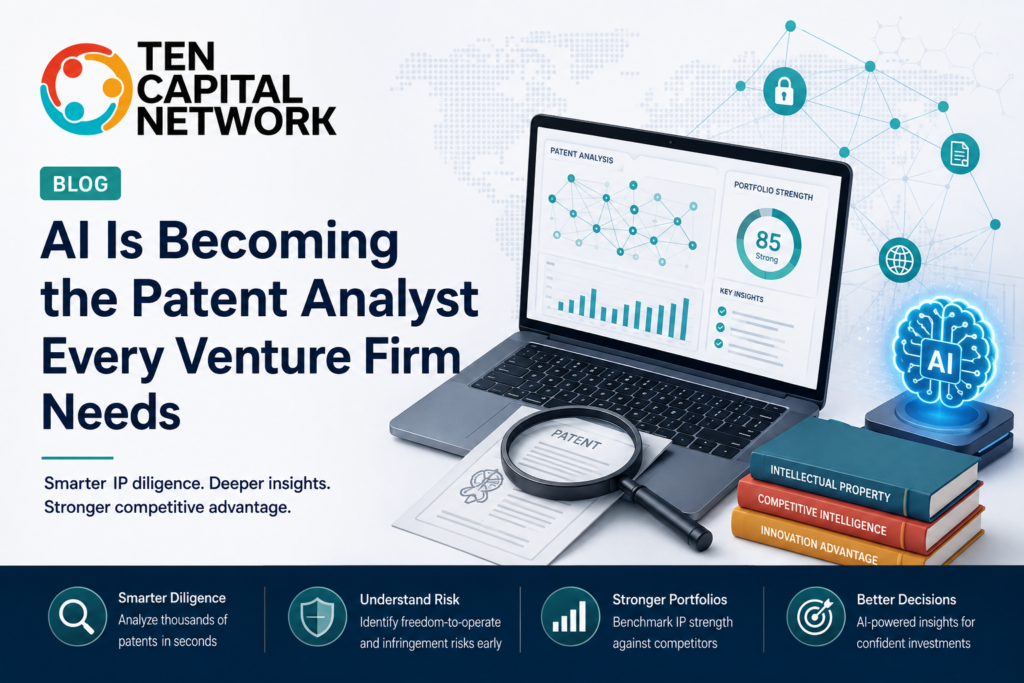
AI Is Becoming the Patent Analyst Every Venture Firm Needs
For decades, intellectual property has been one of the most important—and least understood—drivers of startup value.
Investors routinely ask founders, “Do you have patents?” Yet experienced venture capitalists know that the better question is, “Do you have a defensible competitive advantage?”
A startup can possess an impressive patent portfolio and still be vulnerable to competitors. Conversely, another company may have only a handful of patents yet possess an extraordinarily durable market position through proprietary data, manufacturing know-how, regulatory barriers, network effects, or trade secrets.
The challenge has always been separating intellectual property from genuine defensibility.
Artificial intelligence is beginning to change that equation.
Rather than replacing patent attorneys or IP strategists, AI is becoming a scalable knowledge platform capable of analyzing patents, scientific publications, competitive products, licensing agreements, regulatory filings, litigation history, standards development, and technology trends simultaneously. The result is a fundamental shift in how investors evaluate competitive advantage.
Patents Are Only One Piece of Defensibility
Founders often equate defensibility with patents.
Investors know the picture is far more complex.
A patent protects an invention only if it is novel, enforceable, and difficult to design around. Many patents provide narrow protection that competitors can avoid with modest engineering changes. Others expire long before a company achieves meaningful market penetration.
True defensibility is broader. It may include proprietary algorithms, exclusive datasets, manufacturing processes, clinical evidence, regulatory approvals, customer relationships, distribution networks, or operational expertise. AI enables investors to evaluate these assets together rather than in isolation.
From Patent Search to Competitive Intelligence
Traditional IP diligence required teams of attorneys and technical experts to manually search patent databases, compare claims, review prior art, and identify potential infringement risks.
AI dramatically expands this capability.
Modern systems can examine thousands of patents across multiple jurisdictions, compare claim language, identify overlapping technologies, detect emerging competitors, and monitor new patent filings as they appear. Rather than reviewing a few dozen documents, investors can analyze entire technology ecosystems.
This shifts IP diligence from static document review to dynamic competitive intelligence.
Understanding Freedom to Operate
Owning patents does not necessarily mean a company has the freedom to commercialize its product.
Freedom-to-operate (FTO) analysis asks a different question: Can the company bring its product to market without infringing on someone else’s intellectual property?
This distinction is critical.
AI can identify potentially conflicting patent families, map ownership across competitors, monitor licensing activity, and highlight technologies that may require licensing or redesign. While legal experts remain essential for formal FTO opinions, AI helps investors identify issues earlier in the diligence process.
Measuring the Strength of an IP Portfolio
Not all patent portfolios are created equal.
A robust portfolio often demonstrates several characteristics:
- Broad claim coverage
- Multiple patent families
- International protection
- Continuation strategies
- Strong citation history
- Alignment with the core technology
- Clear commercial relevance
AI can benchmark these characteristics against competitors, providing investors with a more objective assessment of portfolio quality.
More importantly, it can identify gaps that may weaken long-term competitive positioning.
Looking Beyond Patents
Many of today’s most valuable companies derive their advantage from assets that cannot easily be patented.
Large proprietary datasets.
Machine learning models.
Clinical outcome databases.
Manufacturing expertise.
Supply chain optimization.
Customer usage patterns.
Operational workflows.
Trade secrets.
These forms of intellectual capital often create stronger barriers to entry than patents alone.
AI is uniquely suited to evaluating these intangible assets because it can connect technical, commercial, and operational information into a single analytical framework.
AI Reveals Hidden Competitive Risks
One of AI’s greatest contributions is its ability to identify risks that may not be immediately visible.
Examples include:
- Patent claim overlap
- Crowded technology spaces
- Rapid competitor filing activity
- Weak differentiation
- Expiring core patents
- Heavy dependence on licensed technology
- Litigation exposure
- Geographic protection gaps
- Limited trade secret protection
- Weak data exclusivity
Each risk may appear manageable independently.
Together they can significantly reduce long-term enterprise value.
By integrating multiple sources of information, AI helps investors recognize these patterns before they become costly surprises.
Defensibility Extends Into Commercialization
A company’s competitive moat does not end with product development.
Commercial execution often creates additional barriers.
Regulatory approvals can delay competitors for years.
Clinical evidence can influence physician adoption.
Manufacturing expertise can reduce costs while improving quality.
Distribution relationships can limit market access for new entrants.
Customer integrations can increase switching costs.
AI helps investors evaluate how these advantages reinforce one another, creating a more durable competitive position over time.
Better Questions Lead to Better Investments
AI does not eliminate the need for experienced IP counsel.
Instead, it improves the quality of the questions investors ask.
How easily can competitors design around these claims?
Which patents truly protect the core technology?
Are there dominant patent holders in adjacent markets?
Is the company’s value concentrated in a single patent family?
What happens when the earliest patents expire?
Could proprietary data become a stronger competitive moat than intellectual property alone?
These questions elevate diligence from document review to strategic analysis.
The Risk of Synthetic Confidence
AI also introduces new challenges.
Large language models can generate persuasive analyses that appear authoritative even when based on incomplete information.
Patent law is highly nuanced.
Claim interpretation depends on prosecution history, jurisdiction, judicial precedent, and technical context.
An AI-generated IP assessment should never replace qualified legal review.
Instead, it should serve as an intelligent assistant that accelerates information gathering and highlights areas requiring expert attention.
The Hybrid Future of IP Due Diligence
The future of intellectual property analysis is unlikely to be fully automated.
Instead, successful investment firms will combine three complementary capabilities:
- AI systems capable of analyzing vast patent and technical datasets.
- Experienced patent attorneys and technical experts who understand legal nuance.
- Investment professionals who translate IP strength into commercial value.
Together, these capabilities produce a far more comprehensive assessment than any single approach alone.
A New Competitive Advantage for Venture Firms
Historically, only the largest venture firms could afford extensive patent analysis supported by specialized legal advisors.
AI democratizes much of that capability.
Smaller funds can evaluate complex IP portfolios.
Family offices can conduct more rigorous technical diligence.
Corporate investors can screen larger numbers of opportunities.
Founders can strengthen their IP strategies before fundraising.
As a result, intellectual property evaluation becomes faster, broader, and more evidence-based.
Looking Ahead
Innovation is accelerating across biotechnology, artificial intelligence, robotics, advanced materials, climate technology, and medical devices.
At the same time, patent filings continue to increase, technology convergence is blurring traditional industry boundaries, and competitive landscapes are becoming more complex.
No individual investor can keep pace through manual analysis alone.
AI is becoming the institutional memory layer for intellectual property and competitive strategy.
It does not replace legal judgment, technical expertise, or strategic thinking.
It amplifies them.
The venture firms that integrate AI-driven IP intelligence with experienced legal and commercial insight will likely make better investment decisions, identify hidden risks earlier, and allocate capital more effectively.
Ultimately, patents remain important.
But investors are not funding patents.
They are funding sustainable competitive advantage.
In the AI era, understanding the difference may become one of venture capital’s greatest competitive advantages.