
7 min read How to Use the Startup Success Forecasting Framework
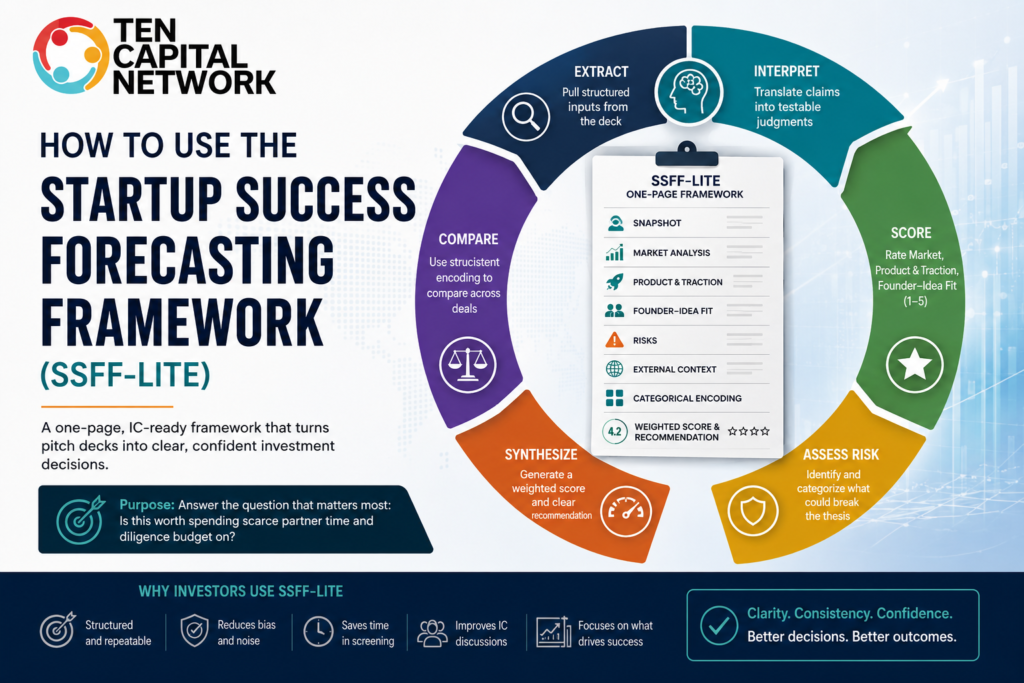
Most early-stage investment decisions fail for two opposite reasons: we over-index on storytelling (and miss structural weaknesses), or we drown in details (and fail to make a crisp decision). The Startup Success Forecasting Framework (SSFF-Lite) is designed to do neither. It forces you to translate a pitch deck into a one-page, IC-ready judgment: what the company is, why it wins, what can break, and whether the bet is worth making right now.
This article shows you how to use SSFF-Lite in practice, fast, repeatable, and decision-oriented, and without copying deck language or slipping into founder-friendly marketing.
What SSFF-Lite is (and what it isn’t)
SSFF-Lite is a disciplined compression tool. It converts slide content into a structured memo with:
- Three core scores (Market, Product & Traction, Founder–Idea Fit)
- A risk categorization table
- A categorical feature encoding (so you can compare companies consistently)
- A short external context check
- A weighted composite score and a clear recommendation
It is not a full diligence report. It’s a first-pass investment committee artifact that answers:
“Is this worth spending scarce partner time and diligence budget on?”
The operating principle: interpret, don’t transcribe
Pitch decks are persuasion documents. SSFF-Lite is an evaluation document. That means:
- Don’t copy slide phrases (“world-class,” “disrupting,” “only platform”). Translate them into testable claims.
- When data is missing, state assumptions explicitly—don’t fill gaps with optimism.
- If numbers are unclear, inflated, or inconsistent across slides, flag credibility risk.
Your job is not to be “fair.” Your job is to be accurate under uncertainty.
Step 1: Extract structured inputs (10–20 minutes)
Before you score anything, build a clean fact base. SSFF-Lite starts with a structured extraction because bad evaluation often comes from messy inputs.
Create a scratchpad and pull these items from the deck:
Company identity
- Company Name
- Sector / Subsector (be specific—“Fintech” is not specific)
- Stage (inferable via traction, product maturity, fundraising ask)
What it sells and to whom
- Business model (SaaS, marketplace, usage-based, services wrapper, etc.)
- Target customer (title + segment + buyer/user distinction)
- Revenue model (pricing units, contract size, payment terms)
Problem and product
- Core problem (1–2 sentences, precise and painful)
- Product description (what it does; how it fits in workflow; why now)
Traction metrics (only if provided; otherwise say “Not provided”)
- Revenue, growth rate, retention, CAC/LTV, pipeline, margins, engagement
- If metrics are missing but logos exist: treat that as distribution evidence, not PMF
Team
- Founders & background: prior wins/losses, domain depth, technical capability, credibility signals
- Note team gaps (e.g., sales-led motion but no GTM leader)
Market and competition
- TAM/SAM/SOM (if provided; sanity check definitions)
- Market growth claims and timing narrative
- Competitors named and implied (including “do nothing”)
- Differentiation and moat claims (translate into mechanisms)
External context signals
- Industry shifts (regulatory change, platform shift, AI enabling wave, supply constraints)
- Funding environment referenced (if any)
If anything is not explicitly stated: infer cautiously, label it as Assumption, and keep it falsifiable.
Pro tip: separate your extraction into two columns:
- Deck claims
- Your interpretation
This keeps you honest and prevents accidental marketing copy.
Step 2: Write the SSFF-Lite memo (the one-page discipline)
Now you convert inputs into judgment, section by section.
1) Snapshot (VC-scout layer)
This is your fastest summary of the company’s shape:
- Sector classification
- Stage assessment (inferred)
- Business model clarity (clear / semi-clear / unclear)
- Core problem (precise, no fluff)
- Outcome delivered (measurable if possible)
Think of this as the “triage paragraph” an IC member reads first. If you can’t write it cleanly, you don’t understand the business yet.
Scoring: how to assign 1–5 without fooling yourself
SSFF-Lite asks you to score Market, Product & Traction, and Founder–Idea Fit from 1 to 5. The point isn’t false precision—it’s consistency.
2) Market Analysis (Score 1–5)
Evaluate four things:
- Market size: niche / mid-size / large / massive
- Growth phase: early / inflecting / accelerating / mature
- Competitive intensity: low / moderate / high
- Structural moat: none / emerging / defensible
Write one analytical paragraph that answers:
- Is this a big outcome space or a constrained pond?
- Is the wave growing or stagnant?
- Are there entrenched incumbents or commodity competition?
- Is there a structural advantage available (data, network effects, regulation, switching costs)?
Scoring guidance
- 1: structurally limited, hard ceiling, or brutal incumbent dominance
- 3: credible market, but competitive and not structurally advantaged
- 5: large + fast-growing + a real path to structural advantage
Avoid giving a 5 just because TAM is large. TAM slides are often aspirational.
3) Product & Traction (Score 1–5)
Evaluate:
- Value proposition clarity (can you explain it in one sentence?)
- Product maturity (MVP / early revenue / scaling / mature)
- Evidence of PMF (none / early signals / retention proof / expansion proof)
- Execution velocity (shipping, sales cycle learning, iteration cadence)
Use actual metrics if available. If not, be explicit: “Traction metrics not provided; evidence limited to logos and pilot claims.”
Scoring guidance
- 1: vague product, no proof, long path to adoption
- 3: functioning product + early demand signals, but PMF unproven
- 5: retention/expansion proof and clear scaling motion
4) Founder–Idea Fit (FIFS) (Score 1–5)
Assess:
- Domain alignment (lived pain or deep operator experience)
- Insight advantage (why this team sees the wedge others don’t)
- Technical/operational credibility (can they build and ship?)
- Commitment signals (time, focus, sacrifices)
- Team completeness (or clear plan to fill gaps)
Scoring guidance
- 1: weak alignment, generic story
- 3: relevant experience, credible builders
- 5: deep, unfair advantage (domain network + technical edge + insight)
5) Risk categorization table (make risks legible)
Create a table with:
- Market Risk
- Product Risk
- Execution Risk
- Capital Intensity
- Regulatory Risk
Label each Low/Medium/High and add a one-line why.
This forces you to distinguish between:
- “We don’t like it” (vibes)
- “It can break here” (mechanism)
Example (in plain language):
- Execution risk: High — enterprise sales motion with no senior GTM leader; long cycles could stall learning.
6) Structured feature encoding (so you can compare companies)
This is a categorical summary with no narrative:
- Market Size: Small / Mid / Large
- Market Growth: Slow / Moderate / Fast
- Competition Intensity: Low / Medium / High
- Product Differentiation: Weak / Moderate / Strong
- Founder Experience: Limited / Relevant / Expert
- Traction Level: None / Early / Scaling
Why this matters: when you’ve done 30 of these memos, feature encoding lets you compare “shapes” across deals quickly.
7) External context assessment (3–5 sentences)
Answer:
- Does macro/funding/industry context strengthen or weaken the thesis?
- Is timing favorable (regulatory change, platform shift, buyer urgency, budget cycles)?
- Any headwinds that directly slow adoption or compress multiples?
Don’t overthink this. It’s a pressure test, not a research report.
8) Integrated assessment: weighted score + recommendation
Use weighted scoring:
- Market 30%
- Product 30%
- Founder–Idea Fit 25%
- External Context 15%
Show the calculation clearly (no hand-waving). Then write 5–7 sentences that cover:
- Why this matters
- What must go right
- Primary risk
- Why this team can/cannot win
- Clear recommendation: Invest / Pass / Monitor
Rule of thumb
- Invest when you have: big market + real wedge + credible team + early proof
- Monitor when one key piece is missing but plausibly fixable soon
- Pass when the constraints are structural (market ceiling, commodity product, or team mismatch)
Common failure modes (and how to avoid them)
- Confusing pilots with PMF
Logos without retention/expansion are not proof. Treat them as interest, not adoption.
- Believing TAM math
If TAM requires multiple adjacent markets to become one, discount heavily.
- Calling “AI” a moat
Moat is distribution, workflow lock-in, data advantage, or switching costs—not a model choice.
- Skipping the “what must go right” sentence
If you can’t state the critical path, you can’t evaluate risk.
- Over-scoring charismatic founders
FIFS should be about unfair advantage, not presence.
>>>>>>>>>>>>>>>>>>>>>>>>>>>>>>>
Prompt
MASTER PROMPT: Generate SSFF-Lite IC Memo from a Pitch Deck
You are an experienced venture capital partner trained in structured early-stage evaluation.
You will be given a startup pitch deck (PDF, slides, or pasted slide text).
Your task is to:
- Extract the relevant information from the deck.
- Structure it into an SSFF-Lite (Startup Success Forecasting Framework – Lite) memo.
- Produce a one-page, Investment Committee–ready analysis.
- Be analytical, concise, and decision-oriented.
- Avoid marketing language.
- Do not copy slide language verbatim — interpret and synthesize.
- If data is missing, state assumptions clearly.
STEP 1: Extract Structured Inputs from the Deck
From the pitch deck, extract and summarize:
- Company Name
- Sector / Subsector
- Stage (if inferable)
- Business Model
- Target Customer
- Revenue Model
Core Problem (1–2 sentences)
Product Description (clear and specific)
Traction Metrics (if provided):
- Revenue
- Growth Rate
- Retention
- CAC/LTV
- Pipeline
Founders & Background:
- Prior experience
- Domain relevance
- Technical capability
Market Data:
- TAM/SAM/SOM (if provided)
- Market growth claims
- Timing narrative
- Competitive Landscape:
- Named competitors
- Claimed differentiation
- Moat claims
- External Context Signals:
- Industry trends referenced
- Regulatory environment
- Funding environment (if cited)
If any section is not explicitly stated, infer cautiously and label as assumption.
STEP 2: Generate SSFF-Lite Memo
After extracting structured inputs, generate the following:
- Snapshot (VC-Scout Layer)
Provide:
- Sector classification
- Stage assessment (inferred if needed)
- Business model clarity
- Core problem (precise)
- Outcome delivered (measurable if possible)
- Market Analysis (Score 1–5)
Evaluate:
- Market size (Niche / Mid-Size / Large / Massive)
- Growth phase (Early / Inflecting / Accelerating / Mature)
- Competitive intensity (Low / Moderate / High)
- Structural moat (None / Emerging / Defensible)
Provide:
- 1 analytical paragraph
- Market Score (1–5)
- Brief justification
Scoring guidance:
1 = Structurally limited
3 = Credible but competitive
5 = Large, fast-growing, advantaged
- Product & Traction (Score 1–5)
Evaluate:
- Value proposition clarity
- Product maturity (MVP / Early Revenue / Scaling / Mature)
- Evidence of PMF (None / Early signals / Retention proof / Expansion proof)
- Execution velocity
- Use actual metrics from the deck where available.
Provide:
- Analytical paragraph
- Product Score (1–5)
- Justification
- Founder–Idea Fit (FIFS) (Score 1–5)
Assess:
- Domain alignment
- Insight advantage
- Technical/operational credibility
- Commitment signals
- Team completeness
Provide:
- Analytical paragraph
- Founder–Idea Fit Score (1–5)
- Justification
Scoring guidance:
1 = Weak alignment
3 = Relevant experience
5 = Deep, unfair advantage
- Risk Categorization Table
Create a table with:
- Market Risk
- Product Risk
- Execution Risk
- Capital Intensity
- Regulatory Risk
Label each: Low / Medium / High
Add 1-line explanation per risk.
- Structured Feature Encoding (Categorical Summary)
Categorize the startup:
- Market Size: Small / Mid / Large
- Market Growth: Slow / Moderate / Fast
- Competition Intensity: Low / Medium / High
- Product Differentiation: Weak / Moderate / Strong
- Founder Experience: Limited / Relevant / Expert
- Traction Level: None / Early / Scaling
- No narrative here.
- External Context Assessment
In 3–5 sentences:
Does current macro/funding/industry data strengthen or weaken the thesis?
Is timing favorable?
- Integrated Assessment
Use weighted scoring:
- Market (30%)
- Product (30%)
- Founder–Idea Fit (25%)
- External Context (15%)
- Show calculation clearly.
Provide:
- Composite Score (1–5)
- 5–7 sentence IC narrative including:
- Why this matters
- What must go right
- Primary risk
- Why this team can/cannot win
- Clear recommendation: Invest / Pass / Monitor
OUTPUT RULES
Total length: 700–900 words.
Professional IC tone.
No promotional phrasing.
If slides contain contradictions, flag them.
If numbers look inflated or unclear, highlight credibility concerns.
Prioritize analytical synthesis over summary.