
How to Use the Startup Success Forecasting Framework
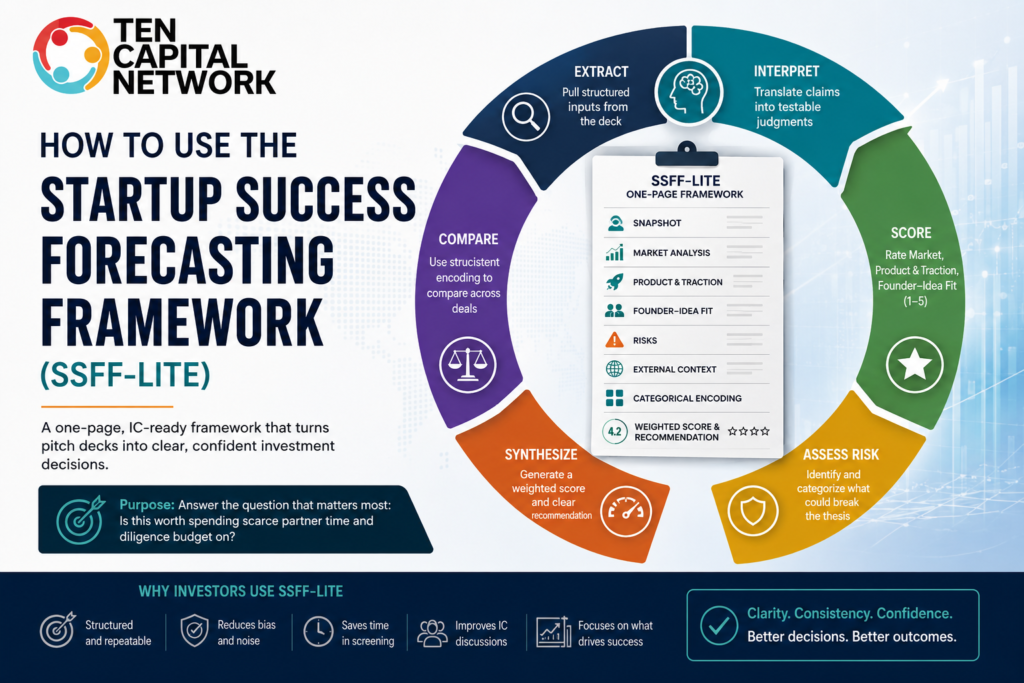
7 min read How to Use the Startup Success Forecasting Framework Most early-stage investment decisions fail for two opposite reasons: we over-index on storytelling (and miss structural weaknesses), or we drown in details (and fail to make a crisp decision). The Startup Success Forecasting Framework (SSFF-Lite) is designed to do neither. It forces you to translate a pitch deck into a one-page, IC-ready judgment: what the company is, why it wins, what can break, and whether the bet is worth making right now. This article shows you how to use SSFF-Lite in practice, fast, repeatable, and decision-oriented, and without copying deck language or slipping into founder-friendly marketing. What SSFF-Lite is (and what it isn’t) SSFF-Lite is a disciplined compression tool. It converts slide content into a structured memo with: Three core scores (Market, Product & Traction, Founder–Idea Fit) A risk categorization table A categorical feature encoding (so you can compare companies consistently) A short external context check A weighted composite score and a clear recommendation It is not a full diligence report. It’s a first-pass investment committee artifact that answers: “Is this worth spending scarce partner time and diligence budget on?” The operating principle: interpret, don’t transcribe Pitch decks are persuasion documents. SSFF-Lite is an evaluation document. That means: Don’t copy slide phrases (“world-class,” “disrupting,” “only platform”). Translate them into testable claims. When data is missing, state assumptions explicitly—don’t fill gaps with optimism. If numbers are unclear, inflated, or inconsistent across slides, flag credibility risk. Your job is not to be “fair.” Your job is to be accurate under uncertainty. Step 1: Extract structured inputs (10–20 minutes) Before you score anything, build a clean fact base. SSFF-Lite starts with a structured extraction because bad evaluation often comes from messy inputs. Create a scratchpad and pull these items from the deck: Company identity Company Name Sector / Subsector (be specific—“Fintech” is not specific) Stage (inferable via traction, product maturity, fundraising ask) What it sells and to whom Business model (SaaS, marketplace, usage-based, services wrapper, etc.) Target customer (title + segment + buyer/user distinction) Revenue model (pricing units, contract size, payment terms) Problem and product Core problem (1–2 sentences, precise and painful) Product description (what it does; how it fits in workflow; why now) Traction metrics (only if provided; otherwise say “Not provided”) Revenue, growth rate, retention, CAC/LTV, pipeline, margins, engagement If metrics are missing but logos exist: treat that as distribution evidence, not PMF Team Founders & background: prior wins/losses, domain depth, technical capability, credibility signals Note team gaps (e.g., sales-led motion but no GTM leader) Market and competition TAM/SAM/SOM (if provided; sanity check definitions) Market growth claims and timing narrative Competitors named and implied (including “do nothing”) Differentiation and moat claims (translate into mechanisms) External context signals Industry shifts (regulatory change, platform shift, AI enabling wave, supply constraints) Funding environment referenced (if any) If anything is not explicitly stated: infer cautiously, label it as Assumption, and keep it falsifiable. Pro tip: separate your extraction into two columns: Deck claims Your interpretation This keeps you honest and prevents accidental marketing copy. Step 2: Write the SSFF-Lite memo (the one-page discipline) Now you convert inputs into judgment, section by section. 1) Snapshot (VC-scout layer) This is your fastest summary of the company’s shape: Sector classification Stage assessment (inferred) Business model clarity (clear / semi-clear / unclear) Core problem (precise, no fluff) Outcome delivered (measurable if possible) Think of this as the “triage paragraph” an IC member reads first. If you can’t write it cleanly, you don’t understand the business yet. Scoring: how to assign 1–5 without fooling yourself SSFF-Lite asks you to score Market, Product & Traction, and Founder–Idea Fit from 1 to 5. The point isn’t false precision—it’s consistency. 2) Market Analysis (Score 1–5) Evaluate four things: Market size: niche / mid-size / large / massive Growth phase: early / inflecting / accelerating / mature Competitive intensity: low / moderate / high Structural moat: none / emerging / defensible Write one analytical paragraph that answers: Is this a big outcome space or a constrained pond? Is the wave growing or stagnant? Are there entrenched incumbents or commodity competition? Is there a structural advantage available (data, network effects, regulation, switching costs)? Scoring guidance 1: structurally limited, hard ceiling, or brutal incumbent dominance 3: credible market, but competitive and not structurally advantaged 5: large + fast-growing + a real path to structural advantage Avoid giving a 5 just because TAM is large. TAM slides are often aspirational. 3) Product & Traction (Score 1–5) Evaluate: Value proposition clarity (can you explain it in one sentence?) Product maturity (MVP / early revenue / scaling / mature) Evidence of PMF (none / early signals / retention proof / expansion proof) Execution velocity (shipping, sales cycle learning, iteration cadence) Use actual metrics if available. If not, be explicit: “Traction metrics not provided; evidence limited to logos and pilot claims.” Scoring guidance 1: vague product, no proof, long path to adoption 3: functioning product + early demand signals, but PMF unproven 5: retention/expansion proof and clear scaling motion 4) Founder–Idea Fit (FIFS) (Score 1–5) Assess: Domain alignment (lived pain or deep operator experience) Insight advantage (why this team sees the wedge others don’t) Technical/operational credibility (can they build and ship?) Commitment signals (time, focus, sacrifices) Team completeness (or clear plan to fill gaps) Scoring guidance 1: weak alignment, generic story 3: relevant experience, credible builders 5: deep, unfair advantage (domain network + technical edge + insight) 5) Risk categorization table (make risks legible) Create a table with: Market Risk Product Risk Execution Risk Capital Intensity Regulatory Risk Label each Low/Medium/High and add a one-line why. This forces you to distinguish between: “We don’t like it” (vibes) “It can break here” (mechanism) Example (in plain language): Execution risk: High — enterprise sales motion with no senior GTM leader; long cycles could stall learning. 6) Structured feature encoding (so you can compare companies) This is a categorical summary with no narrative: Market Size: Small / Mid / Large Market
How to Use the Startup Success Forecasting Framework Read More »