

Startup Funding

Search Startupfunding above or view our

TEN Investors Income Syndicate

Angel groups in the 1990s were based on the sponsor model. In the 2000s they moved to the membership model. Today, they operate on the syndicate model.  Investors line up around deals by sector and stage to share the funding round. TEN Capital now has a series of syndicates and one of the most popular is the TEN Income Syndicate which funds deals generating income for the investor rather than long term gains.  While most angels still want to hold equity in a startup, there is a portfolio play here by diversifying some of your investments into cash generating investments. The TEN Income Syndicate provides monthly or quarterly income from investments from loans and revenue based funding deals. The criteria for revenue-based funding investment includes: $1M revenue run rate Tech-enabled business Gross Margin > 50% Growth rate > 30% annually In a revenue-based funding deal, the company pays back a percent of revenue each month till a predetermined return is achieved. The TEN Income Syndicate uses a 3% scaling to 5% payback rate. For a $100K investment example, the payback plan is an initial revenue payout percentage of 3% of gross sales that scales to 5% by year 2. Year 1 – at least 35K Year 2 – at least 65K Year 3 – at least 70K Year 4 – at least 80K Plus 1-2 points of equity (listed as a warrant) Payback in 3-5 years Early payback comes at a lower return. The turnaround on an RBF deal is quite short compared to an equity deal. Funding decisions are made within 5 days of submitting financials and funds are transferred within 10 days of a funding decision. You can learn more at this link: http://staging.startupfundingespresso.com/ten-income-syndicate Hall T. Martin is the founder of TEN Capital and a builder of entrepreneur ecosystems by startup funding through angel networks, funding portals, syndicates, and more.  Connect with him about fundraising, business growth, and emerging technologies.

Read More »

TEN Investors- The Healthcare Syndicate

I receive calls daily about the TEN Investor Syndicates- in particular the healthcare syndicate. For those raising funding or interested in investing in healthcare startups and growth companies, here’s more information about their investing criteria. Revenue- The company needs to have more than a $500K annual revenue run rate. Typically, the investors want $1M revenue but the exits in the healthcare space tend to outstrip everything else that the investors will engage earlier than usual. Growth is king- you must have a growth story. The investors monitor the progress of the startup over two to three months to see the momentum and traction. As the saying goes, investors don’t invest in “dots”, they invest in “lines.” Huge forecasts don’t count for much unless they are grounded in some historical reality. Proven team- if this is your first go-around it’s going to be tough. They want someone on the team who has been there and done that at least once. Competitive Advantage- They are going to ask about your competitive advantage and a handful of patents will not suffice. You’ll need a competitive advantage that either gives you a 30% increase in revenue over the competition or a 30% reduction in cost. Many of the members of the healthcare syndicate are physicians so they understand the applications and the space very well. They evaluate deals from the physician’s point of view and ask how does this make the physician’s life easier and how does it profit the physician. In summary, the TEN Investors look for a growth story underway and: $500K revenue run rate Strong growth rates Proven team Competitive advantage If you meet these criteria, please contact TEN Capital, and let’s start a discussion.   Hall T. Martin is the founder of TEN Capital and a builder of entrepreneur ecosystems by startup funding through angel networks, funding portals, syndicates, and more.  Connect with him about fundraising, business growth, and emerging technologies.
Read More »

Blockchain and ICOs on the Crossing the Chasm Curve

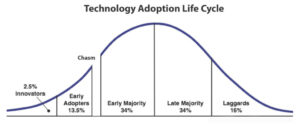
Crossing the Chasm teaches us that the initial users of a new product (called innovators and early adopters) are separated by a gap from the majority of users and what works for the users on the left side of the gap will not work for users on the right hand side of the gap. Clearly blockchain and ICOs are in the innovator and early adopter phase. With the rate of progress and the amount of funding going into the space, it won’t be long before it will “cross the chasm” into the early majority. One of the signals an industry has ‘crossed the chasm’ is the rise of “easy to use” tools and the shrinkage of techno-speak.  In the early days of an industry, technologists fill the blog posts and conferences and have a tendency to talk in technical terms and jargon.  Some of the jargon goes mainstream and stays with the industry while other terms are replaced with more common language. In the early stages, technical considerations take precedence.  In the mature stage business considerations take precedence. In ICOs, the discussion on hard forks, segwits, and data mining algorithms dominate the podcasts and media.  As we cross the chasm, the conversation will shift to tokenomics and the business implications of a blockchain based network. As companies start tying their systems together into a more cohesive digital mesh network with automated data connections, the impact on company strategy and growth methods will rise to the top. ICOs are still in the early phase but as real world applications in social media, supply chain, fin-tech, and other areas come online, the shift to digital ecosystems will move into the mainstream.  The adoption of blockchain to real world applications will lead the charge. We’ll see many new experiments with tokens and how they can be used to foster a digital ecosystem.   Hall T. Martin is the founder of TEN Capital and a builder of entrepreneur ecosystems by startup funding through angel networks, funding portals, syndicates, and more.  Connect with him about fundraising, business growth, and emerging technologies.

Read More »

The DAICO- ​An ICO Version of Milestone Funding

The DAICO is a combination of a DAO (Distributed Autonomous Organization) and an ICO (Initial Coin Offering). In this variation on an ICO, a development team setups a DAICO contract and lets investors contribute funds to the contract in exchange for tokens. Once the contribution phase stops, the token balances are fixed and at that point the tokens are tradable. The contributors of tokens decide how much of the funds are applied to the project. It’s called the “tap” which determines how much of the funds the development team can draw out. The contributors maintain the right to raise the tap, lower the tap, or shut down the system altogether and get their funds back. The intention is to fund a team with an initial amount of tokens and then raise it over time as the team proves itself. It reminds me of the traditional practice among venture capitalists to provide their funding in stages.  Oftentimes a company will announce a fundraise of $5M. In practice, the VC didn’t write a check for $5M, but rather gave the team an initial amount such as $100,000, to begin work. If the funds were spent well and progress achieved, then more funds from the $5M would be allocated. If the funds were not spent well and little progress was achieved, then no further funds would be forthcoming. In the DAICO each investor votes independently, so it is up to the developers to convince some portion of the investors to increase the tap. Other issues to figure out include how to handle the voting process- how often, what duration, what interval?   Hall T. Martin is the founder of TEN Capital and a builder of entrepreneur ecosystems by startup funding through angel networks, funding portals, syndicates, and more.  Connect with him about fundraising, business growth, and emerging technologies.     If you are interested in tracking a startup, you can sign up for TEN Capital’s Monitoring service which tracks key startups and provides information about their revenue, earnings, and other key financial information.  The first 3 companies are free for 6 months. Signing up as an investor with TEN is easy and free. Visit our Investor Page and sign up now! If you have any questions, please contact us at info@tencapital.group.

Read More »

ICO Valuations Merit Higher Valuation for Their Integrated Ecosystems

Valuing cryptocurrencies is quite difficult. There are numerous articles demonstrating how token valuations are coming up short. Tokens don’t follow traditional valuation metrics such as discounted cash flows or net asset value. The startup world faced the same problem in pricing seed stage startups. For those companies we looked at the team, the status of the product, the presence of IP, customers and revenue traction (if any), and valued it based on how much of each was already built into the startup. It was a “funny money” valuation because as the startup grew and eventually shifted from the startup valuation metric to a traditional discounted cash flow metric, the valuation would usually drop by 30%. The drop was due to the fact that we were moving from a value of the business prospects to a stricter value of the cash flow. In tokenomics, we are trying to price the token in an ICO according to the value it will provide. Here again, discounted cash flows and hard asset valuation techniques do not apply. We have to again look at the values built into the business or in the case of an ICO – the digital eco-system you are building.  If there is a strong team behind it with a great track record, that token will be valued higher. Team, product, users and intellectual property are the core four to consider. For ICOs, I propose a fifth component- the value of an ecosystem that digitally integrates all the components. A digital ecosystem built around a core platform or set of standards will provide more value than a disparate group of companies who have a loose association and few if any data linkages. Digitally integrated ecosystems merit a higher valuation than non-digital ecosystems.  Gartner defines these new systems as one of strong interoperability. Companies which share information through integrated data networks will be able to move faster and provide better service than two separate companies that have to manually share information through APIs. ICOs through their tokens will have not only the valuation of a company but also of an integrated digital ecosystem.   Hall T. Martin is the founder of TEN Capital and a builder of entrepreneur ecosystems by startup funding through angel networks, funding portals, syndicates, and more.  Connect with him about fundraising, business growth, and emerging technologies.     If you are interested in tracking a startup, you can sign up for TEN Capital’s Monitoring service which tracks key startups and provides information about their revenue, earnings, and other key financial information.  The first 3 companies are free for 6 months. Signing up as an investor with TEN is easy and free. Visit our Investor Page and sign up now! If you have any questions, please contact us at info@tencapital.group.
Read More »

The GOOSE Society Transitions to a Formal Organization

The GOOSE Society has been funding startups since 2005 when it was formed by Jack Gill, a legendary Silicon Valley venture capitalist, and Rod Canion, the founder and CEO of Compaq computers.   GOOSE stands for the Grand Order of Successful Entrepreneurs and every member has either started or ran a highly successful business.  The Rice Business Plan Competition (RBPC) is the largest and richest student business plan competition in the world.  The GOOSE Society has been awarding prizes to the winner of the RBPC program since its inception. The grand prize is now an investment prize of $300,000 from the GOOSE Society with potential for much more.The group is comprised of twenty members including five MBAs, one MD, four PhDs, and one JD. GOOSE has invested over $30 million in startups with four exits of 5-10x and has 16 current investments.  The net worth of GOOSE membership in aggregate is in the billions and the members thrive on rolling up their sleeves to help their portfolio companies. They have now opened an office at the Rice Alliance office on Rice campus to continue funding startups from the Rice Business Plan competition, the Texas Medical Center, Station Houston, and other sources.  Although based in Houston, TX GOOSE sources and invests in deals from all over the country. [SL2] They currently are invested in deals across industries from life sciences, energy, IT, and green tech.   Entrepreneurs who want to pitch the GOOSE society can send their executive summary and pitch deck to samantha@goosesocietyoftexas.com. Their website is https://goosesocietyoftexas.com/ If you are interested in tracking a startup, you can sign up for TEN Capital’s Monitoring service which tracks key startups and provides information about their revenue, earnings, and other key financial information.  The first 3 companies are free for 6 months. Signing up as an investor with TEN is easy and free. Visit our Investor Page and sign up now! If you have any questions, please contact us at info@tencapital.group.

Read More »

ICO Tokens – It’s a Concept That’s Been Around for Some Time

For some people tokens appear to be a brand new concept that they’ve never seen before. But in reality, we all have seen use cases for tokens. Frequent flyer miles is an example of tokenizing a network. Airlines came up with the frequent flyer program many years ago by giving “miles” to those who flew on their planes.  They offered miles or tokens to reward those who joined their network and used it. One can think of an airline as a network of services such as booking agents, baggage handlers, pilots, and more. For those who flew more often the airlines gave frequent flyer “tokens”. They did not give cash for flying. Why? Because the airline wants you to continue using their network for flying and not a competitors’ network. At some level, it locks you into their network. The frequent flyer program is just one example. There are many others such as cash back on credit card usage, loyalty points for department stores, that free tenth cup of coffee at the coffee shop and there are many more. The only difference with ICO tokens is that there are many more examples of how you can use tokens and keep track of them. Instead of using a punchcard every time you order a coffee, the usage is stored on the blockchain.    Just as frequent flyer miles are not a currency but rather a pseudo currency so tokens are the same—they represent value but not necessarily legal tender. Just like the tokens used in an ICO they are designed to encourage you to use a specific network.     Hall T. Martin is the founder of TEN Capital and a builder of entrepreneur ecosystems by startup funding through angel networks, funding portals, syndicates, and more.  Connect with him about fundraising, business growth, and emerging technologies.     If you are interested in tracking a startup, you can sign up for TEN Capital’s Monitoring service which tracks key startups and provides information about their revenue, earnings, and other key financial information.  The first 3 companies are free for 6 months. Signing up as an investor with TEN is easy and free. Visit our Investor Page and sign up now! If you have any questions, please contact us at info@tencapital.group.

Read More »

Later Stage Companies Shifting Their Fundraise to ICOs & Blockchain

As the ICO industry starts to mature, we’re now seeing the end of the beginning. The regulators are rushing in shutting down the scams and raising the bar for entry. Today just the legal work for an ICO costs $100K+ for the Whitepaper and reviews of the website. ICOs are shifting into the domain of very well-funded startups and later stage firms. I receive calls from companies with substantial revenue and traction asking about ICOs as they want to skip the Venture Capital funding round because they can control the terms better. In addition to funding, some companies are considering the advantages that come with token-based networks.  It’s not only a new way to raise funding but it is also a new way to compensate employees and offers a  new revenue growth strategy. Some companies see potential benefits in paying employees in tokens rather than dollars as the tokens can appreciate through the growth of the network they are building. A dollar is only a dollar but a token can appreciate in value if the network it represents grows. YourNow recently raised $24M in an ICO sale. They shifted their revenue strategy from taking a transaction fee and then having to grow the user base to issuing tokens and then making the tokens more valuable by making the network more valuable – all  without having to substantially grow the user base. Other companies are looking at moving their technical platform to the blockchain as an alternative growth strategy. The blockchain offers clear benefits for those who adopt it. While very large companies may find it difficult to re-engineer their sites into a distributed network most growth companies can reposition their network to accommodate it. ICOs and blockchain technology bring more than just funding –they can provide a  growth strategy and a compensation tool as well.   Hall T. Martin is the founder of TEN Capital and a builder of entrepreneur ecosystems by startup funding through angel networks, funding portals, syndicates, and more.  Connect with him about fundraising, business growth, and emerging technologies.     If you are interested in tracking a startup, you can sign up for TEN Capital’s Monitoring service which tracks key startups and provides information about their revenue, earnings, and other key financial information.  The first 3 companies are free for 6 months. Signing up as an investor with TEN is easy and free. Visit our Investor Page and sign up now! If you have any questions, please contact us at info@tencapital.group.

Read More »

Building a Company an Add-on or an Ecosystem

In the startup world, an entrepreneur could be building a platform, a point application or an add-on tool to other systems. So in the blockchain world, one could be building an entire digital ecosystem, a standalone application, or an add-on to another system. I see ICO candidates daily who want to mint their own coin and run their own ICO campaign.  In looking at their application I find some are building a digital ecosystem but many are building add-on tools or point applications. For those building a digital ecosystem it makes sense to run an ICO and launch a new token. For the others it makes more sense to work with an existing digital ecosystem or application platform and join their network. The Dot Com era imploded for many reasons but one was the fact that major infrastructure components were not yet built.  Those who raised funding in the 1990s often had to raise $5M or more to build a website because they were building their own server farms, coding user interfaces in HTML, and had to pay exorbitant rates for labor because the programmers were few and far between. One of the key issues to consider in your business proposal is the amount of infrastructure available and what resources your application needs. In the early days of the internet many applications were not easily built because the infrastructure was not yet available. If you want to build your own digital ecosystem and launch your own token then realize the challenge ahead of you with regards to the amount of infrastructure and support systems needed to make your system usable. I look at some ICOs that raised $50M and think they will need $500M to accomplish it because of the many layers of infrastructure that need to be built. In looking at your ICO ask yourself, do I need my own token? Can I use other digital ecosystems and their token?  Is the blockchain infrastructure available for my application?  How much will it cost to build the missing pieces? The Dot Com era came to a screeching close twenty years ago but the lessons still remain.   Hall T. Martin is the founder of TEN Capital and a builder of entrepreneur ecosystems by startup funding through angel networks, funding portals, syndicates, and more.  Connect with him about fundraising, business growth, and emerging technologies.     If you are interested in tracking a startup, you can sign up for TEN Capital’s Monitoring service which tracks key startups and provides information about their revenue, earnings, and other key financial information.  The first 3 companies are free for 6 months. Signing up as an investor with TEN is easy and free. Visit our Investor Page and sign up now! If you have any questions, please contact us at info@tencapital.group.

Read More »

Site Map

Scroll to Top