

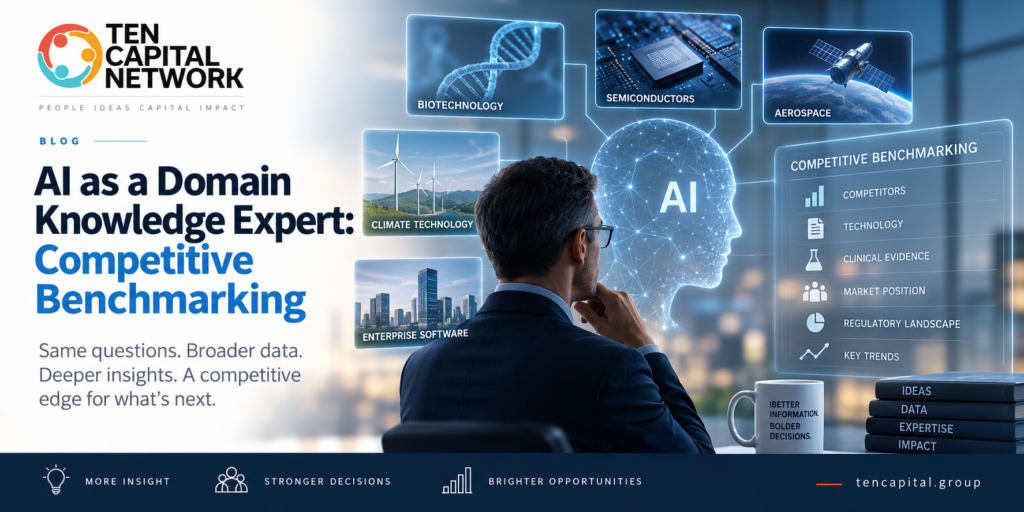
5 min read AI as a Domain Knowledge Expert: Competitive Benchmarking
For decades, one of the greatest competitive advantages in venture capital was domain expertise. The best investors weren’t simply skilled financiers, they were specialists who understood industries at a level that allowed them to recognize breakthrough technologies long before the market did. In biotechnology, semiconductor design, aerospace, climate technology, and enterprise software, successful investors relied on years of accumulated knowledge to distinguish genuine innovation from compelling storytelling.
Artificial intelligence is beginning to redefine that competitive advantage.
Much of the recent discussion around AI has centered on productivity—writing emails, summarizing meetings, or generating presentations. While those applications are valuable, they represent only the first wave of AI adoption. The far more significant transformation is AI’s emergence as a scalable domain knowledge expert capable of performing sophisticated competitive benchmarking across virtually every industry.
The implications for investors, founders, corporate strategy teams, and consultants are profound.
The Traditional Advantage: Human Domain Expertise
Historically, deep domain knowledge has been expensive.
Top venture firms recruited former scientists, physicians, engineers, cybersecurity specialists, pharmaceutical executives, and enterprise software veterans because evaluating technical innovation required specialized expertise.
When reviewing a biotech company, investors needed to answer questions such as:
- Is the biological mechanism plausible?
- Has this pathway failed previously?
- What competing approaches exist?
- Are there hidden regulatory challenges?
- Can this therapy realistically reach commercialization?
Answering these questions often required weeks of research, interviews with key opinion leaders, literature reviews, and extensive consulting networks.
The same challenge exists in nearly every deep technology sector.
Enterprise software investors must understand infrastructure architecture.
Climate investors must understand energy systems.
Defense investors must understand procurement cycles.
Medical device investors must understand clinical workflows.
The limiting factor has always been human capacity.
AI Changes the Scale of Knowledge
Large language models fundamentally change this equation.
Instead of reviewing dozens of scientific papers, AI can analyze tens of thousands.
Instead of manually comparing five competitors, AI can benchmark hundreds.
Instead of relying on memory, AI continuously incorporates new patents, publications, regulatory filings, conference presentations, clinical trials, technical documentation, and public company disclosures into its reasoning process. As your article notes, AI becomes a scalable analytical layer rather than merely a productivity tool.
The result is a new kind of institutional intelligence.
Rather than replacing experts, AI amplifies them.
Competitive Benchmarking Becomes Continuous
Traditional competitive analysis is typically performed periodically:
- During fundraising
- Before board meetings
- During strategic planning
- Prior to acquisitions
AI enables continuous benchmarking.
Every new patent application…
Every FDA announcement…
Every clinical trial update…
Every product release…
Every regulatory decision…
Every pricing change…
Every acquisition…
can immediately be incorporated into an organization’s competitive knowledge base.
Instead of receiving quarterly intelligence reports, executives can maintain a continuously updated understanding of the competitive landscape.
Competitive benchmarking shifts from an event to an ongoing capability.
AI as a Domain Knowledge Expert
The next evolution is even more interesting.
AI no longer simply identifies competitors.
It explains them.
Modern AI systems can compare:
- Technology architectures
- Scientific mechanisms
- Clinical evidence
- Product positioning
- Customer segmentation
- Pricing strategies
- Regulatory pathways
- Intellectual property
- Commercial execution
- Capital efficiency
The system is effectively functioning as a domain expert that has synthesized an enormous body of knowledge.
Instead of asking, “Who competes with this company?”
We begin asking:
- Which competitor has the strongest scientific evidence?
- Which commercialization strategy has historically succeeded?
- Which business model scales most efficiently?
- Which product features consistently drive customer adoption?
- Which regulatory pathway minimizes execution risk?
These are fundamentally different questions.
Benchmarking Beyond Individual Companies
Competitive benchmarking also extends beyond startups.
AI can compare:
- Venture firms
- Pharmaceutical companies
- University spinouts
- Research institutions
- Accelerators
- Corporate innovation programs
- Government funding initiatives
Patterns begin to emerge.
Which firms consistently identify winning technologies?
Which commercialization strategies produce successful exits?
Which scientific founders repeatedly outperform?
Which investment theses have generated the highest returns?
AI transforms benchmarking from descriptive analysis into predictive intelligence.
Decision Quality Improves
One of the most overlooked advantages of AI benchmarking is improved decision quality.
Humans naturally suffer from:
- Confirmation bias
- Availability bias
- Recency bias
- Overconfidence
- Anchoring
AI does not eliminate these problems entirely, but it helps expose contradictory evidence that decision-makers might otherwise overlook.
A startup claiming technological leadership can be benchmarked against published research, competing patents, clinical trial outcomes, pricing models, customer reviews, and historical analogs within minutes.
Weak claims become much harder to hide.
Strong differentiation becomes easier to validate.
Investors Gain a New Competitive Edge
For venture capital firms, AI-powered competitive benchmarking becomes a strategic asset.
Instead of relying solely on partner expertise, firms develop institutional memory.
Every diligence project enriches future analyses.
Every investment decision expands the knowledge base.
Every portfolio company contributes new benchmarks.
The result is compounding intelligence.
Smaller firms can compete with much larger organizations because AI dramatically lowers the cost of acquiring and maintaining deep domain expertise.
Competitive advantage increasingly depends not on the number of partners but on the quality of the firm’s knowledge infrastructure.
Founders Benefit as Well
This transformation is not limited to investors.
Founders can use the same capabilities to strengthen their businesses before approaching investors.
Rather than saying, “We have no competitors,” founders can demonstrate:
- Feature-by-feature comparisons
- Patent differentiation
- Scientific advantages
- Clinical superiority
- Cost advantages
- Customer workflow improvements
- Commercial barriers to entry
AI allows founders to anticipate investor questions before the first meeting.
It effectively becomes an internal strategy advisor.
The Risks of AI Benchmarking
Of course, benchmarking is only as reliable as the underlying evidence.
AI can confidently summarize flawed research.
It can overemphasize published successes while underrepresenting negative results.
It may converge toward consensus thinking, potentially overlooking disruptive innovations that challenge accepted assumptions.
As your article emphasizes, AI excels at information synthesis but remains less reliable at discovering “unknown unknowns.” Human skepticism, scientific judgment, and strategic intuition remain indispensable.
The strongest organizations will therefore adopt hybrid workflows.
Machines provide scale.
Experts provide judgment.
Together they produce superior decisions.
The Future of Competitive Intelligence
We are entering an era in which competitive intelligence becomes dynamic rather than static.
Every organization will eventually possess its own AI-powered knowledge engine capable of continuously monitoring technologies, markets, competitors, regulations, scientific literature, and customer behavior.
The winners will not simply gather more information.
They will organize it more effectively.
They will benchmark more intelligently.
They will identify patterns earlier.
They will challenge assumptions faster.
And they will make better decisions with greater confidence.
Final Thoughts
Domain expertise is not disappearing.
It is being transformed.
The future belongs to organizations that combine experienced professionals with AI systems capable of continuously expanding institutional knowledge. Competitive benchmarking will evolve from an occasional strategic exercise into a permanent organizational capability embedded in every investment decision, product strategy, acquisition, and commercialization plan.
For venture capital firms, this may become the defining competitive advantage of the next decade. The best investors will not necessarily know more than everyone else. They will build systems that learn faster than everyone else.
In a world where scientific literature, market data, patents, and competitive information grow exponentially, knowledge itself becomes infrastructure.
AI is rapidly becoming the operating system for that infrastructure.


