

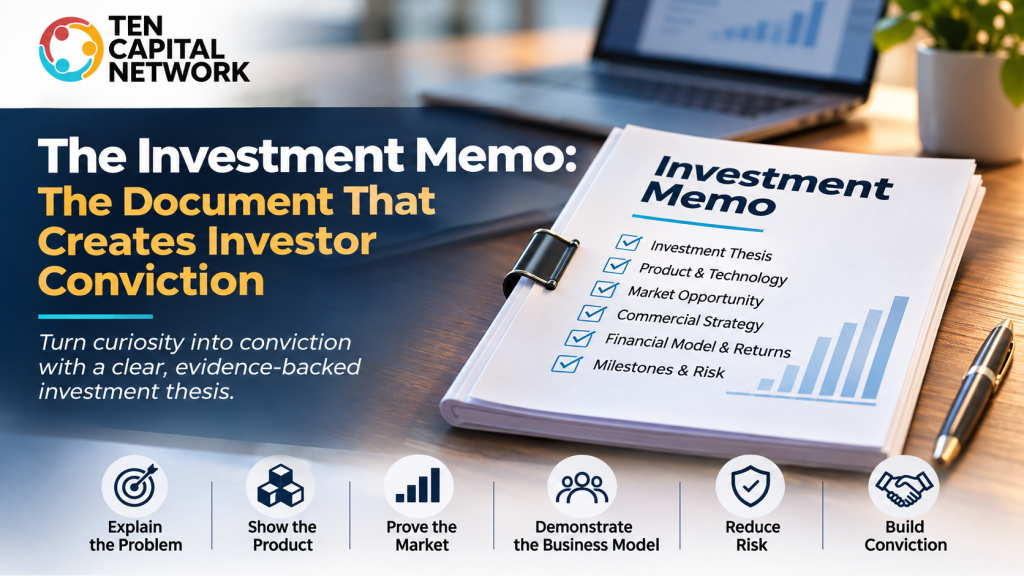
5 min read The Investment Memo: The Document That Creates Investor Conviction
Most founders believe the pitch deck is the centerpiece of a fundraising campaign.
It isn’t.
The pitch deck starts the conversation. The investment memo closes the knowledge gap.
Institutional investors rarely invest based solely on a presentation. A pitch creates curiosity. Meetings build relationships. Due diligence validates assumptions. But somewhere along the way every professional investor needs to answer one question:
“Why should we invest in this company?”
The investment memo becomes the document that answers that question.
In many venture firms, an associate or principal prepares an internal investment memo before the investment committee meets. Increasingly, founders who provide their own institutional-quality investment memo make the investor’s job significantly easier. Rather than forcing investors to assemble the story from multiple conversations, data rooms, and emails, the founder delivers a coherent investment thesis in a single document.
That document creates conviction.
The Investment Memo Is the Core Institutional Document
Unlike a pitch deck, which is designed to persuade during a presentation, an investment memo is designed to educate.
It tells the complete story of the business in a logical sequence.
When an investor finishes reading the memo, they should be able to confidently say:
“I understand the company, its products, the market opportunity, how the business makes money, and why it could become an attractive acquisition or public company.”
That level of understanding is what institutional investors call business conviction.
Without conviction, investors hesitate.
With conviction, they begin advocating for the deal inside their partnership.
Investors Need More Than Excitement
Pitch presentations naturally focus on excitement.
Founders highlight the market size.
They demonstrate the product.
They discuss traction.
They explain why now is the perfect time.
All of these elements matter.
But professional investors must evaluate much more than enthusiasm.
They need to understand:
- How the product actually works
- Why customers buy it
- Whether competitors can replicate it
- How revenue scales
- Why margins improve over time
- How the company becomes valuable enough to generate venture returns
These questions require more depth than a fifteen-slide presentation can provide.
The investment memo fills that gap.
Building the Complete Investment Thesis
Every investment decision begins with an investment thesis.
An investment thesis is simply the reason an investor believes the company can generate exceptional returns.
Great investment memos walk investors through that thesis step by step.
Instead of making broad claims, they provide evidence.
Instead of relying on marketing language, they explain business fundamentals.
A strong investment memo answers questions such as:
- What problem exists?
- Why has it remained unsolved?
- Why is this team uniquely positioned to solve it?
- Why is now the right time?
- What proof already exists?
- What milestones reduce risk?
- What creates long-term competitive advantage?
As investors answer these questions, confidence steadily increases.
The memo becomes the roadmap that transforms uncertainty into conviction.
Explaining the Product Architecture
Many startups underestimate how difficult it is for investors to understand their technology.
Founders live with their products every day.
Investors may spend only a few hours evaluating the opportunity.
The investment memo bridges that knowledge gap.
Rather than relying on screenshots or marketing language, it explains:
- How the product functions
- The underlying technology
- Why it is differentiated
- The customer workflow
- Integration requirements
- Intellectual property
- Technical advantages
- Future product roadmap
For technical businesses—particularly AI, biotech, medtech, cybersecurity, and enterprise software—this section is often critical.
Investors rarely fund technology they don’t understand.
The memo makes complex products understandable.
Demonstrating the Commercial Strategy
Great products do not automatically become great businesses.
Investors want evidence that customers can be acquired efficiently and retained profitably.
An investment memo explains the commercial engine behind the company.
It should cover:
- Ideal customer profile
- Market segmentation
- Sales strategy
- Distribution channels
- Pricing model
- Customer acquisition costs
- Sales cycle
- Partnerships
- Expansion strategy
Instead of simply stating revenue projections, the memo explains the mechanics that produce those projections.
Investors are not buying spreadsheets.
They are buying confidence in the commercial model.
Showing the Business Model
One of the most common weaknesses in fundraising is an incomplete explanation of the business model.
Founders often state pricing.
Few explain economics.
Professional investors want to understand:
- Revenue streams
- Gross margins
- Unit economics
- Customer lifetime value
- Expansion revenue
- Recurring revenue characteristics
- Operating leverage
- Cash generation potential
The memo connects these individual metrics into a complete economic system.
When investors understand how profits compound over time, valuation discussions become much easier.
Presenting the Exit Framework
Every venture investment begins with an exit.
That sounds backwards.
But venture investors earn returns only when companies are acquired or go public.
An investment memo should explain the exit framework from the beginning.
This includes:
- Logical acquirers
- Strategic rationale
- Comparable acquisitions
- Industry consolidation
- IPO potential
- Expected timing
- Value creation milestones
Rather than saying, “We could be acquired,” the memo explains why buyers would pay a premium.
Investors are evaluating future value creation, not current valuation.
A thoughtful exit framework demonstrates strategic thinking and helps investors envision the outcome of the investment.
The Memo Becomes the Internal Sales Document
Founders often assume every partner at a venture firm attends every meeting.
They don’t.
Frequently, one investment professional champions the opportunity internally.
That person must persuade the rest of the investment committee.
The investment memo becomes their primary sales document.
If the memo is clear, well organized, and evidence based, it makes internal advocacy much easier.
If important information is scattered across emails, decks, and data rooms, the investor must reconstruct the story themselves.
Every additional hour of work increases the likelihood the opportunity stalls.
The easier you make it for investors to advocate internally, the more likely your company advances through the investment process.
AI Is Making Investment Memos Even More Valuable
Artificial intelligence is changing how venture firms evaluate startups.
Many investors now use AI tools to summarize decks, compare companies, identify missing information, and prepare diligence materials.
An investment memo is particularly well suited for AI.
Unlike slide presentations filled with graphics, animations, and diagrams, a well-written memo provides structured text that AI systems can easily interpret.
That means:
- Better AI summaries
- Faster investor onboarding
- Improved retrieval during diligence
- More accurate comparisons
- Stronger internal documentation
An AI-readable investment memo ensures both human investors and AI systems understand the business accurately.
Building Conviction Before Due Diligence
One of the biggest misconceptions in fundraising is that due diligence creates conviction.
It doesn’t.
Due diligence validates conviction.
Conviction is built earlier.
It develops when investors understand the opportunity well enough to believe further diligence is worthwhile.
The investment memo is often the document that creates this initial confidence.
It organizes the facts.
It explains the strategy.
It connects the business model to the market opportunity.
It demonstrates thoughtful execution.
Most importantly, it reduces uncertainty.
Final Thoughts
Fundraising is ultimately an exercise in helping investors make decisions.
The easier you make that decision, the more likely investors will move forward.
A polished pitch deck may earn the first meeting.
A compelling founder story may earn the second.
Customer traction may earn a diligence request.
But an institutional-quality investment memo often becomes the document that transforms scattered information into a complete investment thesis.
It creates business conviction.
It explains the product architecture.
It demonstrates the commercial strategy.
It validates the business model.
It frames the exit opportunity.
Most importantly, it allows investors to confidently tell their partners, “I understand this company and why we should invest.”
In today’s competitive fundraising environment, that may be the single most valuable document a founder can create.


