
7 min read The Growth Story Framework: What Top VCs Look for in Follow-On Rounds
Early-stage investors often focus on vision, team, and market potential. But when it comes to follow-on rounds—Series A, B, and beyond—the evaluation criteria shifts dramatically. Later-stage investors are not buying possibility; they’re underwriting performance, scalability, and durability.
Understanding how growth-stage VCs evaluate companies doesn’t just help founders prepare for their next round—it helps angels and seed investors make smarter initial bets and support portfolio companies more effectively. It also sharpens exit strategy thinking from day one.
Here’s the framework top VCs use when deciding whether to lean in—or walk away.
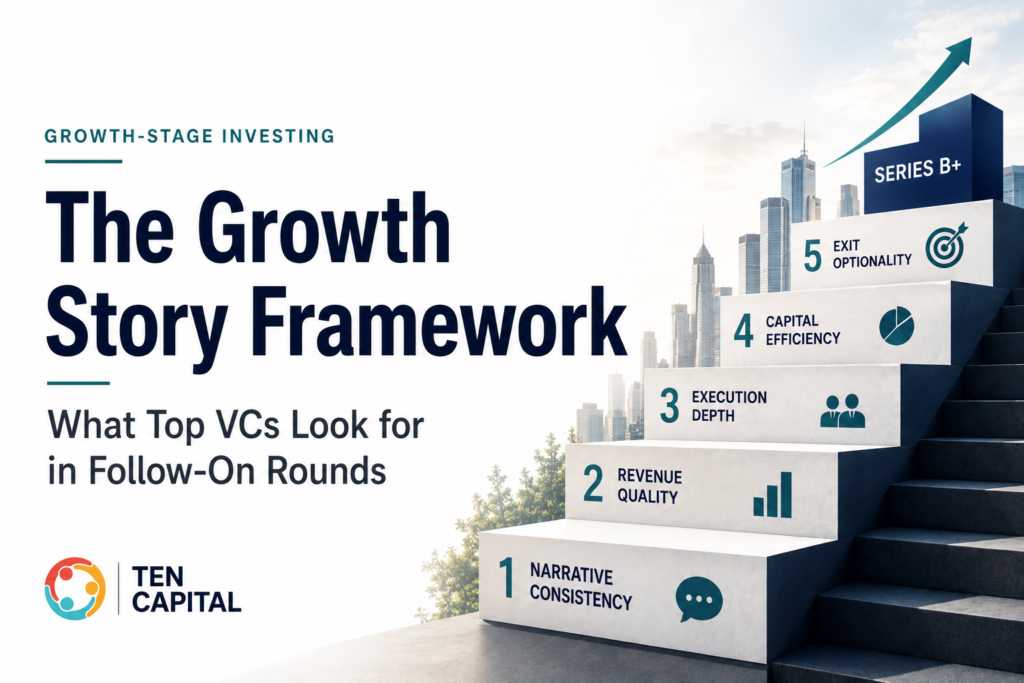
1. Narrative Consistency: Is the Growth Story Coherent?
Growth-stage investors look for a clear, consistent narrative from inception to scale. The story must connect early traction to a larger strategic opportunity: Why this market? Why this model? Why now?
If the company’s direction has pivoted multiple times without a compelling throughline, it raises questions about strategic clarity. The best companies demonstrate evolution—not randomness. Every stage builds logically on the last.
Takeaway: Early investors should help founders craft a scalable narrative from day one. A company’s “Series A story” is often seeded in its pre-seed pitch.
2. Revenue Quality: Not Just Growth, but Durable Growth
At the seed stage, 3x–5x growth can compensate for messy fundamentals. In follow-on rounds, that’s no longer enough. Later-stage VCs dissect revenue composition with precision:
- Customer concentration
- Retention cohorts
- Net revenue retention (NRR)
- Expansion revenue
- Gross margins
- Sales efficiency
They want to know: Is this growth repeatable? Predictable? Profitable at scale?
A company growing 100% year-over-year with strong retention and improving unit economics is fundamentally different from one buying growth through heavy discounting and churn.
Takeaway: Angels should pay attention to revenue quality early. Supporting founders in building strong reporting habits and disciplined GTM processes pays off later.
3. Execution Depth: Can This Team Operate at Scale?
Early-stage investing is often a bet on raw talent and founder grit. Later-stage investing evaluates operational maturity.
Growth investors assess:
- Leadership bench strength
- Functional expertise (sales, finance, operations)
- Hiring velocity and retention
- Board governance
- KPI visibility and forecasting discipline
A strong founder is essential—but insufficient. VCs want to see a management team that can run a multi-million (or multi-hundred-million) revenue engine.
Takeaway: Smart early investors encourage founders to upgrade talent proactively—not reactively. Scaling companies require scaling leadership.
4. Capital Efficiency: How Much Fuel to Create the Next Milestone?
Follow-on investors aren’t just asking, How big can this get? They’re asking, How efficiently can it get there?
Burn multiple, CAC payback, and runway discipline matter. Even in bullish markets, growth-stage VCs prefer companies that demonstrate thoughtful capital allocation. In tighter markets, this becomes non-negotiable.
Companies that can articulate exactly how $20M translates into defined ARR, margin expansion, or market share gains signal strategic maturity.
Takeaway: Early investors should help founders treat capital as strategic leverage, not validation. Efficient companies have more financing options—and stronger negotiating power.
5. Exit Optionality: Is There a Clear Strategic Path?
By the time a company reaches later-stage funding, investors are modeling outcomes.
- Who are the logical acquirers?
- What valuation benchmarks are realistic?
- Is there a credible IPO path?
- How defensible is the competitive moat?
Follow-on investors want to see multiple exit pathways, not a single aspirational scenario. They’re underwriting return profiles based on risk-adjusted probability.
For angels, this perspective is critical. A company that looks exciting at seed may struggle to attract growth capital if it lacks a clear path to liquidity.
Takeaway: Exit strategy thinking shouldn’t start at Series C. It should inform market selection and business model design from the beginning.
Why This Framework Matters for Early Investors
Too often, early investors think in isolation: Is this a good seed deal?
The better question is: Will this be a good Series A or B company?
When angels understand how growth-stage VCs evaluate opportunities, they can:
- Select startups more likely to secure follow-on capital
- Coach founders toward scalable metrics
- Reduce dilution risk
- Increase probability of meaningful exits
In other words, they invest with the end in mind.
Building With the Future Round in Mind
The most successful companies don’t “prepare for a Series A” at the last minute. They build in alignment with what growth capital demands from the start.
As an investor or founder, ask yourself:
- Are we building durable growth—or temporary momentum?
- Are our metrics institutional-grade?
- Is our narrative scaling with our traction?
- Are we designing for exit optionality?
These are not late-stage questions. They are foundational ones.
Final Thought
The Growth Story Framework is more than a fundraising checklist—it’s a strategic lens. Whether you’re writing your first check or preparing your next round, understanding how top VCs think will elevate your decisions.
If you found this helpful, subscribe for deeper insights on startup finance, growth strategy, and investor intelligence. And if you’re supporting portfolio companies today, share this framework with them—it may shape their next round more than you think.