
Startup Funding

Search Startupfunding above or view our

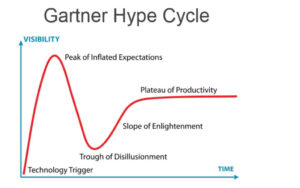
Blockchain on the Gartner Hype Curve

There are many parallels between the blockchain/crypto world of today and that of the Dotcom era of the 90s. I often hear comments such as “It’s 1994 and it’s deja vu- all over again”. The hype, hysteria, and ultimate bubble popping of 2001 still remain a vivid memory for many. Crypto and blockchain are on the same trajectory with all the associated hype, media mania, and startup hysteria that comes with it. The Gartner Hype curve is one way to track our progress through the inevitable cycle of launch, fall back, and then finding the way forward.   Here’s the Gartner Hype Curve for those not familiar with it. It does seem to me that blockchain is progressing more quickly through the hype curve than the Dotcom era. I guess more people know the stages and execute in a “fail fast” mode so as to move to the next phase more quickly. Also, the tools for propagating information (social media, email, other) are better so it leads to reason that we’ll make our way up the curve faster. As with all new technologies, the surrounding ecosystem needs to be built out and this will some take time. Most crypto solutions today focus on infrastructure. High-end point applications are going to be difficult to build until the foundations are in place. Enabling tools and technologies need to be put in place. These are important points to remember in evaluating ICOs on offer. In reviewing the current crop of ICOs it appears some are trying to put a man on Mars with the blockchain equivalent toolset of a 1985 PC and DOS. This is going to be tough. As an investor, you don’t want to invest in a startup for first timers launching a mission to Mars – you want the A-team going for a slam dunk on their home field. It will take some time, but that time clock seems to be moving faster than before. Hall T. Martin is the founder of TEN Capital and a builder of entrepreneur ecosystems by startup funding through angel networks, funding portals, syndicates, and more Connect with him about fundraising, business growth, and emerging technologies.


Read More »

How to Invest in an ICO

Initial Coin Offerings (ICOs) continue to attract large sums of investment dollars. With investor interest comes a volume of deals to sort through. My four rules for investing in an ICO are: The team is always the first criteria. The project needs a capable team, preferably one that has already built something successful.  Just about every startup failure I’ve invested in goes back to the team not being up to the task. There needs to be a real product where I can clearly see why a crypto token is necessary and the product fits a real need. The days of raising funding on a whitepaper only are over. The minimum requirement today is a Minimum Viable Product. There needs to be a clear strategy around how the token fits with regulatory issues as one cannot afford having it shut down because the SEC declared it a security offering and now demands all the related documentation. In addition to checking the basics of the business behind the ICO, I also look for quality providers such as a legal firm who has handled ICOs before and other investors who know something about the space.  Hall T. Martin is the founder of TEN Capital and a builder of entrepreneur ecosystems by startup funding through angel networks, funding portals, syndicates, and more Connect with him about fundraising, business growth, and emerging technologies.

Read More »

The TEN Consumer Product Goods (CPG) Syndicate

At TEN Capital we continue to see a strong flow of consumer product good investments. The shifting landscape in the food and beverage industry brings new opportunities for investors. Food and beverage predominate but health and beauty products and other categories continue to raise funding. Investors give some sectors more attention than others. The move to “healthier” alcohol is an interesting one in which all natural juices and herbs/spices added to the alcohol command higher exit valuations. Alternatives to meat and dairy also receive quite a bit of interest from the investors—in particular the strategic corporate investors. Exits in these areas come at 3X to 5X multiples which is in the same league as SAAS-based tech businesses. I find the CPG space fits the angel investor well. When I led the Central Texas Angel Network for its first two years, I found that almost half the funded deals came from CPG. Investors often found the tech deals were too often “smoke and mirrors” so they had to spend a great deal of technical due diligence to figure out what was real. With CPG, the product is more easily understood and the business model is straightforward. When I helped launched Incubation Station (now called SKU), I found CPG deals held up longer than most tech startups. Half of the tech startups in an accelerator are dead within a year. CPG companies with a product in the market can carry on for many years as a loyal customer base is the same as a recurring revenue SaaS product. The key to investing in CPG is being in the right vertical and its ability to build a brand. It’s not hard to check interest with the strategic buyers to see what sectors they are looking for. Brand building can be taught and learned. In the Tech space, branding is an afterthought. In CPG it’s the primary skill. The basic criteria for most CPG deals is at least a 40% gross margin and a category growth rate of double digits. If the startup seeking funding doesn’t know what a category growth rate is then it probably should be a pass for the investor. There are many CPG deals to choose from but as the rule of startup investing says – the top 10% will return good money, the next 15% will return some money, and the rest will return no money.  It’s best to start with the right sectors and then explore for the best teams from there. You can learn more about CPG investing with TEN at this link: http://staging.startupfundingespresso.com/ten-cpg-syndicate  Hall T. Martin is the founder of TEN Capital and a builder of entrepreneur ecosystems by startup funding through angel networks, funding portals, syndicates, and more.  Connect with him about fundraising, business growth, and emerging technologies.

Read More »

The TEN ICO Syndicate –Search for the Proven and Dealing with the SEC

In 2017, two guys with a whitepaper could raise substantial funding through Initial Coin Offerings. As the dust settles on those days we now find over 40% of the ICOs from 2017 are already dead. As the ICO market matures, investors in ICOs demand a great deal more than just a whitepaper. They look for proven teams and substantial technology already built before they will engage. Today, investors are still very interested in the blockchain and the ICO space. Blockchain technology will underpin the next generation of the internet and solves many of the basic issues including security, identify, and trust. Investor interest skews to the proven – as they ultimately do with every new technology. For those running ICOs, the SEC has determined (for now) that all ICOs (regardless of their use case) are securities and must be treated as such. There are efforts to appease the SEC who looks upon tokens not for what they were intended but for how they could be used. Even if you declare your token to be a utility, the SEC will consider it a security if a user can treat it as such – i.e. sell it on an exchange for a gain. Most ICOs are choosing a Reg D raise while some are considering Reg A+ for their fundraise. The Reg D has no limit on how much you can raise but all the investors must be accredited. The Reg A+ is limited to $50M but you can raise from anyone. One can also use Reg CF but this limits the raise to $1M so it may not make sense to use for an ICO. The TEN ICO Syndicate consists of angels, venture capital, crypto hedge funds and others seeking blockchain-based solutions. For most of the investors the token usage is a secondary consideration. The primary care about is the team and the technology. The investors look for deals with a domain-experienced team and a substantial platform that can solve big problems and can scale. The Emerge ICO Summit scheduled for October 10, 2018, will be a gathering of the ICO Syndicate and those raising ICO funds. To learn more please check out http://staging.startupfundingespresso.com/txvf17/ Hall T. Martin is the founder of TEN Capital and a builder of entrepreneur ecosystems by startup funding through angel networks, funding portals, syndicates, and more.  Connect with him about fundraising, business growth, and emerging technologies.

Read More »

TEN Investors Income Syndicate

Angel groups in the 1990s were based on the sponsor model. In the 2000s they moved to the membership model. Today, they operate on the syndicate model.  Investors line up around deals by sector and stage to share the funding round. TEN Capital now has a series of syndicates and one of the most popular is the TEN Income Syndicate which funds deals generating income for the investor rather than long term gains.  While most angels still want to hold equity in a startup, there is a portfolio play here by diversifying some of your investments into cash generating investments. The TEN Income Syndicate provides monthly or quarterly income from investments from loans and revenue based funding deals. The criteria for revenue-based funding investment includes: $1M revenue run rate Tech-enabled business Gross Margin > 50% Growth rate > 30% annually In a revenue-based funding deal, the company pays back a percent of revenue each month till a predetermined return is achieved. The TEN Income Syndicate uses a 3% scaling to 5% payback rate. For a $100K investment example, the payback plan is an initial revenue payout percentage of 3% of gross sales that scales to 5% by year 2. Year 1 – at least 35K Year 2 – at least 65K Year 3 – at least 70K Year 4 – at least 80K Plus 1-2 points of equity (listed as a warrant) Payback in 3-5 years Early payback comes at a lower return. The turnaround on an RBF deal is quite short compared to an equity deal. Funding decisions are made within 5 days of submitting financials and funds are transferred within 10 days of a funding decision. You can learn more at this link: http://staging.startupfundingespresso.com/ten-income-syndicate Hall T. Martin is the founder of TEN Capital and a builder of entrepreneur ecosystems by startup funding through angel networks, funding portals, syndicates, and more.  Connect with him about fundraising, business growth, and emerging technologies.
Read More »

TEN Investors- The Healthcare Syndicate

I receive calls daily about the TEN Investor Syndicates- in particular the healthcare syndicate. For those raising funding or interested in investing in healthcare startups and growth companies, here’s more information about their investing criteria. Revenue- The company needs to have more than a $500K annual revenue run rate. Typically, the investors want $1M revenue but the exits in the healthcare space tend to outstrip everything else that the investors will engage earlier than usual. Growth is king- you must have a growth story. The investors monitor the progress of the startup over two to three months to see the momentum and traction. As the saying goes, investors don’t invest in “dots”, they invest in “lines.” Huge forecasts don’t count for much unless they are grounded in some historical reality. Proven team- if this is your first go-around it’s going to be tough. They want someone on the team who has been there and done that at least once. Competitive Advantage- They are going to ask about your competitive advantage and a handful of patents will not suffice. You’ll need a competitive advantage that either gives you a 30% increase in revenue over the competition or a 30% reduction in cost. Many of the members of the healthcare syndicate are physicians so they understand the applications and the space very well. They evaluate deals from the physician’s point of view and ask how does this make the physician’s life easier and how does it profit the physician. In summary, the TEN Investors look for a growth story underway and: $500K revenue run rate Strong growth rates Proven team Competitive advantage If you meet these criteria, please contact TEN Capital, and let’s start a discussion.   Hall T. Martin is the founder of TEN Capital and a builder of entrepreneur ecosystems by startup funding through angel networks, funding portals, syndicates, and more.  Connect with him about fundraising, business growth, and emerging technologies.

Read More »

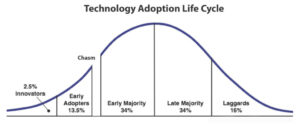
Blockchain and ICOs on the Crossing the Chasm Curve

Crossing the Chasm teaches us that the initial users of a new product (called innovators and early adopters) are separated by a gap from the majority of users and what works for the users on the left side of the gap will not work for users on the right hand side of the gap. Clearly blockchain and ICOs are in the innovator and early adopter phase. With the rate of progress and the amount of funding going into the space, it won’t be long before it will “cross the chasm” into the early majority. One of the signals an industry has ‘crossed the chasm’ is the rise of “easy to use” tools and the shrinkage of techno-speak.  In the early days of an industry, technologists fill the blog posts and conferences and have a tendency to talk in technical terms and jargon.  Some of the jargon goes mainstream and stays with the industry while other terms are replaced with more common language. In the early stages, technical considerations take precedence.  In the mature stage business considerations take precedence. In ICOs, the discussion on hard forks, segwits, and data mining algorithms dominate the podcasts and media.  As we cross the chasm, the conversation will shift to tokenomics and the business implications of a blockchain based network. As companies start tying their systems together into a more cohesive digital mesh network with automated data connections, the impact on company strategy and growth methods will rise to the top. ICOs are still in the early phase but as real world applications in social media, supply chain, fin-tech, and other areas come online, the shift to digital ecosystems will move into the mainstream.  The adoption of blockchain to real world applications will lead the charge. We’ll see many new experiments with tokens and how they can be used to foster a digital ecosystem.   Hall T. Martin is the founder of TEN Capital and a builder of entrepreneur ecosystems by startup funding through angel networks, funding portals, syndicates, and more.  Connect with him about fundraising, business growth, and emerging technologies.

Read More »

The DAICO- ​An ICO Version of Milestone Funding

The DAICO is a combination of a DAO (Distributed Autonomous Organization) and an ICO (Initial Coin Offering). In this variation on an ICO, a development team setups a DAICO contract and lets investors contribute funds to the contract in exchange for tokens. Once the contribution phase stops, the token balances are fixed and at that point the tokens are tradable. The contributors of tokens decide how much of the funds are applied to the project. It’s called the “tap” which determines how much of the funds the development team can draw out. The contributors maintain the right to raise the tap, lower the tap, or shut down the system altogether and get their funds back. The intention is to fund a team with an initial amount of tokens and then raise it over time as the team proves itself. It reminds me of the traditional practice among venture capitalists to provide their funding in stages.  Oftentimes a company will announce a fundraise of $5M. In practice, the VC didn’t write a check for $5M, but rather gave the team an initial amount such as $100,000, to begin work. If the funds were spent well and progress achieved, then more funds from the $5M would be allocated. If the funds were not spent well and little progress was achieved, then no further funds would be forthcoming. In the DAICO each investor votes independently, so it is up to the developers to convince some portion of the investors to increase the tap. Other issues to figure out include how to handle the voting process- how often, what duration, what interval?   Hall T. Martin is the founder of TEN Capital and a builder of entrepreneur ecosystems by startup funding through angel networks, funding portals, syndicates, and more.  Connect with him about fundraising, business growth, and emerging technologies.     If you are interested in tracking a startup, you can sign up for TEN Capital’s Monitoring service which tracks key startups and provides information about their revenue, earnings, and other key financial information.  The first 3 companies are free for 6 months. Signing up as an investor with TEN is easy and free. Visit our Investor Page and sign up now! If you have any questions, please contact us at info@tencapital.group.

Read More »

ICO Valuations Merit Higher Valuation for Their Integrated Ecosystems

Valuing cryptocurrencies is quite difficult. There are numerous articles demonstrating how token valuations are coming up short. Tokens don’t follow traditional valuation metrics such as discounted cash flows or net asset value. The startup world faced the same problem in pricing seed stage startups. For those companies we looked at the team, the status of the product, the presence of IP, customers and revenue traction (if any), and valued it based on how much of each was already built into the startup. It was a “funny money” valuation because as the startup grew and eventually shifted from the startup valuation metric to a traditional discounted cash flow metric, the valuation would usually drop by 30%. The drop was due to the fact that we were moving from a value of the business prospects to a stricter value of the cash flow. In tokenomics, we are trying to price the token in an ICO according to the value it will provide. Here again, discounted cash flows and hard asset valuation techniques do not apply. We have to again look at the values built into the business or in the case of an ICO – the digital eco-system you are building.  If there is a strong team behind it with a great track record, that token will be valued higher. Team, product, users and intellectual property are the core four to consider. For ICOs, I propose a fifth component- the value of an ecosystem that digitally integrates all the components. A digital ecosystem built around a core platform or set of standards will provide more value than a disparate group of companies who have a loose association and few if any data linkages. Digitally integrated ecosystems merit a higher valuation than non-digital ecosystems.  Gartner defines these new systems as one of strong interoperability. Companies which share information through integrated data networks will be able to move faster and provide better service than two separate companies that have to manually share information through APIs. ICOs through their tokens will have not only the valuation of a company but also of an integrated digital ecosystem.   Hall T. Martin is the founder of TEN Capital and a builder of entrepreneur ecosystems by startup funding through angel networks, funding portals, syndicates, and more.  Connect with him about fundraising, business growth, and emerging technologies.     If you are interested in tracking a startup, you can sign up for TEN Capital’s Monitoring service which tracks key startups and provides information about their revenue, earnings, and other key financial information.  The first 3 companies are free for 6 months. Signing up as an investor with TEN is easy and free. Visit our Investor Page and sign up now! If you have any questions, please contact us at info@tencapital.group.

Read More »

Site Map

Scroll to Top