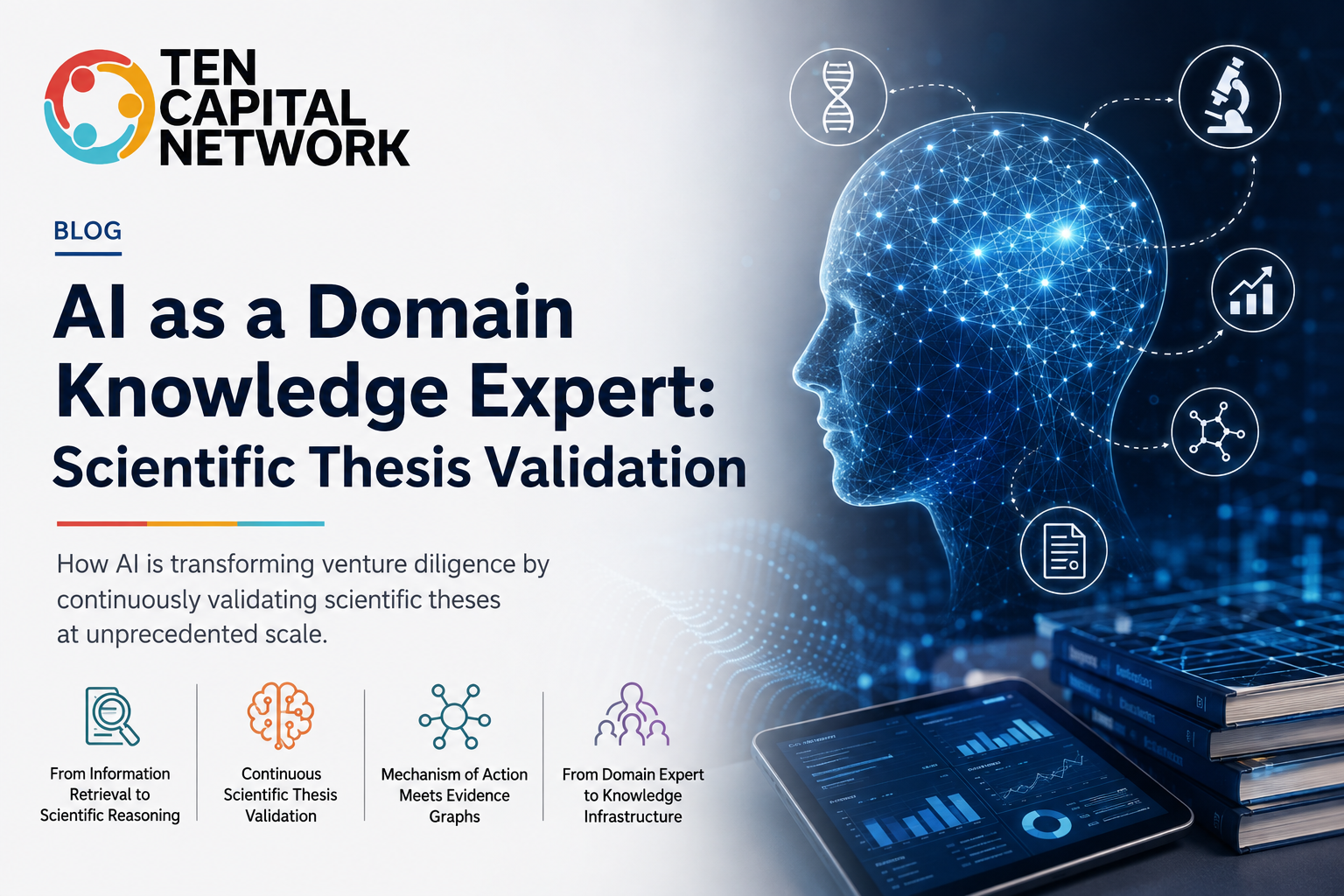
5 min read AI as a Domain Knowledge Expert: Scientific Thesis Validation
For decades, deep technology investing has revolved around one fundamental constraint: knowledge. The most successful venture investors weren’t simply skilled financiers—they were domain experts. In biotechnology, advanced materials, semiconductors, aerospace, climate technology, and energy, the ability to understand complex science often determined whether investors backed the next breakthrough or missed it entirely.
The challenge has never been finding opportunities. It has been determining which scientific ideas are actually correct.
Artificial intelligence is changing that equation.
While much attention has focused on AI as a productivity tool capable of generating reports, writing code, or summarizing research, a far more significant transformation is emerging. AI is rapidly becoming a domain knowledge expert capable of validating scientific hypotheses at a scale previously impossible for human teams.
This represents one of the most important shifts in venture capital since the widespread adoption of online data services.
From Information Retrieval to Scientific Reasoning
Historically, validating a scientific thesis required assembling an expensive network of advisors. Venture firms hired former professors, physicians, regulatory specialists, and industry veterans to evaluate whether a startup’s underlying science was plausible.
Each expert reviewed papers within their specialty.
Each brought years of accumulated knowledge.
But each also carried natural limitations.
No individual scientist can read the millions of papers published annually across biomedical research, chemistry, molecular biology, engineering, and computational sciences. Human expertise remains deep—but necessarily narrow.
AI changes this dynamic.
Modern large language models coupled with scientific databases can simultaneously analyze thousands of journal articles, patents, conference proceedings, clinical trial records, FDA filings, regulatory guidance documents, and competitive intelligence reports.
Rather than simply retrieving information, AI increasingly identifies relationships between discoveries that may have been published years apart across entirely different disciplines.
The result is something closer to institutional scientific memory than simple search.
Scientific Thesis Validation Becomes Continuous
Every startup begins with a thesis.
The founders believe they understand a problem better than everyone else.
In biotechnology, that thesis might involve a disease pathway.
In climate technology, it may involve a novel catalyst.
In semiconductor design, it could be an architectural innovation.
Investors ultimately ask one question:
Is the underlying scientific thesis likely to be true?
Previously, answering that question required weeks of diligence.
Today, AI can evaluate supporting evidence almost instantly.
It can compare competing hypotheses, identify contradictory findings, analyze reproducibility across studies, map biological pathways, review historical clinical outcomes, and identify analogous technologies that succeeded—or failed.
Instead of asking whether a single paper supports an idea, AI asks whether the entire body of scientific literature supports it.
That shift fundamentally changes venture diligence.
From Domain Expert to Knowledge Infrastructure
Traditional venture firms scaled by hiring experienced partners.
Each new investment required additional human expertise.
As portfolios expanded, so did the need for specialized consultants.
AI introduces a different model.
Instead of scaling people, firms scale knowledge infrastructure.
Every investment benefits from continuously updated scientific reasoning built upon expanding global research.
The knowledge base never retires.
It never forgets prior diligence.
It continuously incorporates newly published evidence.
Human experts remain essential, but their role evolves.
Instead of spending weeks collecting information, they spend their time interpreting evidence, questioning assumptions, and exercising judgment where uncertainty remains.
AI performs synthesis.
Humans perform skepticism.
The combination is considerably more powerful than either operating alone.
Mechanism of Action Meets Evidence Graphs
One of the most difficult aspects of biotech investing has always been evaluating mechanism of action.
Does the proposed therapy truly affect disease progression?
Or does it simply influence a biomarker without improving patient outcomes?
These questions require understanding complex biological systems.
AI now builds evidence graphs connecting genes, proteins, signaling pathways, published experiments, prior drug programs, regulatory outcomes, and clinical trial results.
Rather than reading papers individually, investors can explore an interconnected map of scientific evidence.
This allows venture teams to identify weak assumptions much earlier in diligence.
It also helps founders strengthen their scientific positioning by identifying overlooked supporting evidence or highlighting areas requiring additional validation.
Scientific rigor becomes increasingly data driven.
AI as a Scientific Devil’s Advocate
Perhaps the greatest opportunity lies not in confirming ideas—but in challenging them.
Every founder naturally believes in their technology.
Every investor hopes a promising opportunity succeeds.
Confirmation bias can quietly influence diligence.
AI provides an opportunity to intentionally search for contradictory evidence.
Instead of asking:
“What supports this thesis?”
Investors increasingly ask:
“What evidence disproves this thesis?”
That subtle shift dramatically improves decision quality.
AI can identify failed clinical programs targeting similar mechanisms.
It can surface contradictory animal studies.
It can reveal competing patents or manufacturing constraints.
It can identify regulatory precedents that founders overlooked.
Scientific validation becomes less about proving a company right and more about testing whether it survives rigorous scrutiny.
The strongest opportunities typically do.
Beyond Biotechnology
Although biotechnology illustrates this transformation clearly, the implications extend across nearly every science-driven industry.
Climate technologies require understanding chemistry, materials science, manufacturing economics, and energy systems.
Advanced manufacturing depends upon physics, automation, and supply chains.
Defense technologies combine engineering, software, regulatory compliance, and procurement.
Space companies integrate aerospace engineering, orbital mechanics, propulsion, communications, and advanced materials.
Each field produces more knowledge annually than any individual expert can absorb.
AI becomes the connective tissue linking these disciplines.
The competitive advantage shifts from possessing information to asking better questions of increasingly intelligent systems.
The New Risk: Synthetic Confidence
AI also introduces new challenges.
Large language models produce confident answers even when uncertainty remains.
Scientific language can sound convincing while resting on fragile evidence.
Investors must avoid confusing fluency with validity.
Every AI-generated conclusion should remain traceable to original evidence.
Every recommendation should include confidence levels.
Every scientific assertion should identify supporting studies, contradictory findings, and remaining unknowns.
Transparency becomes essential.
Scientific diligence should become more explainable—not less.
The Future Venture Partner
The venture capitalist of the future will look different from today’s archetype.
They will still possess deep judgment.
They will still cultivate relationships.
They will still recognize exceptional founders.
But increasingly, they will operate as architects of intelligence.
Their competitive advantage will come from orchestrating AI systems, scientific databases, proprietary investment frameworks, regulatory intelligence, and experienced human advisors into a unified decision engine.
Instead of asking whether AI replaces domain expertise, the better question becomes:
How can AI multiply domain expertise?
The firms that answer this question first will evaluate more opportunities, identify stronger science earlier, reduce false positives, and allocate capital more effectively.
Scientific Thesis Validation as Competitive Advantage
Ultimately, venture investing is an exercise in probability.
Every investment represents a prediction about the future.
AI cannot eliminate uncertainty.
Biology will remain unpredictable.
Markets will still change.
Founders will still surprise investors—for better or worse.
What AI changes is the quality of the evidence supporting those predictions.
Scientific thesis validation becomes faster.
More comprehensive.
More objective.
More repeatable.
The result is not automated investing.
It is better investing.
As scientific knowledge continues expanding exponentially, no organization can rely solely on individual expertise.
The winners will be those that combine human judgment with machine intelligence to create continuously improving knowledge systems.
In that future, AI is no longer merely a research assistant.
It becomes a domain knowledge expert.
And scientific thesis validation becomes one of the most valuable capabilities in venture capital.