

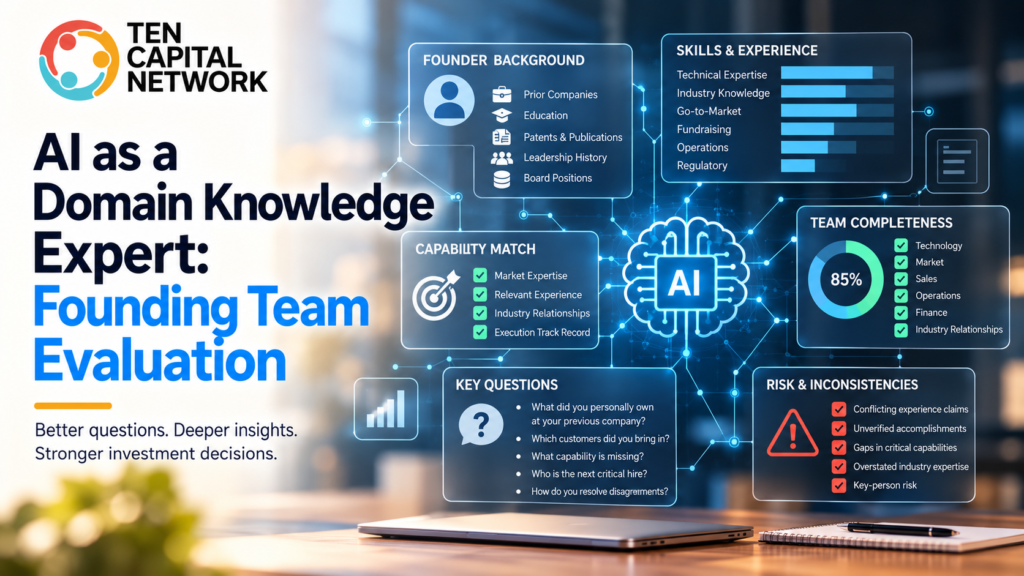
5 min read AI as a Domain Knowledge Expert: Founding Team Evaluation
For every early-stage investor, one question sits near the center of the investment decision:
Is this the team capable of building the company?
A startup may have a large market, differentiated technology, early customer traction, and an attractive financial opportunity. Yet if the founding team lacks the capabilities required to execute, the investment thesis can quickly weaken.
Founding team evaluation has always been one of the most important—and difficult—parts of startup investing.
Artificial intelligence is changing how that evaluation can be performed.
Rather than serving only as a research assistant, AI can become a scalable domain knowledge expert capable of analyzing founder backgrounds, mapping experience against company requirements, identifying gaps, finding inconsistencies, and generating questions for further diligence.
The opportunity goes beyond faster background research.
It changes how investors evaluate founder-market fit.
The Team Slide Is Not Enough
Most pitch decks dedicate one slide to the team.
- Names.
- Titles.
- Previous employers.
- Universities.
- Perhaps a previous startup or notable accomplishment.
- That information is useful, but it provides only a narrow view of the team’s ability to execute.
- Investors need to understand much more.
- Has the founder built a company before?
- Has the team worked together?
- Who understands the customer?
- Who can build the product?
- Who can sell it?
- Who understands the industry’s regulatory environment?
- Who can recruit the next ten employees?
- Who can raise the next round of capital?
Most importantly, does the team’s collective experience match the challenges the startup must overcome?
These questions require analysis rather than biography.
Start With What the Company Needs
Team diligence should begin with the business rather than the founders.
Every startup requires a different combination of capabilities.
A biotechnology company may need scientific expertise, clinical development experience, regulatory knowledge, intellectual property strategy, and pharmaceutical relationships.
An enterprise software company may require product development, enterprise sales, implementation, cybersecurity, and customer success.
A semiconductor startup may need engineering depth, manufacturing knowledge, supply-chain relationships, and experience selling into large technology companies.
AI can analyze the company’s market, technology, business model, stage, and go-to-market strategy to construct a capability map.
The investor can then compare that map with the founding team.
The question changes from:
Is this an impressive team?
to:
Does this team possess the capabilities this particular company requires?
That is a far more useful diligence question.
Build a Founder Evidence Graph
One of AI’s greatest strengths is synthesis.
The clinical diligence model demonstrates how AI can connect evidence across multiple sources rather than evaluating individual documents in isolation. Clinical Data Integrity Review …
The same approach can be applied to founding teams.
AI can organize available information around each founder.
- Previous companies.
- Roles.
- Products launched.
- Patents.
- Research publications.
- Prior financings.
- Exits.
- Industry experience.
- Board positions.
- Customer relationships.
- Technical accomplishments.
- Leadership responsibilities.
The goal is not simply to gather information.
The goal is to connect it.
A founder may claim fifteen years of healthcare experience. AI can help determine whether that experience relates to hospitals, pharmaceuticals, medical devices, healthcare software, or another part of the industry.
The distinction matters because experience is most valuable when it relates directly to the company’s primary execution challenges.
Separate Credentials From Capabilities
Founder slides often emphasize prestigious credentials.
- A recognizable university.
- A major technology company.
- A leading consulting firm.
- A previous venture-backed startup.
Those can be positive signals, but credentials are not the same as relevant operating experience.
Consider a founder building enterprise cybersecurity software for financial institutions.
Ten years developing consumer applications demonstrates technical ability.
It does not necessarily demonstrate experience with cybersecurity, bank procurement, enterprise implementation, compliance, or long sales cycles.
AI can help separate credential strength from execution relevance.
The founder may still be capable of building the company.
The diligence question is whether the required capabilities already exist elsewhere on the team or can realistically be added.
Look for Evidence of Execution
Founders frequently describe themselves using broad terms.
- Serial entrepreneur.
- Industry veteran.
- AI expert.
- Experienced operator.
- Successful founder.
AI can turn those descriptions into questions that can be tested against available evidence.
- What companies did the founder build?
- What responsibilities did the founder actually hold?
- Did the founder manage employees?
- Did the founder own revenue targets?
- Did a product reach the market?
- Did the previous company raise outside capital?
- Was there an acquisition or other exit?
- Which accomplishments can be verified?
This does not mean that investors should favor only repeat founders.
A first-time entrepreneur may be exceptionally well suited to an opportunity.
The objective is to distinguish demonstrated experience from implied experience.
Evaluate the Entire Team
Startup investing can become overly focused on the CEO.
Yet companies are built by teams.
AI can map responsibilities across founders and identify overlaps and gaps.
- Who owns technology?
- Who understands the market?
- Who owns customer acquisition?
- Who understands operations?
- Who manages financing?
- Who possesses the industry’s critical relationships?
- Who recruits senior talent?
A founding team does not need every capability on day one.
The important question is whether investors understand what is present, what is missing, and when those missing capabilities become critical.
This can also reveal key-person risk.
If virtually every critical function depends on one founder, the company may be more vulnerable than the team slide suggests.
Search for Contradictions
Another valuable AI capability is inconsistency detection.
A pitch deck may claim deep industry expertise while the founders’ professional histories suggest narrower experience.
A founder may be described as having built several companies when previous roles appear primarily advisory.
A team may claim extensive commercialization experience while most of its background is technical.
These discrepancies are not automatically red flags.
Public information can be incomplete. Job titles can understate actual responsibilities. Private-company accomplishments may never appear online.
But inconsistencies should generate questions.
That is where AI can add considerable value to diligence.
AI Generates Better Questions
One of the most useful principles from AI-assisted clinical diligence is that AI does not need to produce definitive answers to be valuable.
It can produce better questions. Clinical Data Integrity Review …
For founding teams, those questions might include:
- Why did the previous startup fail?
- What did you personally own at your previous company?
- Which customers did you personally bring in?
- Who on the team understands regulatory strategy?
- Who owns enterprise sales?
- What capability is currently missing?
- Who is your next critical hire?
- How do the founders resolve disagreements?
- What happens when the company grows from ten employees to one hundred?
These questions help expose the operating reality behind the team slide.
Founder-Market Fit Becomes Measurable
The ultimate question is founder-market fit.
Why are these founders particularly suited to build this company?
Sometimes the answer is technical expertise.
Sometimes it is customer knowledge.
Sometimes it is industry relationships.
Sometimes it is direct experience with the problem.
AI can compare the company’s primary execution risks with the founders’ demonstrated capabilities.
If regulation represents the primary risk, who understands regulation?
If customer adoption is the primary risk, who knows the buyer?
If manufacturing represents the primary risk, who has scaled production?
If distribution is the challenge, who possesses the necessary relationships?
Founder-market fit becomes less abstract when evaluated against the obstacles the company must overcome.
AI Has Important Limitations
AI-based founder evaluation also introduces risks.
Public information may be incomplete.
Professional profiles may exaggerate responsibilities.
Databases may contain outdated information.
Private accomplishments may not be documented.
AI may also overvalue easily measured credentials such as prestigious universities, recognizable employers, previous funding, or prior exits.
Most importantly, absence of evidence is not evidence of absence.
The attached clinical diligence framework makes a similar point: AI can confidently summarize imperfect information and lose important context. Human expertise therefore remains essential. Clinical Data Integrity Review …
AI should identify evidence, inconsistencies, gaps, and questions.
Investors must make the judgment.
The Hybrid Future of Team Diligence
No database can prove that a founder will become an exceptional CEO.
No algorithm can guarantee that cofounders will remain aligned during difficult periods.
AI cannot fully measure resilience, adaptability, integrity, leadership, ambition, or the ability to learn.
Those characteristics still require human interaction and judgment.
But AI can improve the evidence surrounding those judgments.
It can determine what capabilities the company needs.
It can map what the founders have demonstrated.
It can identify what is missing.
It can expose contradictions.
It can benchmark relevant experience.
Most importantly, it can generate better questions.
Startup investing has always depended on understanding people as much as markets, technologies, and financial models.
AI will not remove that human element.
It will give investors a more complete body of evidence from which to exercise it.


