

Startup Funding

Related Guides

Trending

The most popular articles on Startup Funding in the past day.

Pitching Your Startup

2 min read Pitching your startup is one of the most important aspects of landing new investors. Emphasizing your story, growth, and competitive advantage helps you to make a strong first impression. In this article, we dive deeper into these three components of your pitch. Use this information to help write or revise your investor pitch. Tell Your Story When pitching your business plan, use the story format for greater impact. Start with the problem you faced in the industry. Show how you couldn’t find a solution.  Show how you created your own solution. After you address the issue of not finding a solution, be sure to show others are now coming to you for that solution. Along the way you can talk about how you built the team and chose a go-to-market strategy.  Highlight the challenges you overcame. Show the current business status and your upcoming plans. Each element of the story should highlight one aspect of the business plan. A story format keeps your audience engaged throughout the pitch because it flows smoothly and moves the audience along from point A to point B in a logical manner.  Show Your Growth Most investors look for a growth story. They look for an operational revenue model in the business with increasing numbers on:  sales  team  product fundraise   Many startup entrepreneurs avoid talking about their current revenues because they think the investor wants to hear big numbers. This simply isn’t the case. If your company is pre-revenue, you can show how the business model is successful based on the unit economics level. Show you can generate leads, qualify them, and finally close them for revenue that exceeds the cost of acquiring and fulfilling the customer.  Demonstrate Your Competitive Advantage It’s not enough to say your product is better or your team will execute faster. You must identify your core competitive advantage and show how it gives you at least a 30% cost reduction or a 30% revenue increase over the traditional methods. This could be through:  network effects  virality  channel access monetization If you are concerned about protecting your business idea, then focus on the benefits of your competitive advantage such as:  “Our software reduces cost by 30% through better algorithms.” You don’t have to go into the details; in due diligence, investors can sign NDAs to see the detailed workings of the business.   Read more on the TEN Capital Network eGuide: The Art of Pitching Hall T. Martin is the founder and CEO of the TEN Capital Network. TEN Capital has been connecting startups with investors for over ten years. You can connect with Hall about fundraising, business growth, and emerging technologies via LinkedIn or email: hallmartin@tencapital.group
Sourcing Investors: How to Find and Build Relationships

2 min read The first step in securing funding can often be the most difficult. How do you source potential investors, and when you find them, how do you build a relationship? While there is no one way to do either of these tasks, there are tips and tricks of the trade you can follow. Below, we discuss some of the options your startup has for finding and creating relationships with potential investors. How to Contact Investors In running a fundraise campaign, you’ll need to set up calls and meetings with investors who are busy and may struggle to find time to give you. How do you initiate these calls and meetings? One option is to have a mutual contact make an introduction. Another way to get a call/meeting is to do some meaningful research in a trend, company, or market and offer to share the results with the prospective investor. Investors love to be educated about the market and companies and appreciate gaining relevant information that informs their decision process. In your outreach, show the time and effort you’ve put into researching an area and some of the findings to pique their interest. Then ask for a call/coffee to review the rest of the findings. Investors are much more likely to find time for a meeting in which they will gain something rather than just give something.  How to Build a Relationship with Investors To pitch your deal, you must first start with a prospective list of investors. Include your contacts who are angels, family offices, and VCs. Canvas your network for those who know angels, family offices, and VCs. This is two degrees of separation which means warm introductions can work. When it goes to three degrees of separation or more, then warm introductions no longer work. Include local venture capital and formal angel network groups you have heard about. Capture the names and emails of all the prospects and plan your approach for each one.  After you’ve made contact and given the initial pitch, you want to keep those investors up to date on your progress with monthly mailers that are short and to the point. Focus the mailers on core results related to sales, team, product, and fundraise.  Avoid long stories as most investors want to know there are real results at play and will listen to the full story later. Through a series of mailer updates, you can start to build a relationship with the investor. It starts with a prospective list and it’s important to take the investors on the journey with you. How to Meet Investors in Person When building a relationship with a potential investor through email, start with an introduction of who you are and what you’re all about. Share how it is relevant to them- bring something to the investor in addition to the ask for funding. If you have a contact-making email introduction, provide them with a short two-paragraph summary. Include the following: Who you are: Demonstrate experience and credibility. What you are doing: Make it interesting. Why did you want to connect: Is the connection about an investment, advice, feedback, or something else? When you do finally meet the potential investor in person, bring something interesting to the discussion such as new information about a sector, company, or group that may be useful to them. It could also be the latest research you have done on a topic of interest. Keep the dialogue going until you build a rapport with the investor.   Read more on the TEN Capital Network eGuide: Closing the Investor Hall T. Martin is the founder and CEO of the TEN Capital Network. TEN Capital has been connecting startups with investors for over ten years. You can connect with Hall about fundraising, business growth, and emerging technologies via LinkedIn or email: hallmartin@tencapital.group

Investor Connect Interview: Ander Iruretagoyena of Impact Engine

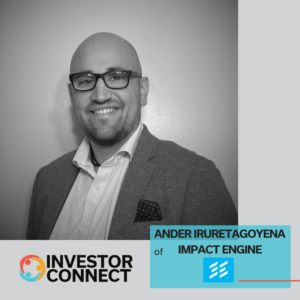
2 min read On this episode of Investor Connect, Hall welcomes Ander Iruretagoyena, the Senior Associate at Impact Engine. Headquartered in Chicago, Illinois, Impact Engine is a women-owned and led venture capital and private equity firm investing in companies driving positive impact in education, economic empowerment, health, and environmental sustainability. Impact Engine was launched in 2012 as an accelerator fund with the goal of identifying promising entrepreneurs starting businesses with the potential to drive both attractive financial returns and positive social impact. Impact Engine raised two subsequent accelerator funds in 2013 and 2014, all focused on investing in pre-seed stage companies. Across the three accelerator funds, Impact Engine invested in a portfolio of 23 companies. Between 2015 and 2016, Impact Engine shifted its investment strategy and raised a $10 million venture fund which invested in 22 companies. Between 2018 and 2019, they began operating as a public benefit corporation, raised a $25M second venture fund, and raised a $31.5M first PE fund, allowing them to invest in impact funds for the first time. Impact Engine’s investors include institutions, family offices, foundations, and individuals who believe in investing for both financial return as well as social impact. They are also committed to cultivating community among their investors. Their goal is to help their investors learn from each other and leading-edge impact investors who deploy capital across asset classes and geographies. Prior to joining Impact Engine, Ander was an investment banking associate at Bank of America Merrill Lynch, working with Latin American corporations. During these years, Ander worked on a total of 17 transactions for $10.7B across 4 products, 9 industries, and 6 geographies. Ander also previously worked on financial inclusion strategies at the Bill and Melinda Gates Foundation. Ander holds a BA in Economics as well as Latin American Studies from the University of Chicago and earned his MBA degree from the Chicago Booth School of Business. Ander is originally from Mexico and loves FC Barcelona. Ander shares what excites him now and discusses the state of impact investing, how he sees the industry evolving, the challenges investors and startups face, and more.  You can visit Impact Engine at www.theimpactengine.com/, via LinkedIn at www.linkedin.com/company/theimpactengine/, and via Twitter at www.twitter.com/TheImpactEngine.  Ander can be contacted via email at ander@theimpactengine.com, and via LinkedIn at www.linkedin.com/in/ander-iruretagoyena/.  If you would like to read the full transcript click here or listen to the interview click here.  Hall T. Martin is the founder and CEO of the TEN Capital Network. TEN Capital has been connecting startups with investors for over ten years. You can connect with Hall about fundraising, business growth, and emerging technologies via LinkedIn or email: hallmartin@tencapital.group
Exits: How and When to Do It

2 min read As a startup investor, it is imperative that you are considering the exit strategy before beginning the investment as this is what determines your return on investment. When, how, and to whom the startup will sell are essential topics to cover at the beginning of your relationship with the startup organization. Let’s take a look at each of these topics. Timeline For an Exit Most exits come from another company buying the startup. It takes six months to a year to complete a buyout. Delays often come from the startup not being prepared or ready for the M&A process. Additionally, setting valuation and final terms can take substantial time for research and negotiations. To shorten the time, consider the following: Identify and contact the likely buyers and build a relationship before starting the process.  Position the startup leadership as a thought leader with published articles and keynote speeches to provide credibility. Build a data room of key documents that will be used in a transaction process. This is basically a gathering process, but does take some time.  Beware of competitors in the diligence process as they will have access to your detailed financials and other information. Understand the interest level from the buyer and what other activities may delay their work on your deal. Set realistic expectations for how fast things will go. Early Exits In setting the exit, most investors look to maximize the exit value. It’s important to remember that the metric investors use, Internal Rate of Return (IRR), has a time component to it. The faster the exit, the higher the IRR. As an investor, consider pursuing the highest IRR and not just the biggest dollar exit as bigger exits take longer. While the news highlights the biggest exits, the vast majority of exits are under $20M. Selling a business for under $20M is not that hard, however growing a business and selling it over $100M is very hard. Most acquirers don’t need the business to be large, they just need to know the business model is defined and is profitable. Staying in the deal longer opens up the investor for dilution and other events that reduce the return on investment. A startup should be proving their business model and turning it into a repeatable, predictable process. With funding and time, it will scale. As an angel investor, you should look for early exits and structure your investments accordingly. Finding Alignment Investors should gain alignment with the startup about the exit before making the investment. This includes the size and timing of the exit. There needs to be some clear thinking and research about who will buy the company and how much they will pay. The investors and the startup need to work together to achieve the exit. One of the biggest impacts on the exit for early-stage investors is follow-on funding. It’s important to gain alignment on the subsequent financing rounds required and the impact it will have on the early investors. It’s often the case the startup is overly optimistic and comes back later asking for additional funding.  Also, be sure to discuss the path the startup will take to achieve the exit; will the company grow organically, or will it push aggressively for growth? It’s important to maintain communication about the exit strategy and discuss whether the company is on track for it or not.  Finding The Buyer In selling a business there are two types of buyers: strategic buyers and financial buyers. Strategic buyers look for companies that can enhance their current business. Financial buyers look for companies that generate cash. Their motivations and concerns are different. The strategic buyer will look to see how closely the acquisition is to the buyer’s business and how much work it will take to integrate it, while the financial buyer will look at the financials to determine the cash flow and how long it may sustain. A company seeking a buyer will need to develop a relationship with CEO and VP-level contacts in the industry. This can be done through introductions, conferences, and other events. The company may also find an avenue through the corporate development team in some cases. Bankers are also potential conduits to potential acquirers. The board of directors of the acquiring company may provide an additional entry into the company. Finding the buyer takes time and building a rapport takes even more time.    Hall T. Martin is the founder and CEO of the TEN Capital Network. TEN Capital has been connecting startups with investors for over ten years. You can connect with Hall about fundraising, business growth, and emerging technologies via LinkedIn or email: hallmartin@tencapital.group

Where To Source Funding

2 min read: A common funding source for launching and growing a business is equity funding. However, equity funding is expensive. Luckily, there are many other sources of funding you can take advantage of and put to use. This article will discuss several sources of funding your startup can consider.  Anchor Clients Anchor clients are those who prepay for a custom version of your product. They are typically more prominent companies that have special needs. If you are building an enterprise or consumer software product, consider looking for an anchor client to pay you to create a custom version of it.   Anchor clients provide funding and a precise specification of what they want. Unfortunately, they often hurry and want the solution yesterday, which means they will pay the best price. Also, anchor clients give you information about the market. Anchor clients have researched it and have not found the solution they want. These clients become good references to use when you launch your standard product into the market. One of your platforms may require more than one anchor client to fund a version fully. Take the funding you need to build your platform and divide it by three, then look for three anchor clients to cover it. Bootstrapping and Barter Bootstrapping uses your funds and initial customers to launch your business. Investors tend to appreciate you investing personal funds as it shows you have skin in the game in addition to sweat equity. Barter is a valuable tool to reduce cash expenditures. Consider providing your services to businesses that can provide you with something you need in return, such as bookkeeping, accounting, legal, and financial work. For investors, this demonstrates resourcefulness and the ability to negotiate. Accelerators and Incubators Accelerators and incubators provide startups with workspace, mentorship, pitch practice, and in some cases, funding. Sponsorships are by universities, companies, and entrepreneur collectives.  Accelerators provide an intensive program to help entrepreneurs prepare their business and product for an initial investment. The classes are usually small, around 5-10 companies. At the end of the program, the participants pitch to investors for funding.  Incubators offer a physical workplace with offices, administration, and meeting rooms. In addition, universities offer accelerators and incubators for students and faculty who want to commercialize research. The accelerator or incubator may have a fund from which it invests in startups who complete the initial program. Often, this takes the form of equity funding. However, some programs structure it as a grant, and In addition, they often sponsor demo days in which you pitch to prospective investors. Other Funding Sources There are several other funding sources to consider. Some examples include: Grants: consisting primarily of government-based funds that are one-time offerings and are paid back. Loans: This is debt funding that the business must pay back to the loaner.  Factoring/AR Funding: This includes selling your invoices and accounts receivables in return for cash. Equipment Leasing: using equipment for a contracted time instead of buying reduces cash burn and spreads out the payments. Line of Credit: A short-term debt used for smoothing out the cash-flow cycles. Crowdfunding: This is collected via a prepayment for products from clients/customers. Consultation Funding: Extending your product to include consultation services is a way to bring in additional revenue. Supplier Funding: This consists of contract manufacturing or software developers who provide upfront cash injections in return for a contract to build or design your product.    Hall T. Martin is the founder and CEO of the TEN Capital Network. TEN Capital has been connecting startups with investors for over ten years. You can connect with Hall about fundraising, business growth, and emerging technologies via LinkedIn or email: hallmartin@tencapital.group
Is Your Investment Ready to Exit Their Business?

2 min read As an investor, you receive your most significant return on investment when your startup investment takes its exit. But, is your startup investment ready to exit their business? This article covers reasons to exit, when to sell, and how to exit successfully as an investor. Reasons to Exit the Business There are many reasons to exit the business. However, here are some key ones to consider: The company is ready to go IPO. By taking the company public, new ownership comes into place.  The market has changed dramatically, putting the future of the business into question. The business failed and can no longer remain solvent. The owners lose interest and decide to follow other passions. The owners lose the physical ability to run the business and need to find someone else. When to Sell For every business, there comes a time to sell. Ask the following questions to find if now is the right time to sell the company: Do they still want to run the business? They may want to move on to new projects and opportunities, and the current company may no longer be fulfilling. Do they still believe in the business and what it can do for them? Sometimes the market changes and the business opportunity is no longer there.  What can they get from the business today versus two years from now? Waiting a few years to sell may give them a better exit. Do they need more funding, and can they raise it? If they cannot, then consider exiting. What do the other team members want to do? Aside from your interests, what do the different stakeholders want? It takes a team to run a business. If they want an exit, that should be part of the consideration. How to Achieve an Exit for Investors It’s easy to get into a startup investment but challenging to get out, especially with a positive return. Most startup exits come when they sell the business to another company or go public on the stock exchange. It takes seven to ten years to achieve an exit in most cases. Most investors let the startup define the exit. If they do, that’s great. If they don’t, then you define an exit for your investment. I recommend using a convertible note that has a 3X in 3-year redemption right at the investor’s sole discretion. This provides you the option of exiting at the 3-year mark or staying in for the long haul. By year three it becomes clear where the startup is headed. They are either on the venture path to larger returns, or they have left the venture path and moved into payroll mode.   The problem with leaving the venture path is that most terms sheets give the investor an equity stake. If the company leaves the venture path and turns into a lifestyle business, then the equity is going to be worth, at most, a small return typically around the 10-year mark.  Define the exit you want and make an offer. Not all startups will take it, but many will.   Hall T. Martin is the founder and CEO of the TEN Capital Network. TEN Capital has been connecting startups with investors for over ten years. You can connect with Hall about fundraising, business growth, and emerging technologies via LinkedIn or email: hallmartin@tencapital.group

Understanding Impact Investing

2 min read Impact investing seeks to fund startups with social or environmental benefits. Impact companies have the intent of providing social or environmental aid and solutions with measurable results. The investment must provide a benefit that is more than what would have occurred without the aid of the organization, a concept referred to as additionality. In this article, we will understand how to predict and measure the impact of your startup’s investment. Indicators of Successful Impact Investment The indicators of a successful impact investment are as follows: Shows a measured impact over time, based on its business model forecast. The company brings innovation that provides for significant impact. The company has a sustainable business model and strong entrepreneurial skills and capabilities. If you have these elements, you have a true impact investment that is making a difference. How To Measure Impact Impact startups need to know and understand how to measure their impact in addition to their financial return. Here are some ways to measure impact: The startup could measure the impact for each unit sold. This works well when the impact is the same for each customer. An example would be a bottle-less solution for water distribution. The startup could measure the impact based on a sample and then extrapolate across the entire business. This works well when the impact is not exactly the same for each customer. An example would be the graduation rate of a student through an education program. Look at comparable solutions with a stated impact and adopt those metrics. An example would be the reduction in carbon emissions based on reduced fuel usage. The startup could then apply that metric to their own user base. Impact investors will look for impact metrics from the startup, so it’s important to measure and track them. Impact Measurements The measure of impact is in the eye of the beholder. What impact you see may not be shared with the investor or company you are working with. Using a measuring system helps offset bias in this regard. There are several systems you can use. Some examples include: GIIRS (Global Impact Investing Rating System): This system rates companies based on social and impact performance metrics. This system is considered one of the primary standards.   IRIS (Impact Reporting and Investment Standards): This system provides metrics for social, environmental, and financial performance of a company.  B Analytics: This system was developed by B Lab, and it provides a tool to assess, compare, and improve impact. SASB Standards (Sustainable Accounting Standards Board): This system provides sustainability standards for over 70 industries. GRI Standards: This system was one of the first to provide standards for sustainability reporting. International Integrated Reporting Council: This system provides reporting with an emphasis on bringing cohesion and efficiency to the reporting process.  The above tools can help immensely when comparing metrics across sectors. Impact metrics In addition to measuring, startups in the impact space should also show their impact metrics. Investors will be looking for the impact metric results. A common mistake by impact companies is to focus on the size of the market to be served and the needs in those markets. Instead, you should measure the actual impact results of your business on the market you are serving and show those results. For example, you can show how many students graduated, how many bottles of plastics were removed from the waste stream, or how many students improved their test scores. Focus on the primary impact on the customer rather than the secondary impact on the employee of the business. There are several metric systems including GIIN’s IRIS+ metrics, the IRIS Thematic Taxonomy, and the Impact Management Project. In short, no one system covers all impact sectors. To learn more about the impact metrics your startup fits, review the UN’s Sustainable Development Goals. Feel free to try out our calculators and contact us if you would like to discuss your fundraise: http://staging.startupfundingespresso.com/calculators/ Hall T. Martin is the founder and CEO of the TEN Capital Network. TEN Capital has been connecting startups with investors for over ten years. You can connect with Hall about fundraising, business growth, and emerging technologies via LinkedIn or email: hallmartin@tencapital.group.

Best Practices for Entrepreneurs Seeking Funding

2 min read Working with entrepreneurs every day who are going through the fundraising process. Over time, I’ve found some entrepreneurs employing practices that make the process go smoothly. For those who seek funding here are some best practices to consider in your fundraising efforts: Develop a relationship with investors early on. Entrepreneurs often say that they do not need funding right now so they don’t need to talk with investors. Ask when they will need funding and surprisingly the answer is usually six to twelve months later. I advise the entrepreneur to start developing relationships now. If you wait six months and then start looking you’re behind. In meeting with an investor the entrepreneur can state that he’s not ready for investment but then lay out the plans for developing the business. By building a relationship now and keeping the investor informed of your progress, the entrepreneur will be in a better position when it comes time to raise the funding. Have ready the executive summary, slide deck, and business plan with financials. It helps to have the core three documents – executive summary (one-page only), slide deck, and business plan already developed and ready to go. As the entrepreneur meets prospective investors he can use the appropriate docs for each meeting. Publish a periodical email newsletter for interested investors. In the fundraising process, some entrepreneurs send out email updates to highlight the progress of the company. Some come as often as weekly to show progress in sales, product plans, and other milestones. This shows the company’s ability to execute. Find a lead angel to develop a terms sheet and start off the funding round. By finding a lead angel and creating a terms sheet, the entrepreneur removes the biggest barrier to fundraising – the negotiation process. There are numerous angel investors who find the initial negotiation and due diligence process too time-consuming. By eliminating this hurdle, the entrepreneur opens up the deal to a larger number of investors. Make the deal terms “investor-friendly” Of course, every deal must be negotiated. The harder the terms for the investor to accept the longer the time it will take to negotiate. By making the terms “investor-friendly” through reasonable pre-money valuations, preferences, and other terms, the faster the process goes. Due diligence docs to a password-protected website The due diligence phase can be sped up by having all the key docs already available. I’ve seen some entrepreneurs put everything on a protected website and then give out the password to interested investors. This knocks down the hurdle of trying to send 600 MB worth of documents through the email system. Quarterly email newsletter after funding  It’s important to keep investors up to date even after the funds are raised since investors can help in other ways. Some investors bring a rolodex of contacts while others bring experience and coaching. By keeping them informed of your progress and challenges, they may be able to help. This practice is also useful for when it comes time for follow-on fundraising. Feel free to try out our calculators and contact us if you would like to discuss your fundraise: http://staging.startupfundingespresso.com/calculators/ Hall T. Martin is the founder and CEO of the TEN Capital Network. TEN Capital has been connecting startups with investors for over ten years. You can connect with Hall about fundraising, business growth, and emerging technologies via LinkedIn or email: hallmartin@tencapital.group.

Doing Your Due Diligence

2 min read There are several approaches to due diligence. The most common is the “Thorough Approach” in which you review each aspect of the business and focus on the top items. The main areas to cover in due diligence are the market and the team. In this article, we will cover how to diligence the market, how to diligence the team, and what key documents you should have in your due diligence box in following the thorough approach. How To Diligence the Market When implementing due diligence in a startup, the size of the market is a key question. The larger the market, the greater the growth potential of the startup. There’s rarely a need to pay for research as so much exists on the web. In searching the web, you’ll find research reports giving market sizes, trends, analysis, and more. The key here is to analyze the market at three levels. The first is Total Available Market which is anyone the company could ever sell to. The second is the Serviceable Market which is the target market the company wants to serve. The third is the Beachhead Market, which is the first niche the company will pursue. Ideally, this is a small but well-defined group of companies that fit the startup’s current product. The startup should have some interactions with the companies in the Beachhead market already. How To Diligence the Team In doing diligence as a startup, the team is the most critical factor in the process. For implementing diligence in the team, first, review the resumes of those who are on the team or plan to join when funding becomes available. Next, look for domain knowledge. Who has it, and how current is it? After that, look for complementary skills. Is there someone who has sales skills and will spend their time selling the product? Is there someone who is going to build the product and will manage either an internal development team or an external one? Outsourcing the product development with no one actively managing it is a recipe for disaster. Next, look at how long the team has worked together if at all. Ideally, the team has some experience working with each other. The more the better. Finally, look at completeness. Many successful teams follow the Designer, the Hacker, and the Hustler formula. The Designer knows the customer problem and plans the product development, including how it will be monetized and promoted. The Hacker is the developer who builds the product, and the Hustler is the one who sells it. Due Diligence Box Key Documents You’ll need to gather your basic company documents for investors to review. In preparing a due diligence box also called a data room, the following are basic documents to include: Income statement Balance Sheet Three- to five-year financial forecast Cap Table including shares outstanding Entity filings (LLC, C-Corp, and Articles of Incorporation) Intellectual Property filings including patents, trademarks, etc. C-level team resumes There may be other documents you may need to add based on your situation. Feel free to try out our calculators and contact us if you would like to discuss your fundraise: http://staging.startupfundingespresso.com/calculators/ Hall T. Martin is the founder and CEO of the TEN Capital Network. TEN Capital has been connecting startups with investors for over ten years. You can connect with Hall about fundraising, business growth, and emerging technologies via LinkedIn or email: hallmartin@tencapital.group.

Site Map

Scroll to Top