
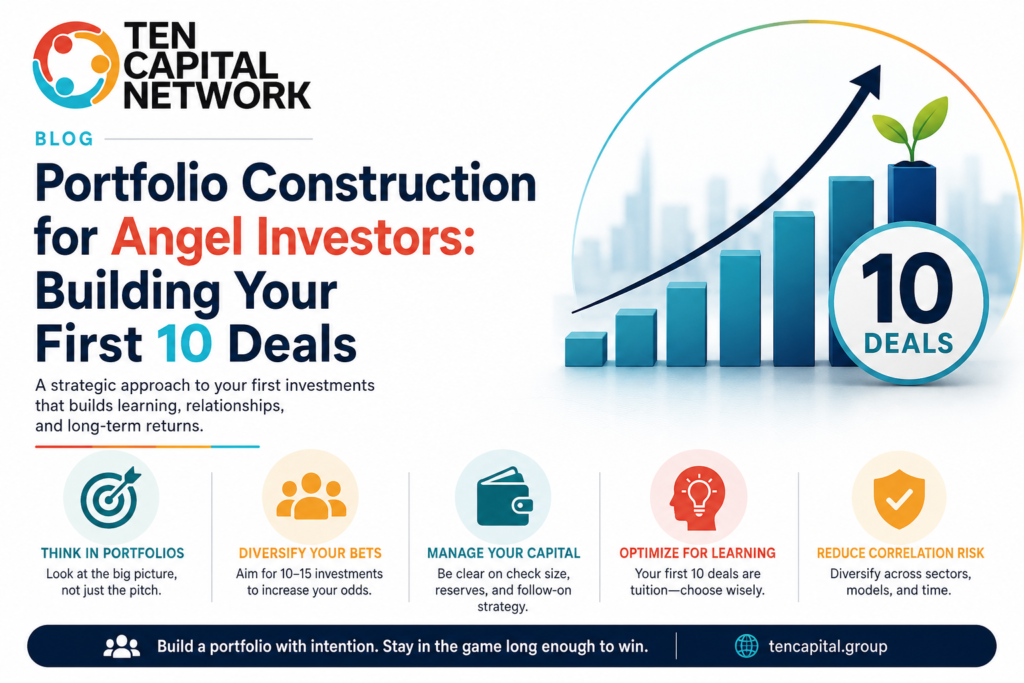
Portfolio Construction for Angel Investors: Building Your First 10 Deals
7 min read Portfolio Construction for Angel Investors: Building Your First 10 Deals Angel investing is often romanticized as a series of bold bets on visionary founders—but the reality is more disciplined and far more strategic. Your first 10 investments will shape not only your financial outcomes, but also your learning curve, reputation, and long-term access to quality deal flow. Portfolio construction at this stage isn’t about finding the one unicorn; it’s about building a foundation that gives you multiple shots on goal. In this piece, we’ll break down how to think about your first 10 deals with intention, realism, and a long-term edge. Why the First 10 Deals Matter Most new angels underestimate how much variance exists in early-stage investing. Outcomes are lumpy, timelines are long, and even great decisions can produce bad results. That’s exactly why portfolio construction matters more than individual deal selection early on. Your first 10 deals are less about maximizing returns and more about: Learning how deals actually play out Understanding your own risk tolerance Developing pattern recognition Building founder and co-investor relationships Think of this phase as laying track, not racing the train. 5 Key Takeaways for Building Your First Angel Portfolio 1. Think in Portfolios, Not Pitches It’s easy to get swept up in a compelling founder story or a slick deck. But angel investing only makes sense when viewed across a portfolio, not deal by deal. Any single investment has a high probability of underperforming—or going to zero entirely. When evaluating a deal, ask yourself how it fits with your other investments. Does it diversify your exposure by sector, business model, or stage? Portfolio thinking forces discipline and reduces emotional decision-making. 2. Aim for 10–15 Investments, Not 1–2 Big Bets A common early mistake is concentrating too much capital into a handful of deals. Early-stage outcomes follow a power-law distribution: one or two companies may drive most (or all) of the returns, while many will fail or return capital at best. If you’re just starting out, spreading capital across at least 10 deals increases your odds of participating in an outlier. Smaller check sizes buy you more data, more learning, and more optionality—without betting the farm too early. 3. Be Honest About Your Check Size and Reserves Before making your first investment, define your total angel allocation—not just what you’ll invest today. Can you afford follow-on investments? Do you want the option to double down on winners, or are you strictly a one-check angel? Clarity here matters. Writing a $25k check without the ability to support future rounds may be perfectly fine—but it should be a conscious choice, not an accident. Portfolio construction is as much about capital management as it is about deal quality. 4. Optimize Early for Learning, Not Returns Your first 10 deals are your tuition. Prioritize opportunities where you can learn the most: transparent founders, strong lead investors, and sectors where you want to build long-term expertise. Consider deals where you have some proximity—industry knowledge, customer insight, or the ability to add value. Even if the financial outcome is uncertain, the informational return can compound across your next 20 investments. 5. Don’t Ignore Correlation Risk Many first-time angels over-index on what’s familiar: the same industry, the same geography, the same founder archetype. Familiarity feels safe, but it can quietly increase correlation risk across your portfolio. If all 10 of your investments depend on the same market cycle, technology trend, or buyer behavior, you’re effectively making one macro bet. Intentional diversification—across sectors, go-to-market models, and time—helps smooth outcomes and protect against blind spots. A Simple Framework for Your First 10 Deals While there’s no one-size-fits-all model, many new angels benefit from a rough structure like this: 5 core bets in areas you understand well 3 exploratory bets in adjacent or emerging spaces 2 asymmetric bets that feel riskier but have outsized upside This isn’t about rigid rules—it’s about making your implicit strategy explicit. The Long Game of Angel Investing Angel investing rewards patience, humility, and process. Your first 10 deals won’t define your net worth, but they will define your habits. Investors who survive long enough to see real returns are rarely the ones who chased every hot deal—they’re the ones who built thoughtful portfolios, learned quickly, and stayed in the game. If you’re intentional now, you’ll give yourself something far more valuable than a lucky win: a repeatable approach. Final thought: If you’re building—or thinking about building—your angel portfolio, I’d love to hear how you’re approaching your first few deals. Subscribe for more practical insights on early-stage investing, drop a comment with your questions, or reach out if you want to go deeper on portfolio strategy.
Portfolio Construction for Angel Investors: Building Your First 10 Deals Read More »