
What Is the Raskin Framework — And Why Great Pitch Decks Start With Change
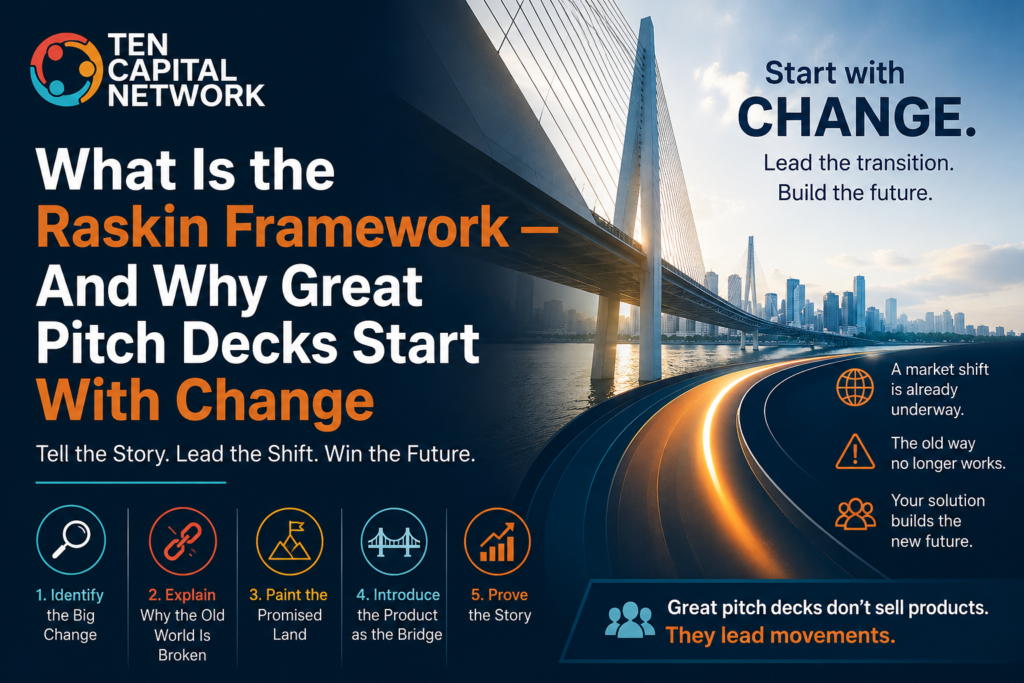
7 min read What Is the Raskin Framework — And Why Great Pitch Decks Start With Change Most startup pitch decks fail in the first three slides. Not because the founders lack vision. Not because the market opportunity is too small. Not because the technology is weak. They fail because they start in the wrong place. Most founders begin with the product. Great founders begin with change. That insight sits at the center of the Raskin Framework, a strategic storytelling methodology popularized by messaging strategist Andy Raskin. His work has influenced some of Silicon Valley’s most effective sales narratives and venture pitches, helping companies frame themselves not merely as software vendors, but as leaders of an inevitable market transition. [1][4] The framework has become particularly influential in SaaS, AI, fintech, and enterprise technology because it transforms a pitch deck from a product presentation into a movement investors and customers want to join. And in today’s market, narrative matters more than ever. The Core Idea: Every Great Pitch Starts With a Shift Traditional pitch decks usually follow this structure: Here’s our company Here’s our product Here are our features Here’s our traction Please invest The problem is that investors see hundreds of these decks every month. What they rarely see is a founder who convincingly explains why the world has fundamentally changed. Raskin argues that the best pitches begin by identifying a major market shift already underway. [1] That shift becomes the foundation for the entire story. Examples include: AI replacing manual workflows Distributed teams replacing centralized offices APIs replacing monolithic software Private markets becoming accessible to retail investors Real-time analytics replacing static reporting The founder’s job is not merely to sell a product. The founder’s job is to explain why the old way no longer works. That framing instantly creates urgency. Why the Raskin Framework Works Humans understand stories better than spreadsheets. Investors do not just evaluate numbers. They evaluate conviction, timing, inevitability, and market psychology. The Raskin Framework works because it aligns the startup with a larger historical trend. Instead of saying: “We built software that automates compliance workflows.” The narrative becomes: “As financial regulation becomes exponentially more complex, manual compliance systems are collapsing under the weight of modern reporting requirements.” That shift changes everything. Now the company is no longer selling software. It is helping customers survive the future. This approach is visible in many iconic enterprise companies. Salesforce framed itself around the shift away from on-premise software. Gong framed itself around the collapse of intuition-based sales management. Cloudflare framed itself around the transformation of internet infrastructure. [4] The strongest startups position themselves as inevitable consequences of market evolution. The Five Parts of the Raskin Framework While versions vary, the framework generally follows five core components. 1. Identify the Big Change Start with a market transition that is already happening. The key is credibility. The shift cannot feel hypothetical. It must feel observable and unavoidable. Good examples: AI copilots are becoming the default software interface Venture capital is moving from intuition toward data-driven underwriting Consumers increasingly expect embedded financial products inside non-financial platforms Weak examples: “People want better software.” “Technology is evolving.” “Digital transformation matters.” The change must feel urgent and specific. 2. Explain Why the Old World Is Broken Once the shift is established, show why legacy approaches fail inside the new environment. This is where pain enters the narrative. A strong deck demonstrates: inefficiency risk lost revenue operational bottlenecks market irrelevance The goal is not fearmongering. The goal is to demonstrate inevitability. If the audience believes the old world is collapsing, they naturally begin searching for the new model. That creates receptivity. 3. Paint the “Promised Land” This is one of the most powerful ideas in Raskin’s methodology. The “promised land” is the future state customers want to achieve. [2] Importantly, it is not a product description. It is an aspirational transformation. For example: “Every investment decision powered by real-time intelligence.” “Compliance completed autonomously.” “Sales teams coached instantly by AI.” The best promised lands are emotional. They make the audience imagine a better operating reality. 4. Introduce the Product as the Bridge Only after the shift, pain, and future vision are established should the company introduce the product. This ordering matters enormously. Because now the product feels like a solution to an urgent market problem — not merely another software platform. This is where founders explain: product architecture competitive differentiation workflows automation layers proprietary data advantages integrations But the product is always subordinate to the narrative. The product exists because the market changed. 5. Prove the Story Finally, validate the narrative with evidence. This includes: customer success stories revenue growth retention metrics case studies testimonials adoption curves Narrative without proof feels like hype. Proof without narrative feels like noise. The strongest decks combine both. Why Most Founders Get This Wrong Founders are naturally product-centric. They spend years building features, workflows, infrastructure, and technical differentiation. So when they pitch, they instinctively explain the mechanics. But investors are not buying software demos. They are buying market timing. Great venture outcomes happen when a company aligns with a large structural transition. The best pitch decks therefore answer one question above all others: “Why now?” That question sits at the heart of the Raskin Framework. Applying the Raskin Framework to a Pitch Deck Here’s how founders can structure a modern narrative-driven deck. Slide 1: The Market Shift Open with the macro change. This should immediately create tension and relevance. Avoid company history. Avoid feature lists. Lead with transformation. Slide 2: Why Legacy Systems Fail Demonstrate why incumbent approaches break under the new market conditions. Use data, trends, customer pain, or workflow friction. The audience should feel the problem becoming unavoidable. Slide 3: The Cost of Inaction Show what happens if companies fail to adapt. Lost revenue. Operational risk. Competitive decline. This creates urgency. Slide 4: The Promised Land Now introduce the future state. Describe the world customers actually want. Keep this visual and aspirational. Slide 5: Your Product Only
What Is the Raskin Framework — And Why Great Pitch Decks Start With Change Read More »